Maintenance Call Handling for Landlords: A Practical Guide
Learn how landlords receive, prioritize, assess and document every maintenance call, with response targets, intake steps and rules for charging tenants.

41% of respondents dealt with maintenance issues at least weekly, according to Clever Real Estate's 2024 survey of 764 U.S. residential real-estate investors. A maintenance call isn't an occasional interruption you can reliably handle from memory. It needs an owner, a priority and a record that survives the conversation.
For a small landlord, the difficult part often starts after answering: deciding whether the unit is safe, finding the right trade, arranging access and explaining a delay. Treat the call as a documented workflow, and you can manage those decisions without turning every repair into an emergency.
Why Every Maintenance Call Needs a Process
Median U.S. maintenance and repair spending was $1,600 per unit for calendar year 2023, while the mean reached $2,782, according to RapidEye Inspections' analysis of the Census Bureau and HUD's 2024 Rental Housing Finance Survey. That gap matters more than a tidy average: expensive failures can push an owner's actual spending well beyond an otherwise ordinary year.
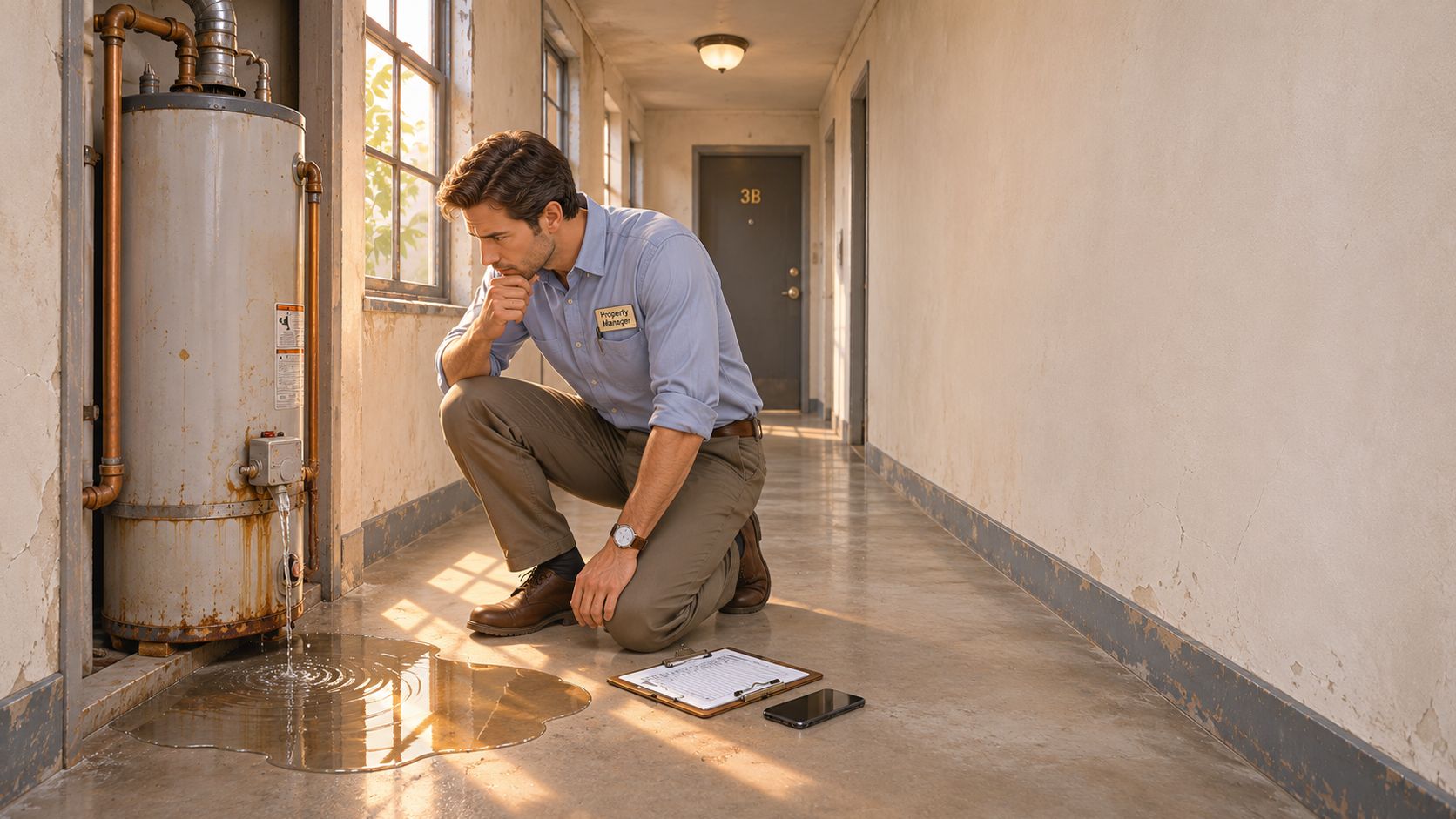
Say a tenant reports water around the water heater. If you save the message for later without asking whether water is still flowing, you're making a financial decision without knowing the exposure. A contained drip and a ruptured tank need different responses, even when both arrive as “the water heater is leaking.”
The first useful inspection separates the symptom from the immediate risk.
Practical rule: Treat a maintenance call like a smoke alarm, not a doorbell. Sort the risk before deciding what can wait.
You don't need elaborate software to do that. You need consistent intake, severity-based priorities, vendor commitments and evidence of completion. If answering calls is the weak point, Expressify AI's voice AI assistant for service businesses is a resource to evaluate for intake support, while keeping safety decisions and spending authority with a person.
A good process also connects today's invoice to tomorrow's preventive work and keeps tenant charges separate from repair decisions. Start with the next call: determine whether someone could be harmed or property could suffer further damage before discussing scheduling.
Priority Levels and Response Targets
| Priority | Typical examples | First response | Target resolution | First action |
|---|---|---|---|---|
| Emergency | Gas smell, sewage backup, sparking outlet, no heat in freezing weather, active flooding | Immediately | Contain immediately; pursue emergency correction | Direct the tenant away from danger, contact emergency services or the utility when appropriate, and dispatch the licensed trade |
| Urgent | No hot water, air conditioning failure in extreme heat, constantly running toilet, drain backing up in a unit | Prompt acknowledgment | Earliest safe appointment, escalated for habitability risk | Confirm severity and access, then secure vendor acceptance |
| Routine | Dripping faucet, sticking window, cabinet door off hinge, appliance noise | Acknowledge within the standard intake window | Scheduled routine repair window | Book the visit and confirm it with the tenant |
| Cosmetic | Scuffed paint, loose towel bar, minor caulk gap | Acknowledge within the standard intake window | Next planned visit, unless inspection reveals a safety or moisture problem | Log the request and bundle suitable work |
Use these as operating categories, not legal conclusions. RapidEye Inspections' maintenance response-time guidance identifies practical targets of acknowledgment within four hours, emergency resolution within 24 hours, and routine resolution within one to three days, while noting a 24-hour correction requirement for life-threatening deficiencies in HUD-assisted housing.
Those targets don't give permission to leave an active hazard unattended. Acknowledgment, containment and completed repair are different events. Local requirements, the housing program and the actual condition may require a faster response.
Sort by consequence, not arrival order
An emergency room doesn't treat patients strictly in arrival order. You shouldn't send a handyman to adjust a cabinet while another tenant waits beside a sparking receptacle.
Categories also change with context. A running toilet that's contained is different from an overflowing toilet. A sticking window may be routine until you learn it's a required escape opening, and air conditioning failure can become an emergency when occupants face dangerous indoor heat.
For gas odor, tell the tenant to leave and contact the utility or emergency services from a safe location. Don't ask them to operate switches, investigate the appliance or attempt a gas repair. For flooding, discuss a water shutoff only if it's safely accessible and the tenant knows how to use it.
Make the overnight decision before bedtime
An after-hours plan needs an actual escalation route, not just voicemail. Our guide to handling emergency maintenance requests at night can help you organize that coverage.
If the tenant can't tell whether the problem is spreading, provisionally treat it as urgent and ask a focused follow-up: is water still entering, has the affected area expanded, or is anyone unable to use an essential service?
How to Receive a Call Without Losing Key Details
A tenant doesn't need to diagnose the failure. Your intake process should turn their description into a usable dispatch brief without asking them to perform risky troubleshooting.
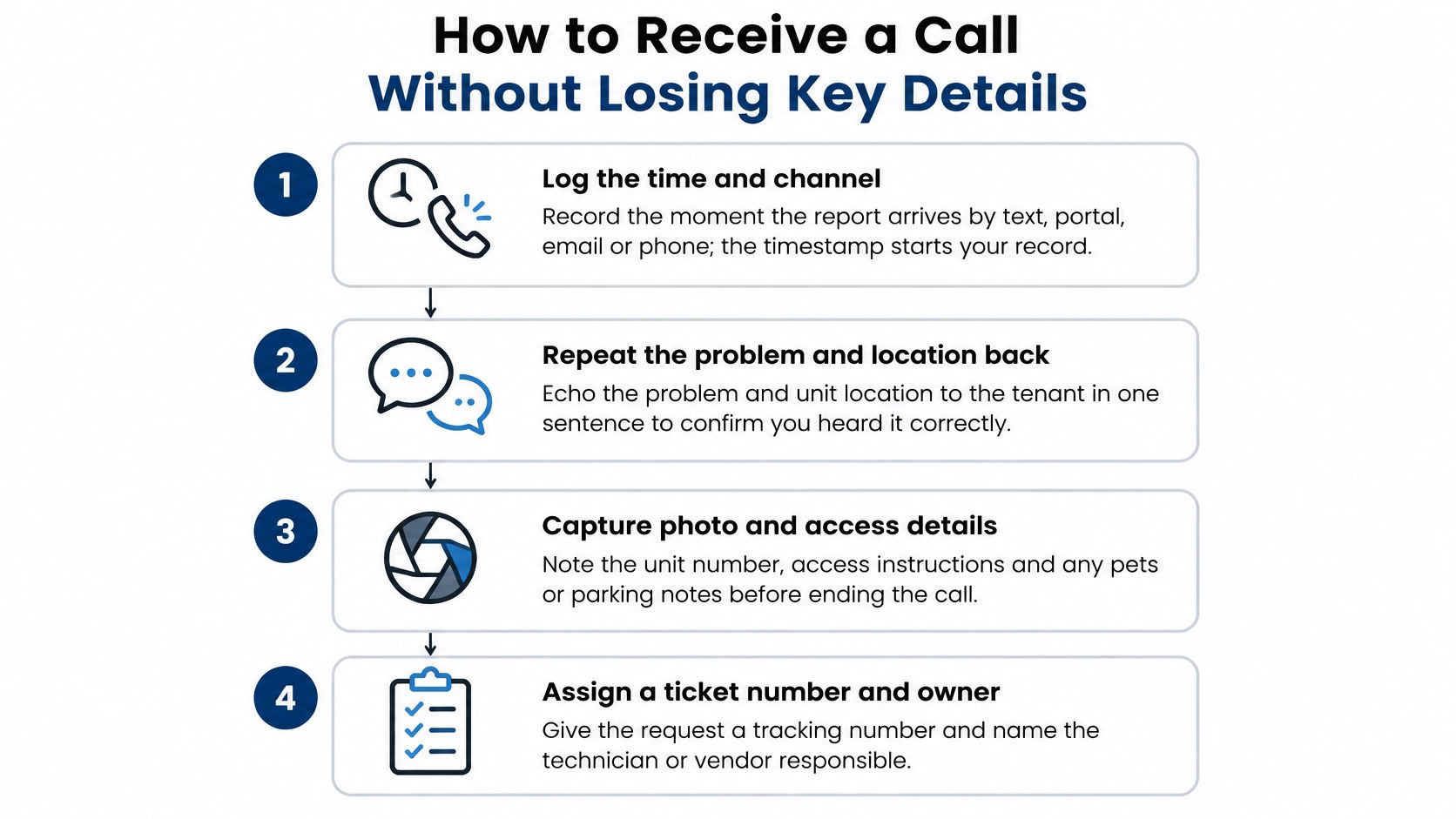
Keep the sequence visible wherever you answer requests.
Capture the report before troubleshooting
Log the arrival. Record the time, channel, property, unit and caller as soon as the report arrives. Don't replace the original submission time with the time you eventually returned the call.
Repeat the location and symptom. Confirm that water is coming through the kitchen ceiling below the upstairs bathroom, rather than recording “leak.” Read the description back so the tenant can correct it.
Ask the intake questions. Establish what's affected, exactly where it is, when it started, whether it's worsening and whether anyone is at risk. Ask when the tenant first noticed the symptom separately from when they reported it.
Request useful evidence. Ask for a photograph or short video when it's safe, plus the make, model and serial number for equipment. Don't delay emergency dispatch while waiting for an image, and don't ask tenants to remove electrical covers or climb onto roofs.
Finish with access and ownership
Check safe mitigation. Ask whether water has been shut off or the affected equipment has been stopped. Give only instructions appropriate to the tenant's ability and the conditions, never make access to a hazardous area part of intake.
Confirm entry arrangements. Record available appointment windows, pets, parking restrictions and key arrangements. Tenant availability doesn't replace any notice or consent your jurisdiction requires.
Send a written acknowledgment. Include the ticket identifier, assigned priority, named contact and next expected step. If a vendor hasn't accepted, say that scheduling is pending rather than implying an appointment exists.
A maintenance request form template helps keep phone calls, texts and portal submissions consistent. For a night-time report, finish the safety assessment immediately and set the next contact according to the condition, not your morning inbox routine.
Use the video as a supplementary resource, while keeping your written intake checklist beside the phone.
Assessing and Recording Each Call
A ceiling stain below an upstairs bathroom doesn't automatically mean a failed supply pipe. A drain connection, fixture seal, roof penetration or another moisture source could require a different inspection.
Ask whether the stain is wet or growing, what's directly above it and whether recent fixture use or rainfall coincided with the change. For a roof-related assessment in that service area, America Roofing's Tucson roof repair page is a relevant contractor resource, not a reason to assume every ceiling stain needs a roofer.
| Symptom | Questions to ask | Likely trade |
|---|---|---|
| Water stain on ceiling | Is it wet, growing, or below a bathroom or roof? | Plumber or roofer |
| Warm air or no HVAC cooling | Is the outdoor unit running, what's the thermostat setting, and when was the filter changed? | HVAC technician |
| Breaker trips or flickering lights | Is it a circuit or the whole unit, and is there a burning smell? | Licensed electrician |
| Slow drain or sewage odor | Are several fixtures affected, is there gurgling, and is there an odor? | Plumber, urgent if several units are affected |
| Appliance not working | What's the model, error code and approximate age, and is it plugged in? | Appliance repair technician |
| Pest sighting | What species, where, and have neighbors reported it? | Licensed pest control |
Safety overrides diagnosis. Burning smells, sparks and gas odors go straight to emergency action. Automated categorization can suggest a trade, but a person must authorize the assignment and spending.
Keep separate timestamps
The KHAN Rental Housing Survey Report found that 38% of surveyed renters who requested repairs received no response, while contractors or repair workers were a barrier for 24% of renters. Those are different failures and need different records.
Track submission, acknowledgment, triage, vendor assignment, appointment, completion and tenant confirmation separately. Add habitability risk, affected system, mitigation, vendor commitment, authorization limit and before-and-after evidence.
Record what happened before deciding who's responsible for the delay.
A missed appointment doesn't prove tenant obstruction or vendor negligence. Preserve notices, arrival attempts and messages rather than overwriting them with a blame label. Automatic Accepted, In Progress and Complete notifications can provide useful milestones, but they don't replace evidence that the repair worked.
Handling Delays When Parts or Labor Are Missing
A repair can be correctly diagnosed and still remain unfinished. The part may be unavailable, the vendor may decline the job, or access may remain unconfirmed. Name the actual blocker on the ticket instead of leaving it marked “in progress.”
A useful update says what the vendor found, what's preventing completion, who's responsible for the next action and when you'll update the tenant again. If a delivery estimate isn't confirmed, don't turn it into a promised repair date.
Separate waiting from protecting the tenant
Temporary measures must match the hazard. A safely isolated leaking supply may prevent further damage, but a bucket under a sagging ceiling isn't an adequate response. Portable heaters aren't a blanket substitute for safe heat, either: electrical capacity, placement and manufacturer instructions matter.
Use a short pending-work checklist:
- Communicate the blocker. Send a written update when you learn about the delay, including the next action and a realistic appointment or update commitment.
- Document interim protection. Record shutoffs, professional temporary repairs and any accommodation arrangements. If the unit is unsafe, address safe occupancy rather than extending the ticket.
- Keep ownership explicit. Name who is ordering the part, confirming delivery or obtaining access. An unanswered vendor message isn't an accepted job.
- Escalate stalled assignments. Contact another qualified trade when the assigned vendor won't commit. Preserve the original contact attempts.
- Verify before closing. Obtain completion evidence and seek tenant confirmation. If the tenant doesn't respond, document that attempt and your independent verification rather than inventing confirmation.
Pending doesn't mean unattended. Keep a firm next-contact commitment even when you can't promise a completion date.
A status note creates a communication record, not immunity from repair obligations. Continue evaluating habitability and applicable deadlines while the repair remains open.
Turning Repeat Calls into Preventive Work
Say you're arranging another air-conditioning visit for the same unit after earlier repairs failed to hold. Paying another diagnostic charge may be reasonable, but only if the technician has the service history and a clear instruction to investigate recurrence.
Otherwise, you're buying isolated responses to a problem nobody has been asked to solve.
Use recurrence as an inspection trigger
LandlordKeep's maintenance cost benchmarks recommend root-cause inspection after two similar calls in a year and put planned HVAC service at roughly $100 to $200, compared with approximately $4,000 to $8,000 for emergency replacement. These are planning benchmarks, not a quote or proof that servicing will prevent replacement.
Other warning signs deserve attention even without repeat tickets:
- Unusual noise. Record when it occurs and under what operating conditions, then request diagnosis rather than authorizing another symptom-only fix.
- Rising utility use. Compare operating conditions and equipment behavior before assuming the tenant is using the system incorrectly.
- Corrosion or staining. Inspect the source and surrounding materials instead of covering the visible mark.
- Escalating backups. Give the plumber the previous findings and ask whether inspection beyond another clearing is justified.
Tag each job by system, symptom, diagnosed cause, labor, parts and total cost. Keep the equipment identifier consistent so a replacement thermostat doesn't disappear into the same broad category as a compressor repair.
Schedule work that answers the pattern
Build filter inspection and replacement around the equipment requirements and actual conditions. Arrange seasonal HVAC service before peak demand, and inspect accessible water-heater and plumbing connections for leakage or corrosion.
A preventive maintenance checklist makes those tasks assignable rather than aspirational. Include the asset, inspection task, responsible person and evidence required.
Preventive spending still needs judgment. Don't replace an appliance solely because it has attracted several calls if the actual cause is a correctable installation problem. Ask the technician to distinguish the immediate repair, the underlying defect and the replacement case, then compare those options against the documented history.
Charging Tenants for Maintenance Calls Without Legal Risk
“The tenant called, so the tenant pays” is a poor billing policy. It confuses the cost of receiving a report with responsibility for causing damage, and it can discourage the very reporting that protects your property.
The right starting point is what caused the expense, not who picked up the phone. Lease wording matters, but a lease clause doesn't automatically override applicable law.
Sort the expense before sending an invoice
| Category | Practical treatment | Evidence to retain |
|---|---|---|
| Ordinary owner maintenance | Treat wear, aging and owner-responsibility repairs as owner expenses | Diagnosis, equipment history and invoice |
| Tenant-caused damage | Consider recovery only when causation and local rules support it | Condition photos, technician findings and itemized costs |
| Failed access | Review lawful notice, agreed access, lease terms and local restrictions before charging | Notice, appointment confirmation and attendance record |
| Emergency safety work | Don't automatically add a hotline, after-hours or travel fee | Hazard description, response actions and legal review |
| Vendor diagnostic charge | A contractor's fee doesn't automatically become a tenant obligation | Diagnostic findings, invoice and lawful basis for allocation |
A 2026 Virginia legislative study on residential rental fees.pdf) describes a proposed ban covering charges for contacting management, maintenance hotlines, after-hours requests, travel for safety repairs and pest treatment where the tenant didn't cause the infestation. A proposal isn't enacted law, but it illustrates why generic fee policies need jurisdiction-specific review.
Document causation without delaying repairs
A technician finding a worn component isn't evidence of misuse. Ask for factual findings, such as the obstruction removed or the damaged part's condition, rather than accepting “tenant negligence” without explanation.
For water-damage situations, Restore Heroes' landlord tenant restoration articles provide related restoration context. Keep the legal decision about cost allocation separate from the contractor's restoration scope.
If a charge is supportable, send the applicable notice, photographs, itemized invoice and written explanation. Give the tenant a clear way to dispute the facts and retain their response.
Never make agreement to a charge a condition of addressing a safety problem. This is general information, not legal advice. Check local requirements before billing, and never let a fee discourage a legitimate report.
Set Up Your Call Workflow This Week
Build something you can use while the phone is ringing. A spreadsheet and shared document can work, provided they have a clear owner and don't scatter the evidence across personal inboxes.
Make the setup usable
- Publish your priority reference. Put the categories, escalation contacts and applicable response requirements where anyone covering your calls can find them.
- Save an intake template. Include the symptom questions, safe-mitigation checks and access details. Keep a ready-to-send acknowledgment beside it.
- Create the repair log. Use separate milestone fields, attach evidence and record authorization before the vendor expands the scope.
- Confirm your trade list. Establish who accepts emergency work, who provides backup and how each vendor confirms an assignment.
- Review unresolved and recurring work. Look for tickets without a next action and systems receiving repeated symptom-only repairs.
Keep the decisions with the landlord. With our Platinum AI, maintenance requests are categorized and prioritized automatically, but AI maintenance triage doesn't dispatch vendors automatically. You can assign a vendor or leave a request open for service pros to quote; pros still accept the job from My Jobs.
Choose your priorities today, then run the next incoming request through the template. Adjust the process where it creates confusion, not by abandoning the record.
VerticalRent offers tenant-submitted maintenance requests, AI triage and vendor assignment tools to help you manage the gap between a report and a completed repair. Visit VerticalRent to organize your maintenance workflow while keeping priority, vendor and spending decisions in your hands.
Put this into practice
VerticalRent tools related to this guide
Legal Disclaimer
VerticalRent and its authors are not attorneys, CPAs, or licensed legal or financial advisors, and nothing on this site constitutes legal, tax, or professional advice. The information in this article is provided for general educational purposes only. Landlord-tenant laws, eviction procedures, security deposit rules, and tax regulations vary significantly by state, county, and municipality — and change frequently. Nothing on this site creates an attorney-client relationship. Always consult a licensed attorney or qualified professional in your jurisdiction before taking any action based on information you read here.
Co-founded VerticalRent in 2011, growing it from nothing to 100k landlords and renters. Sold it in 2019, then re-acquired it in 2026 to make it better than ever.


