What Is Schedule E? a Landlord's Guide to Rental Income
What Is Schedule E? Learn who files it and how landlords report rent, expenses and depreciation by property on IRS Form 1040.


Schedule E is the IRS form attached to Form 1040 that reports rental real estate income and expenses, property by property. For an individual landlord, Part I of that form is where a year of rent, repairs, mortgage interest and depreciation lands, one column at a time, before the net result flows back to your 1040.
So how does a rental that puts real money in your bank account end up showing a loss on your tax return? That question sits at the center of what is Schedule E and why it trips up so many first-time landlords. The form doesn't ask how much cash you kept. It asks how much taxable income your property produced, and those two numbers can point in opposite directions.
The gap between cash in hand and taxable income explains most of the surprises a landlord meets in April. Work through the form in the right order and the surprises stop.
What Schedule E Is and Why the IRS Uses It
The form's official title is Supplemental Income and Loss, and the IRS instructions for Schedule E describe it as the schedule attached to Form 1040, 1040-SR, 1040-NR, or in some cases Form 1041. It covers rental real estate, royalties, partnerships, S corporations, estates and trusts, plus residual interests in real estate mortgage investment conduits. Most of that list means nothing to someone renting out a duplex. Part I is the section that does.
Think of Part I the way a restaurant chain tracks its locations. Each store reports its own sales and costs first, then the chain adds the stores together into one company total. Schedule E works the same way: your properties stay separate until the very last line.

One column per property, on purpose
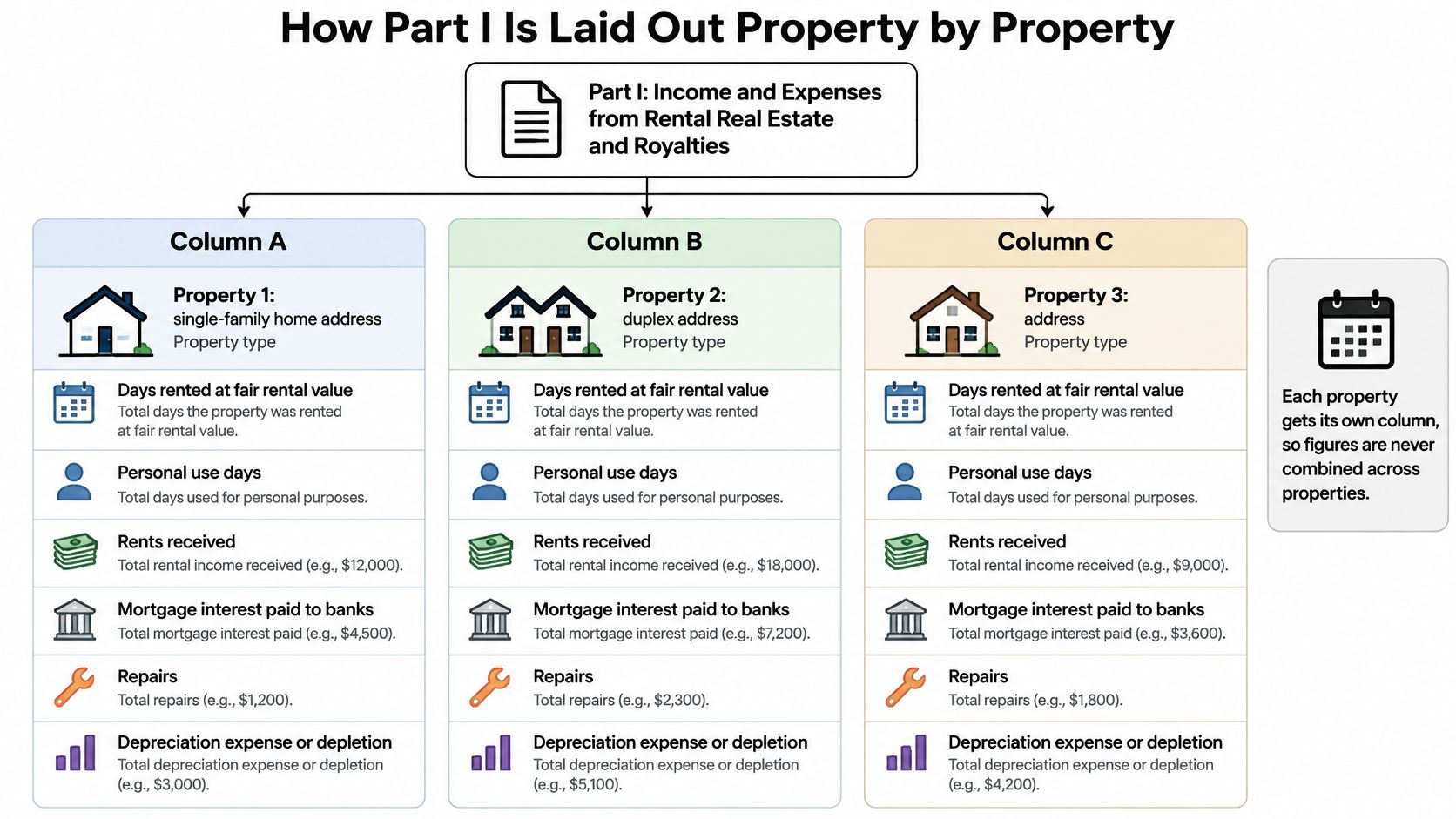
The form gives you columns A, B and C for rental properties. Each column holds one address, its gross rents, its deductible operating costs and its depreciation, ending in a net figure for that property alone. Own a fourth rental or royalty property and you attach another copy of the schedule.
That structure is why a bank statement won't do the job. A single annual deposit total can't tell the IRS which property earned what, and it can't support the expenses you're claiming against each one. Records have to preserve income and costs by property all year, because you can't rebuild that split from a lump sum in March.
Where the number goes next
The form totals your columns and carries the combined result to Form 1040, so the figure doesn't stop at Schedule E. One more split matters: renting real estate belongs here, while running a business that rents out personal property, such as equipment, generally belongs on Schedule C instead.
The simple test: if rent from your property is taxable, this is the page where it gets reported. You can now name the form, say what it's for, and judge whether it applies to you.
Who Must File Schedule E and Who Can Skip It
Find your situation in the table before reading further. The reporting route depends on what you own and how you hold it.
| Situation | Form or Part | What to Report |
|---|---|---|
| Individual owns residential rental property | Schedule E, Part I | Gross rent, expenses and depreciation for each property |
| Partner or S corporation shareholder | Schedule E, Part II | Share of the entity's rental or royalty income or loss |
| Estate or trust with rental income | Schedule E, Part III | Income and expenses passed through from the estate or trust |
| Rental of personal property as a business | Schedule C | Business income and expenses from the equipment rental |
| Home rented fewer than 15 days in the tax year | Not reported | Rent and rental expenses are excluded |
| Owner of more than three rental properties | Additional Schedules E | Combined totals carried to the summary lines |
The 15-day exclusion, stated precisely
If you use a dwelling as a home and rent it for fewer than 15 days during the tax year, the IRS instructions for Schedule E say not to report the rental income and not to deduct the rental expenses. Both halves move together. You don't get to leave out the rent and keep the deductions.
At 15 days the exclusion is gone entirely. There's no partial version, so count the days before you assume you're covered.
Practical rule: count rental days and personal-use days as they happen. Reconstructing them in April almost always produces a guess, and a guess is the one thing an examiner won't accept.
Passive by default, with one big exception
Ordinary rental real estate is treated as passive in most cases, which the same instructions confirm. A renting activity that a qualifying real estate professional materially participates in is not passive, and that status gets reported on the schedule. Ordinary rentals of buildings, rooms or apartments with basic services such as heat, light or trash collection normally land on Part I.
Three questions you can answer today
- How many days was it rented? Fewer than 15 in a home you also use changes everything.
- Real estate or personal property? Real estate goes to Schedule E, equipment rental usually goes to Schedule C.
- Direct ownership or through an entity? A partnership or S corporation interest reports on Part II with a K-1.
If those three answers are clear, you know which form applies. Anyone weighing a second property, particularly a short-term unit where personal-use days stack up fast, can study how buyers buy a vacation rental property in Destin and then work out which row of the table the new unit will land in.
How Part I Is Laid Out Property by Property
Read the form from the top of a column downward and it tells you exactly what records to keep.
- The property header. Address and property type, so the column is identified.
- Days rented at fair rental value, and personal use days. Two numbers that decide how much of the property's cost you can deduct.
- Rents received. Everything the property brought in during the year.
- Expenses, line by line. Mortgage interest, repairs, insurance, taxes, management fees and the rest.
- The net result for that column. Income minus expenses minus depreciation.
The same layout repeats in columns B and C. Past three properties, you attach additional schedules and carry the combined totals to the summary lines.
Two properties, one total
Say Property A was rented all 12 months, collected $18,000 in rent and spent $6,400 on deductible expenses. That column nets $11,600. Property B was rented 7 months, collected $9,000 and spent $11,200 after a turnover and a plumbing replacement, so its column shows a $2,200 loss.
Add the two columns and the schedule reports net income of $9,400, which is the figure that travels to Form 1040. One property's loss offsets the other's income right there on the page.
Why that total isn't the end of the story
Adding columns together is arithmetic. Whether the combined result reduces the tax you owe is a separate question, governed by rules that look at your participation and your other income. A schedule that shows net income gives you a straightforward answer. A schedule that shows a net loss does not, and that's where landlords get caught.
Set up your bookkeeping with one ledger per property from the first month. When the columns already exist in your records, filing becomes a report you print rather than a year you reconstruct.
Income and Expenses You Report Each Year
Part I is the federal reporting schedule for rental real estate income, expenses and depreciation, and the IRS Publication 527 sets out the categories the form expects. Here's how the common items sort.
| Item | Treatment | Notes |
|---|---|---|
| Gross rent received | Income in the year received | Includes fees and rent paid in advance |
| Mortgage interest | Deductible expense | Interest only, not principal |
| Property taxes | Deductible expense | Taxes on the rental property |
| Insurance premiums | Deductible expense | Policies covering the rental property |
| Management fees | Deductible expense | Commissions and fees paid to a property manager |
| Repairs | Deductible in the year paid | Fixes that keep the property in working order |
| Improvements | Added to depreciable basis | New roof, addition or major upgrade |
| Depreciation | Deducted over the recovery period | Residential rental property is generally depreciated over 27.5 years |
Repairs versus improvements, the line that costs money
A repair restores the property to working order and is deducted in the year you pay for it. An improvement adds value, extends the life of the building, or adapts it to a new use, and it goes into the property's depreciable basis instead of being written off immediately.
Fixing a broken window pane is a repair. Replacing every window in the house is an improvement. Patching a section of roof is usually a repair, while a full tear-off and replacement is not. Misclassify in either direction and the deduction lands in the wrong year.
The publication is explicit that capital improvements generally enter the basis rather than being immediately deducted, which is why the label you attach on the day you record an expense matters more than the label you attach in April.
Depreciation, the line that isn't cash
Depreciation spreads the building's cost across a set recovery period, and residential rental property is generally depreciated over 27.5 years. The building depreciates; the land under it does not. That's why a purchase has to be split between the two.
This is the largest non-cash line on most small landlords' schedules, and it's the reason a profitable rental can show a paper loss. A kitchen remodel that repairs water damage and upgrades the cabinets at the same time belongs in two places, and the split needs a note in your file while the invoice is still in your hand. For a fuller breakdown of what qualifies, this list of landlord tax deductions for Schedule E covers the categories one by one.
Personal-use days belong in this review too. Mixed use changes what share of the property's expenses you can deduct, which is why the form asks for both day counts at the top of every column. Landlords running short-term rentals face extra sorting here, and these tax tips from Global work through how nightly rentals shift the expense picture.
Check every receipt against the table before you file, and flag anything that fits two rows.
Passive Losses and Why a Paper Loss May Not Help
Here's the assumption worth testing: a loss on Schedule E automatically reduces the tax on your salary. It usually doesn't.
Ordinary residential rental real estate is generally passive, so the IRS guidance in Publication 527 explains that losses usually offset passive income rather than wages or business income. Your property can be profitable in cash terms and still produce a suspended loss that helps you in a later year, or not at all until you sell.
| Situation | Offsets Wages Now? | What Decides It |
|---|---|---|
| Ordinary residential rental | Generally no | Passive activity rules |
| Active participation, modest income | Up to $25,000 allowed | Income level and participation records; the allowance phases out at higher incomes |
| Qualifying real estate professional | Yes, if materially participating | Hours and status reported on Schedule E |
| Disallowed passive loss | Not this year | Carried forward against future passive income or released on sale |
The cash flow that hides a taxable loss
Say a single-family rental collected $24,000 in rent and paid out $18,000 in mortgage interest, taxes, insurance and repairs. The landlord banked $6,000. Positive cash flow, no drama.
Now add depreciation of $9,000 on the building. The schedule shows a $3,000 loss even though not one dollar left the landlord's account. The money is real; the deduction may not be usable this year.
That's the whole confusion in one example. Cash flow measures what reached your bank. Taxable income measures what remains after the rules take their bite. Suspended passive losses measure the third thing: deductions you've earned but can't use yet.
A landlord can be profitable, liquid and holding a tax loss at the same time. Anyone who tells you otherwise is describing a different form.
Where suspended losses go
Disallowed losses aren't thrown away. They carry forward and offset passive income in later years, and they're generally released when you dispose of the property in a fully taxable sale. Landlords who plan to hold for decades should treat that running total as an asset of its own and keep it with the property file.
If active participation might apply, the record that matters is proof you made real decisions: approving tenants, setting rents, authorizing repairs, hiring contractors. A spreadsheet of dates and decisions is worth more than a memory of them. The full passive activity loss rules explain how the allowance and the carryforward interact.
Three questions to answer before you file: is this loss currently deductible, what evidence proves my participation, and where is last year's suspended total recorded?
Records and Pre-Filing Checks for Schedule E
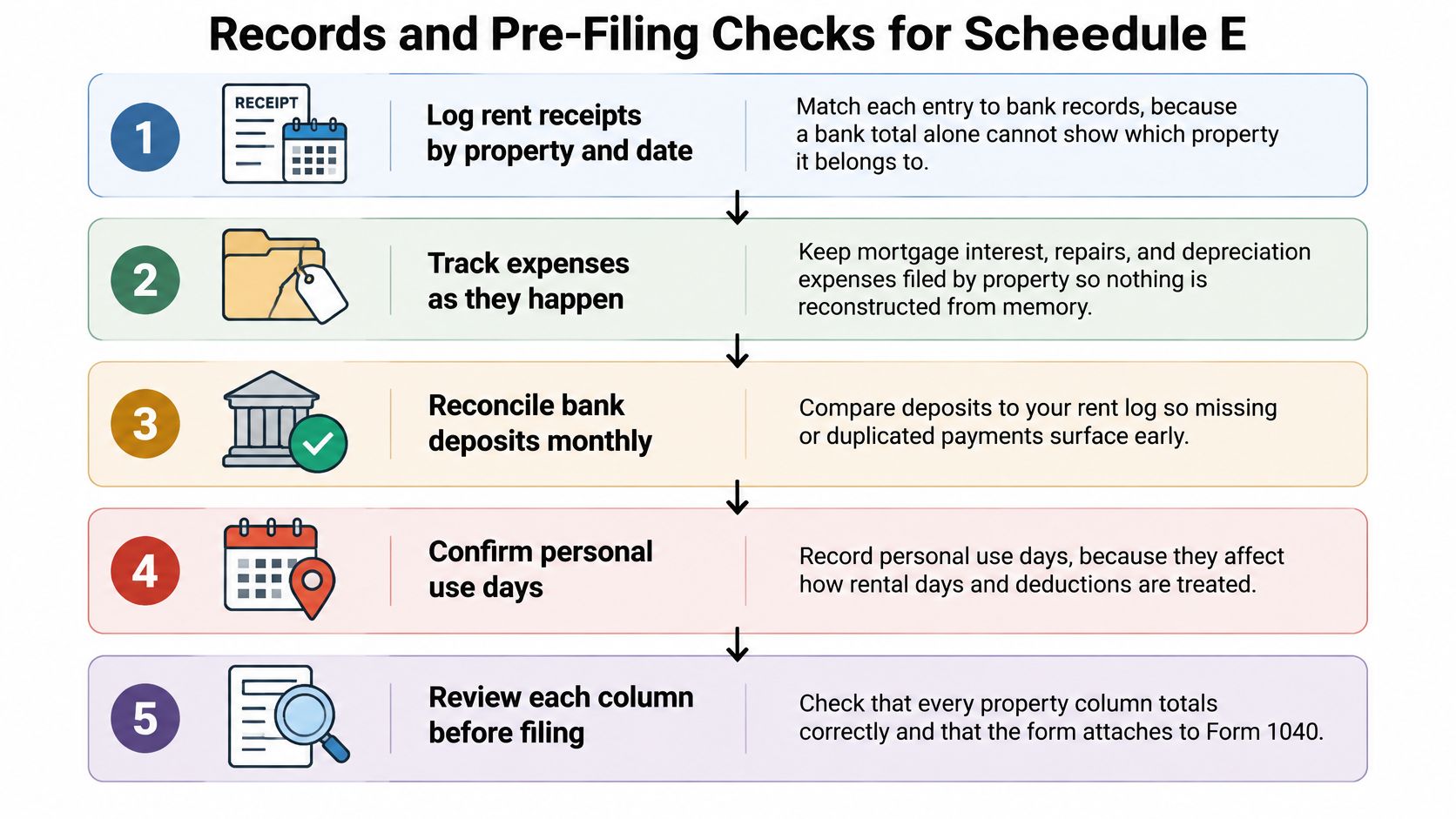
A defensible return is built in small blocks through the year. Start with a routine you'll keep.
A monthly routine that takes minutes
- Log every rent receipt by property and date. Match each entry to the bank deposit, because a deposit total alone can't show which property earned it.
- File the invoice, the vendor and the property with every expense. Mark it repair or improvement the day you record it, while you still remember what the work involved.
- Reconcile deposits against your rent log once a month. Missing payments and duplicates surface early instead of in December.
- Keep a running count of rental days and personal-use days per property. The top of every column depends on those two numbers.
- Record the depreciation basis and in-service date for each building and each improvement. Land stays separate, and the date the property was ready and available for rent is the one that starts the clock.
That routine also feeds the pre-filing review, which is where money gets found.
The week before you file
Say a landlord finds a $1,200 roof patch invoice from December. Was it a repair that stops a leak, or the first payment on a full replacement that will continue into January? The answer changes which year and which line the money lands on, and the invoice plus a photo of the work settles it.
Run four checks every year:
- Confirm each property's total rent ties to the deposits you logged.
- Sort expenses into the categories the form uses, not into your own groupings.
- Classify each loss as passive, active-participation, or tied to real estate professional status, and carry forward anything suspended.
- Decide whether a tax professional should review the return, particularly with multiple properties, a large loss, or a partnership interest.
The standard for a file that survives scrutiny is simple: every number traces to a dated document tied to one property. Not a monthly total, not a bank export, a document.
The test: if you can't point to the receipt, the date and the address in under a minute, the number isn't ready.
Software helps when it logs transactions by property rather than in one pot. Rent payments can be recorded as rental income in the Schedule E category automatically, and the AI Expense Categorizer maps a receipt to an IRS Schedule E category such as repairs, depreciation or utilities and logs it to the ledger, which is included on the Free plan.
A simple rental property expense tracker is enough to start, as long as it keeps properties apart and dates attached.
Here's a walkthrough of the form's layout if you'd rather see it filled in before you build your own file.
VerticalRent keeps the property-level detail Schedule E asks for, with every rent payment recorded as rental income in the right category and every transaction logged by property. When filing season arrives, the Schedule E export on the Platinum plan turns that year of records into a report instead of a reconstruction project. Visit VerticalRent to see how the ledger and the export fit together for a small portfolio.
Put this into practice
VerticalRent tools related to this guide
Legal Disclaimer
VerticalRent and its authors are not attorneys, CPAs, or licensed legal or financial advisors, and nothing on this site constitutes legal, tax, or professional advice. The information in this article is provided for general educational purposes only. Landlord-tenant laws, eviction procedures, security deposit rules, and tax regulations vary significantly by state, county, and municipality — and change frequently. Nothing on this site creates an attorney-client relationship. Always consult a licensed attorney or qualified professional in your jurisdiction before taking any action based on information you read here.
Co-founded VerticalRent in 2011, growing it from nothing to 100k landlords and renters. Sold it in 2019, then re-acquired it in 2026 to make it better than ever.


