Lease Termination Notice: Tenant Rights Explained
End your tenancy correctly with a lease termination notice. Learn the required steps, notice periods, and legal tips to avoid disputes in 2026.


For a month-to-month tenancy, a common baseline is written notice at least 30 days before the end of the rental period, but the actual requirement depends on the state and lease type. Some jurisdictions require 7 days, while others require substantially longer notice.
The problem usually appears on an ordinary Tuesday. A tenant calls to say they're moving out, or a landlord decides not to renew and sends a letter that seems clear enough. Someone counts forward 30 days, writes a move-out date, and assumes the matter is settled. Then the rent cycle, delivery rules, lease language, or a local protection changes the legal end date.
A lease termination notice isn't just a courtesy letter. It can determine when rent stops accruing, when possession must be returned, whether a landlord can begin a possession case, and whether a tenant has ended the tenancy. The safest approach is to treat the notice as a dated legal procedure, not an informal announcement.
What Is a Lease Termination Notice
A tenant calls and says, “I'm leaving at the end of the month.” A landlord replies, “That's fine,” and both parties move on. Weeks later, they disagree about whether notice was given, which day the tenancy ended, and whether another rent payment is due.
A lease termination notice is the formal written communication that states one party intends to end the tenancy and identifies the proposed effective date. The document creates a record of intent. It doesn't automatically override the lease, state law, service requirements, or protections that apply to the property.
The first distinction is between ending a periodic tenancy and ending a fixed-term lease.
- Periodic tenancy: A month-to-month or week-to-week arrangement renews by rental period. The relevant party normally gives notice that the tenancy will end at a legally permitted point.
- Fixed-term lease: The agreement has a defined end date. Leaving early may require a break clause, mutual surrender, a statutory right, or another lawful basis. A termination letter alone may not cancel the tenant's remaining obligations.
- Nonrenewal: A party may be choosing not to continue the tenancy after the current term. That is different from alleging nonpayment, a lease violation, or another ground for early termination.
- Termination for cause: A landlord may need to identify the breach, provide a chance to cure where required, and follow a separate statutory process.
What makes the notice usable
A defensible notice should identify the people, property, date, and legal purpose without forcing the recipient to guess. At minimum, include:
- The full name of each tenant covered by the tenancy.
- The complete rental address, including the unit designation.
- The date the notice is issued and the date it was delivered.
- The exact proposed tenancy end date.
- A clear statement that the tenancy is being terminated or not renewed.
- The reason, when the applicable law or lease requires one.
- Instructions for returning keys, surrendering possession, and providing a forwarding address.
- The sender's name, signature, and contact information.
- A description of how and when the notice was served.
A notice can fail because its substance is incomplete or because its service can't be proved. Saying “please move out soon” is weaker than stating a precise legal intention and date. An oral conversation may help the parties coordinate, but it shouldn't replace the written record required by the governing rule.
Practical rule: Write the notice so a person who has never spoken with either party can identify the property, the end date, the basis for termination, and the evidence of delivery.
Before using a template, compare it with the lease and the current rule for the property's jurisdiction. A practical overview of move-out documentation is available in this move-out notice guide, but no general template should be treated as a substitute for checking local service and timing requirements.
How Notice Periods Are Calculated
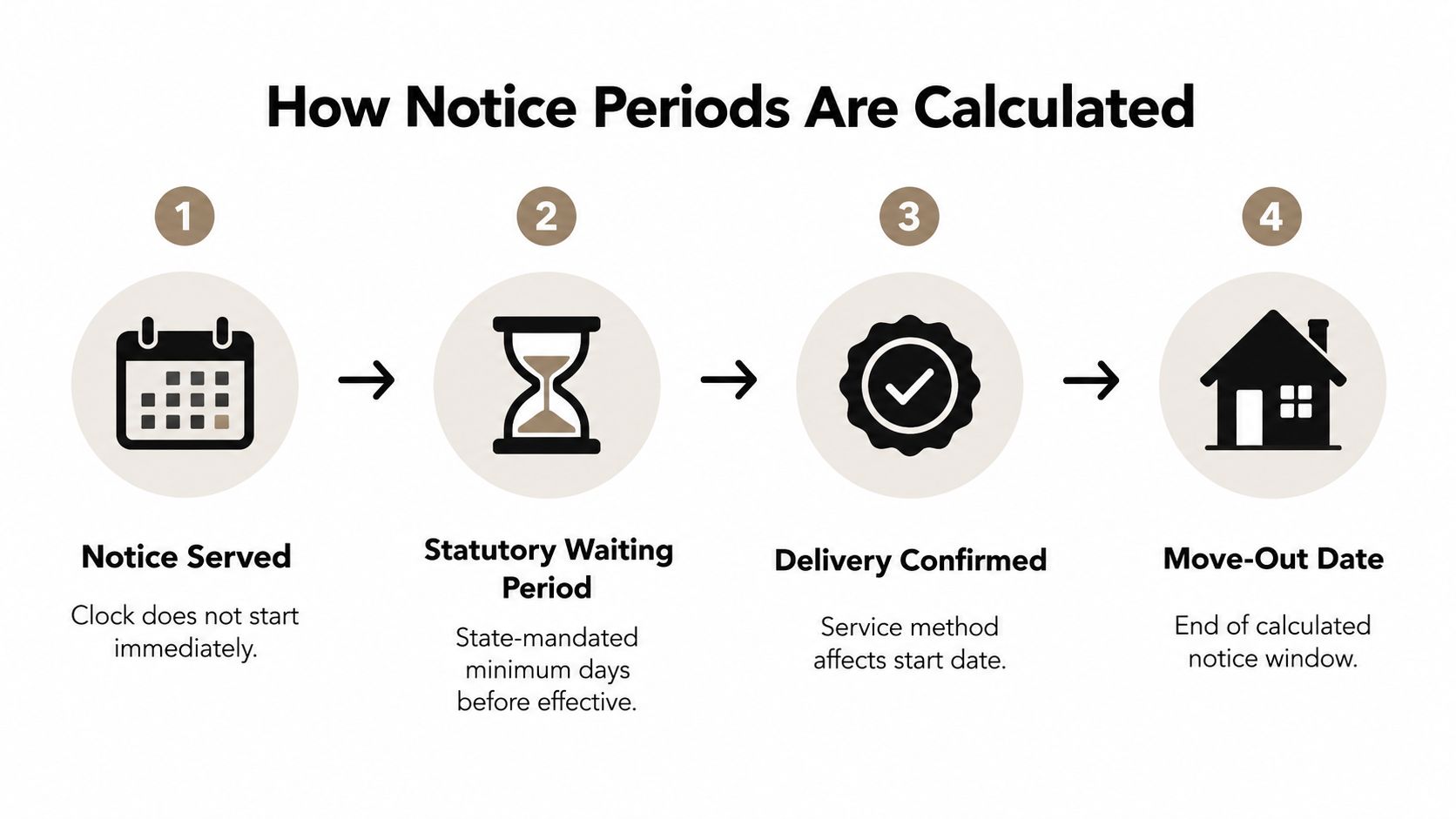
The most expensive mistake is treating notice as a simple countdown from the moment a letter is written. In many arrangements, the notice period interacts with the rental cycle. The date the notice is served and the date the tenancy may legally end can be different points on the calendar.
Florida illustrates the variation. Its statute requires 7 days for week-to-week tenancies, 15 days for month-to-month tenancies, and 45 days for quarter-to-quarter tenancies. Virginia requires 7 days for week-to-week tenancies and 30 days for month-to-month tenancies unless the rental agreement says otherwise. Louisiana provides 5 days for tenancies between a week and a month, 10 calendar days for month-to-month tenancies, and 30 calendar days for leases longer than a month. These are state-specific rules, not a national formula. Florida's statutory provisions demonstrate why the rental period matters.
A different model ties the deadline to the rent cycle. Minnesota guidance explains that, when the lease doesn't specify the advance notice required, written notice must be received at least one full rental period before the tenancy's last day. In practical terms, the deadline can be the day before the final rent payment is due rather than a free-standing day count. Minnesota's landlord-tenant guidance also describes a 30-day minimum for certain federally regulated housing termination notices.
The calendar method
Use this sequence before writing the date into a notice:
- Identify the rental period. Confirm whether rent is paid weekly, monthly, quarterly, or under another cycle.
- Read the lease. Look for notice length, renewal language, a notice-address clause, and any break provision.
- Check the jurisdiction. Determine whether the rule uses a fixed number of days, a full rental period, or an end-of-period date.
- Confirm service. Work out when delivery legally counts, then calculate the earliest lawful end date.
Suppose the applicable rule requires a full rental period and the tenant sends notice just after a new monthly period begins. A notice described casually as “30 days” may not end the tenancy after exactly 30 calendar days. If the law requires the notice to line up with the next permitted rental-period boundary, the effective timeline can approach 60 days in practice. The exact result depends on the lease, jurisdiction, service method, and dates.
That distinction affects both sides. A tenant who schedules movers based only on the mailing date may still owe rent after the planned move. A landlord who advertises the unit for an assumed vacancy date may lose time, incur turnover costs, or create a dispute if the notice was defective.
For the calculation itself, a notice-period calculator can help organize the dates and required notice details. For the physical move, a 2026 moving checklist and tips can help coordinate packing, utilities, address changes, and key return around the legally calculated end date.
Landlord vs Tenant Termination Rules
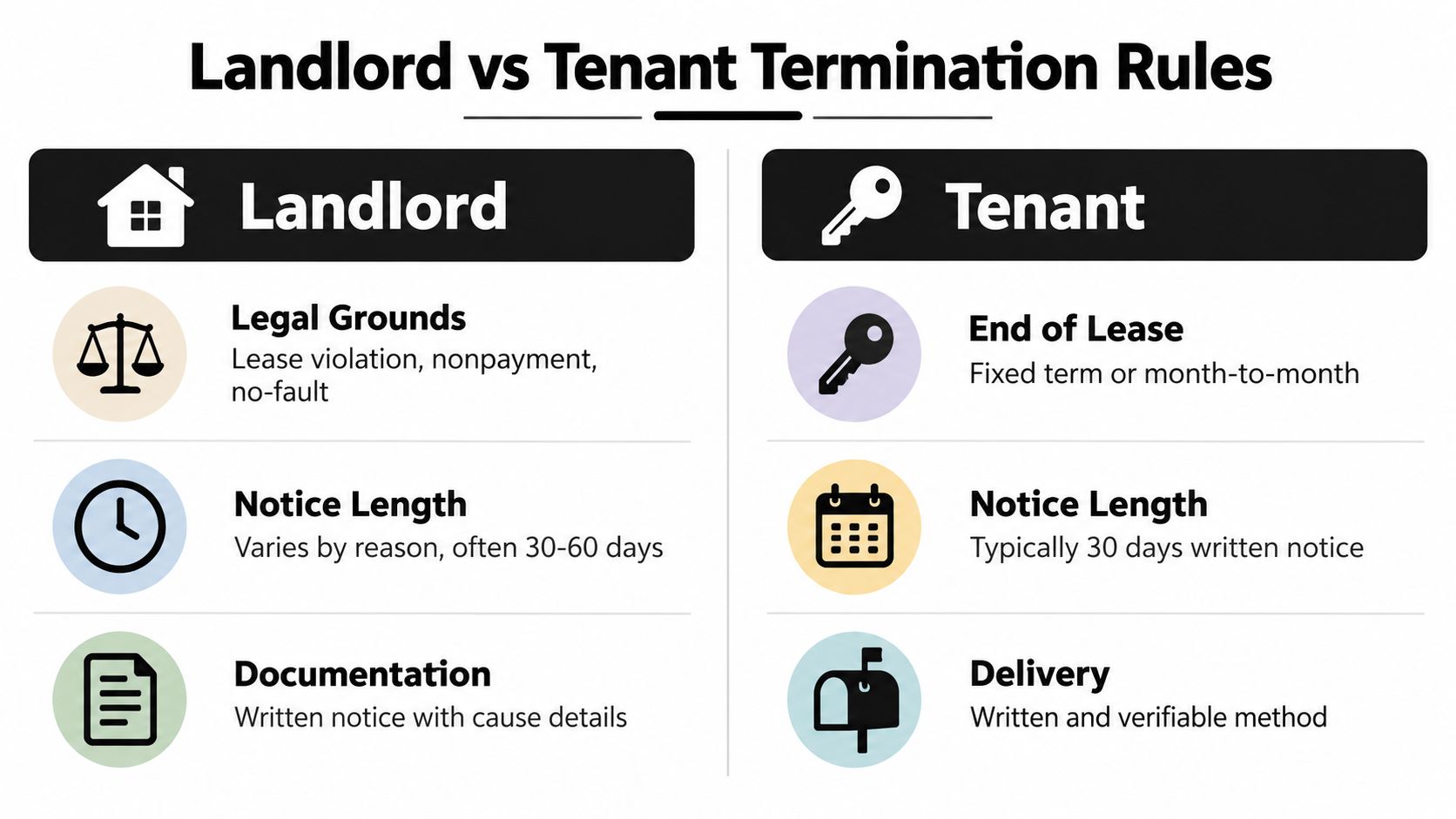
The party giving notice changes the legal question. A tenant usually asks, “What must I do to end my obligation?” A landlord must also ask, “What authority allows me to end this tenancy, and what reason, notice, and procedure apply?”
A tenant ending a month-to-month arrangement may only need to provide written notice that meets the applicable timing and service rules. A tenant ending a fixed-term lease faces a different analysis. The tenant may remain responsible until the term ends unless the agreement permits early termination, the landlord agrees to surrender, or a statute provides a right to leave.
A landlord's nonrenewal is not always interchangeable with an eviction notice. If the landlord alleges nonpayment or a lease violation, the notice may need to state the breach and provide the legally required opportunity to cure. If the landlord seeks possession for another reason, local law may require a lawful ground, a longer notice period, or compliance with tenant-protection rules.
The practical difference
| Issue | Tenant ending the tenancy | Landlord ending the tenancy |
|---|---|---|
| Main question | Has the tenant given valid notice under the lease and law? | Is there a lawful basis and has the required process been followed? |
| Fixed term | Check for a break clause, surrender agreement, or statutory right | Check the term, renewal language, and any permitted nonrenewal procedure |
| Periodic tenancy | Match notice to the rental period and service rule | Match notice to the rental period, reason, and local protections |
| Documentation | Keep the signed notice and proof of delivery | Keep the notice, lease, payment history, inspection records, and service evidence |
| Possession | Return keys and leave the property as agreed | Don't change locks or remove belongings without lawful authority |
Long-term, subsidized, or locally protected tenants require additional care. The ordinary month-to-month assumption may not apply where a housing program, local ordinance, or regulated tenancy imposes a longer notice period or requires a specific reason. A landlord should verify those rules before selecting a no-fault or nonrenewal form.
Inspection records are particularly useful when the landlord expects a dispute over condition, damage, or possession. A resource on the role of inspections for property managers can help connect notice administration with the condition documentation needed during turnover.
A termination notice establishes intent. It doesn't give a landlord permission to bypass a court process or give a tenant permission to ignore a fixed-term obligation.
Don't combine unrelated purposes in one vague letter. A nonrenewal notice, a demand for unpaid rent, a notice to cure a violation, and a notice to vacate may have different content and deadlines. If the facts involve protected housing, retaliation concerns, discrimination allegations, a serious safety issue, or a contested fixed-term departure, get jurisdiction-specific legal advice before serving anything.
Drafting the Termination Letter
A strong letter is precise, calm, and easy to prove. Start with the property and the parties, then state the legal action in plain language. Avoid emotional accusations, casual promises, and dates that depend on the recipient doing additional calculations.
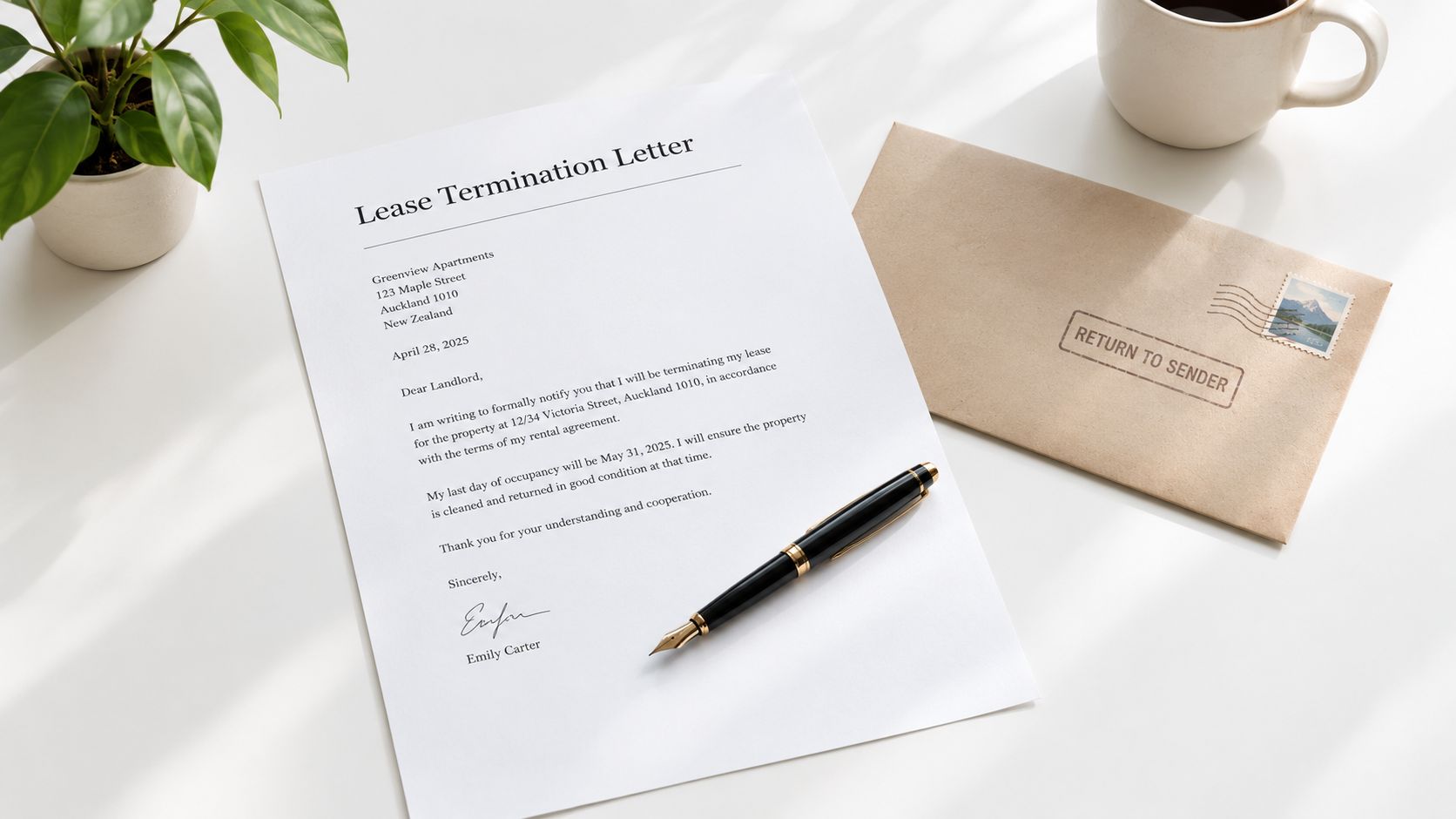
Use a structure such as this:
- Date and recipient: Address every tenant named in the lease and use the correct notice address.
- Premises: State the complete street address and unit.
- Intent: Say whether the notice ends a periodic tenancy, declines renewal, or alleges a specific breach.
- End date: State the exact date possession must be returned. Don't write only “30 days from receipt.”
- Reason: Include the reason when required, and describe a breach accurately rather than using a broad label.
- Move-out instructions: Explain key return, personal property removal, cleaning expectations, and forwarding-address procedures.
- Sender details: Sign the notice and include a reliable contact method.
- Service record: Record the method, date, time, and person who completed delivery.
Choose service for proof
Personal delivery can provide immediate confirmation, but the server should document where, when, and how the notice was handed over. Certified mail or another trackable mailing method creates a delivery trail, although mailing rules can affect the date on which service is deemed effective. Posting may be permitted in limited circumstances, but it can have strict conditions and shouldn't be used merely because it is convenient.
Check the lease and local law before assuming email, text message, ordinary mail, or posting is sufficient. If more than one method is allowed, a landlord may choose a primary lawful method and preserve supporting evidence through another channel, while avoiding inconsistent versions of the notice.
A dedicated lease cancellation letter guide can help organize the wording and information, but the final document still needs to match the governing agreement and jurisdiction.
The letter should never imply that the recipient has fewer rights than the law provides. Don't threaten a lockout, utility interruption, immediate removal, or forfeiture of property. If the notice is for nonpayment or a lease violation, use the correct statutory form or wording where required instead of adapting a generic nonrenewal letter.
After the letter is served, save the signed copy, delivery record, tracking information, photographs if posting is lawful, and all related communications in one file. The record should show not just what you intended to send, but what was delivered and when.
Real-World Scenarios and Common Mistakes
Consider a month-to-month tenant whose rent cycle runs from the first day of the month through the last day. The tenant decides to leave and sends a written notice shortly after the new rental period begins. The tenant writes “30 days' notice,” but doesn't first confirm whether the governing rule allows the tenancy to end on any date or only at the end of a rental period.
The landlord should record the date the notice was received, verify the lease, identify the applicable state rule, and calculate the first permitted end date. If the notice misses the relevant cutoff, the tenancy may continue into a later rental period even though more than 30 calendar days have passed since the letter was sent. The landlord should acknowledge the notice in writing and state the calculated date, while the tenant should obtain confirmation before booking movers or stopping payment.
Where the process commonly breaks
Oral notice creates uncertainty. A phone call may alert the landlord, but it doesn't reliably establish the date, wording, recipients, or service method. Both sides should follow up with a written notice and preserve the response.
The sender counts from the wrong event. The date on the letter, the date it is mailed, the date it is received, and the date service is legally effective may differ. The sender must calculate from the event recognized by the applicable rule.
The notice uses an assumed end date. “End of next month” can be ambiguous if the rental period doesn't align with calendar months. Write the actual date and verify that it falls on a permitted termination point.
The sender ignores the lease type. A fixed-term lease isn't automatically a month-to-month tenancy, and a month-to-month tenancy isn't automatically governed by a universal 30-day rule.
The parties overlook delivery evidence. A correct letter can still become difficult to enforce when nobody can show who received it, where it was sent, or when delivery occurred.
Service mistakes also arise in documents that require acknowledgment of receipt. Guidance addressing premises injury receipt notice errors is focused on a different legal setting, but its practical lesson applies here: preserve a clear record of what was delivered, to whom, and on what date.
Weekends and holidays deserve attention because some rules measure business days, while others use calendar days or a full rental period. Don't assume that a delivery attempt on a weekend has the same legal effect as delivery on a business day. When the date is close, build in enough time for service and confirm the result through the governing rule or qualified local counsel.
Key Takeaways for a Smooth Exit
A smooth termination starts before anyone drafts the letter. Identify the tenancy type, read the lease, and determine the legal end point. The central question isn't “How many days do I have?” It is “What event starts the period, and on what date may this tenancy legally end?”
Use this final working checklist:
- Classify the tenancy: Determine whether the arrangement is fixed-term, month-to-month, week-to-week, or another periodic form.
- Read the agreement: Find the notice clause, renewal language, break rights, notice address, and service provisions.
- Check exceptions: Look for subsidized housing rules, local protections, reason-based requirements, and special rules for long-term or protected tenants.
- Calculate from the correct trigger: Use receipt, effective service, the next rent-due date, or another trigger required by the applicable rule.
- Write one exact end date: Don't leave the recipient to count days or interpret “the end of the month.”
- Use a lawful delivery method: Select a method the lease and jurisdiction recognize, then preserve proof.
- Separate legal purposes: Don't use a generic nonrenewal letter for nonpayment, a breach, or another cause-based termination unless the form is legally appropriate.
- Coordinate the handoff: Confirm keys, possession, inspection, forwarding information, utilities, and deposit administration in writing.
- Escalate unusual matters: Get local legal advice before acting on a protected tenancy, disputed notice, abandonment concern, or proposed lockout.
Landlords should keep the lease, notice, delivery proof, payment ledger, inspection records, and communications together. Tenants should keep the notice they sent, delivery confirmation, the landlord's response, rent records, and evidence of the condition in which they returned the property.
The strongest process is not the most aggressive one. It is the process that produces a lawful date, a reliable record, and no avoidable surprise about rent or possession.
VerticalRent offers small landlords tools for state-specific lease and notice workflows, online rent collection, maintenance requests, and transaction records that help keep termination documentation organized. Visit VerticalRent to review the platform and choose the tools that fit your rental operation.
Put this into practice
VerticalRent tools related to this guide
Legal Disclaimer
VerticalRent and its authors are not attorneys, CPAs, or licensed legal or financial advisors, and nothing on this site constitutes legal, tax, or professional advice. The information in this article is provided for general educational purposes only. Landlord-tenant laws, eviction procedures, security deposit rules, and tax regulations vary significantly by state, county, and municipality — and change frequently. Nothing on this site creates an attorney-client relationship. Always consult a licensed attorney or qualified professional in your jurisdiction before taking any action based on information you read here.
Co-founded VerticalRent in 2011, growing it from nothing to 100k landlords and renters. Sold it in 2019, then re-acquired it in 2026 to make it better than ever.


