What Happens if You Don't Pay Rent: Key Timelines
Learn what happens if you don't pay rent, including eviction timelines, late fees, and potential legal consequences in 2026.


You miss the rent deadline because your paycheck is late, an unexpected bill drained your account, or a job change disrupted your budget. At first, the problem looks manageable. Then a late fee appears, your landlord sends a formal notice, and you realize that the question isn't only what happens if you don't pay rent, but how quickly unpaid rent can become a court case.
The answer depends on your lease, local law, the amount owed, and whether you communicate before the arrears grow. Tenants should act at the first missed payment. Landlords should document every step and follow the required process exactly. Waiting usually makes the financial and legal options worse for everyone.
The Immediate Aftermath of a Missed Payment
Suppose rent is due on the first, but your payment doesn't clear. On the next business day, your account may show an unpaid balance, your lease may treat the rent as delinquent, and an automated reminder may arrive. That doesn't usually mean an eviction case has started. It does mean the private problem has become a documented lease violation that can grow through late fees, returned-payment charges, and additional unpaid rent, depending on the lease and applicable law.
The first few days matter because the lease controls the starting point. Some agreements provide a grace period. Others allow a late charge immediately after the due date, subject to local restrictions. A property manager may also send a written past-due notice that identifies the balance, the payment deadline, and the consequences of continued nonpayment. Tenants should read the lease rather than assume that a customary grace period exists.
Practical rule: Treat the first missed payment as an emergency, not as a problem that can wait until the second one.
What tenants should do immediately
Contact the landlord or property manager before the balance grows. Give a specific explanation, a realistic payment date, and a proposed amount you can pay now. Avoid promising money you don't have. A short written message is more useful than an unanswered call because it creates a record of your effort to resolve the account.
Ask for the current ledger, including rent, fees, credits, and any returned-payment charges. You can also review guidance on handling a notice of past-due rent to understand what information a written notice should communicate. Don't assume that a partial payment automatically stops escalation. Get any agreement about timing, fees, or acceptance of partial payment in writing.
What landlords should do
Landlords should apply the lease consistently, update the tenant ledger, and preserve payment records. A reminder is often more effective than silence, but it shouldn't replace a legally required notice. The landlord should distinguish between an informal collection message and a statutory demand to pay or vacate.
The immediate objective is resolution. A clear ledger and early communication can prevent a small shortfall from becoming a disputed balance. If the tenant doesn't respond or the account remains unpaid after the lease's applicable period, the landlord must move from ordinary collection activity to the formal notice process required by local law.
Statutory Notices and the Cure Window
A landlord generally can't change the locks, remove a tenant's belongings, or shut off essential services just because rent is overdue. In many U.S. jurisdictions, the landlord must first serve a statutory rent-demand notice, allow the tenant the required opportunity to pay or leave, and then file an eviction case if the tenant does neither. The exact timing varies by jurisdiction and sometimes by the lease or housing program.
The operational sequence is straightforward:
- Rent becomes overdue. The landlord records the unpaid amount and any lawful charges.
- A formal notice is served. The notice states what the tenant must pay or when the tenant must vacate.
- The cure window runs. The tenant has the statutory period to pay, move, or seek legal help.
- A court case may begin. The landlord can file only after the notice period and other requirements are satisfied.
- The court decides possession. A landlord still needs a judgment and enforcement order before a forced removal.
Michigan illustrates a relatively short cure period. A written Demand for Possession gives the tenant seven days to pay or vacate before the landlord may file in district court, according to Michigan Legal Help's explanation of nonpayment eviction. New York uses a 14-day rent demand before a nonpayment case can start, as described in the verified legal guidance for this topic. These examples show why a tenant can't safely assume that every state provides the same amount of time.
Read the notice as a deadline
Tenants should check the amount demanded, the property address, the date of service, the payment method, and the final date to cure. A notice can create problems for a landlord if it demands an incorrect amount, uses the wrong service method, identifies the wrong tenant, or gives less time than the law requires. A tenant who pays should keep proof of delivery and confirmation that the landlord accepted the payment.
Landlords should use a jurisdiction-specific form and verify service. A notice that looks reasonable may still fail if it doesn't meet a statutory requirement. The landlord should also avoid mixing informal threats with formal legal language that could create confusion about the actual deadline.
For a practical explanation of the distinction between an ordinary past-due message and a formal pay-or-quit notice, review the notice requirements before sending anything. Once the cure window expires, the landlord may have the right to file, but filing still doesn't authorize a lockout.
Navigating the Court Eviction Process
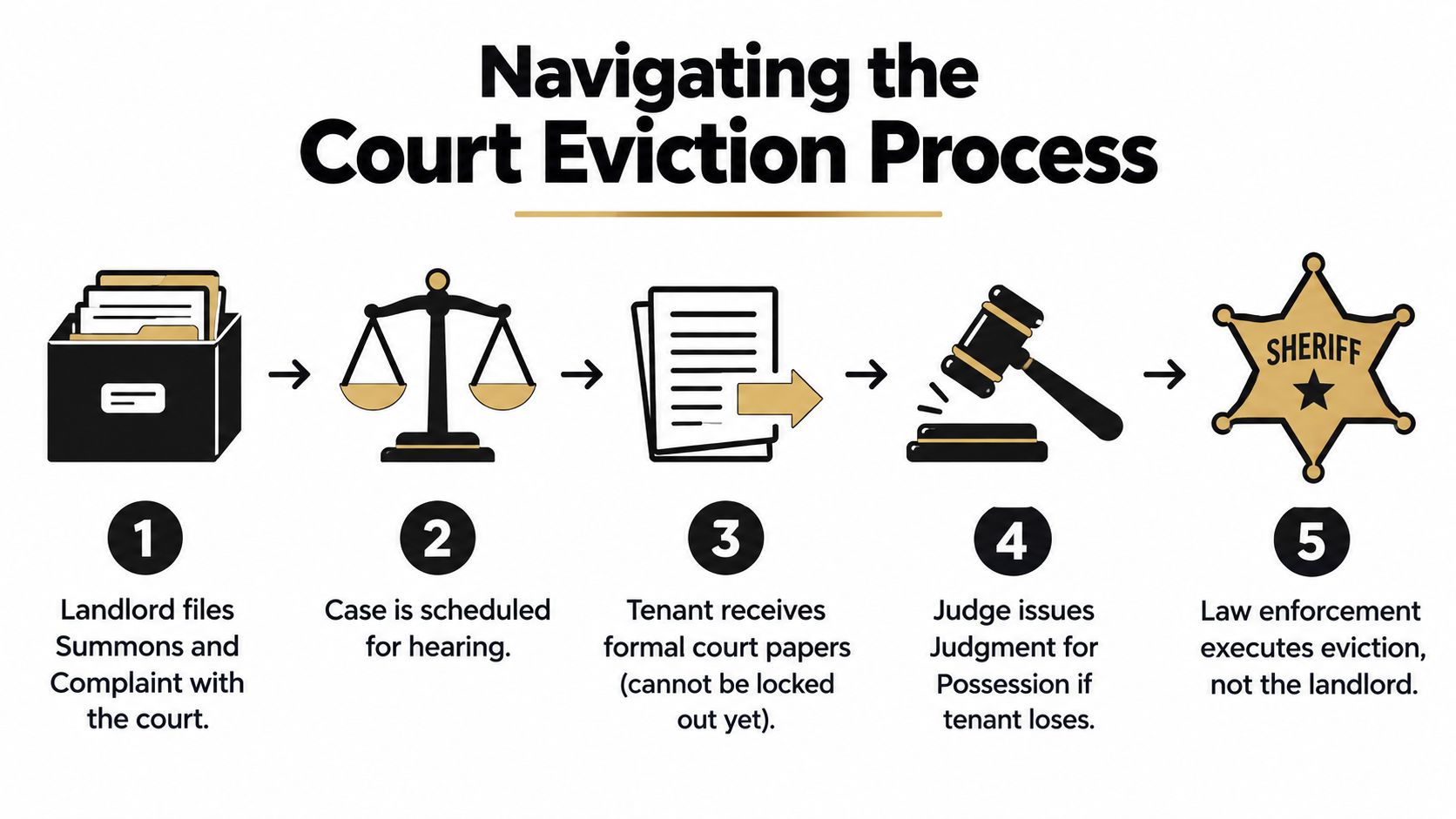
When the cure period ends without payment or an agreed move-out, the dispute enters court. The landlord files a complaint or petition, pays the required filing charges, and arranges for the tenant to receive formal court papers. The tenant then has a hearing date and an opportunity to answer the claim, present evidence, and raise legally recognized defenses.
The court isn't deciding only whether money is missing. It also evaluates whether the landlord has proved the right to possession. That usually requires a reliable lease, a payment ledger, a valid notice, proper service, and evidence that the tenant failed to pay or leave by the stated deadline.
The court sequence
The case commonly follows this pattern:
- Filing: The landlord submits the complaint and supporting information to the appropriate court.
- Service: The tenant receives a summons or equivalent court papers. Informal texts and prior notices aren't substitutes for court service.
- Hearing: Both sides present documents, testimony, and arguments. A tenant who ignores the hearing risks losing without presenting a defense.
- Judgment: If the landlord proves the claim, the court may issue a judgment for possession and determine the recoverable amounts.
- Warrant or writ: The court can issue an order authorizing a sheriff, marshal, or other authorized officer to enforce possession.
- Execution: Law enforcement, not the landlord, carries out the physical removal under the applicable procedure.
The eviction timeline calculator can help organize the stages, but it can't replace local legal advice. Court schedules, service rules, appeal rights, and enforcement practices differ by jurisdiction. No landlord should promise a tenant a fixed move-out date without checking the court order and local enforcement rules.
A landlord may have a strong rent claim and still lose or delay possession because the notice, service, or filing record is defective.
What a judgment changes
A judgment changes the landlord's power. The dispute is no longer only an unpaid invoice. The court may issue a warrant of possession or restitution authorizing the sheriff or marshal to remove the tenant. In New York, execution can be delayed if the tenant pays the judgment amount and court costs before enforcement, as explained in this overview of rent court and eviction.
Tenants should attend the hearing, bring the lease and payment evidence, and respond to every court paper. Landlords should prepare a complete chronological file. Neither side benefits from treating a court notice as another routine collection email.
Long-Term Financial and Credit Consequences
The most damaging mistake is to measure the problem only by the rent currently missing. Arrears can combine with lawful late charges, filing costs, service costs, attorney fees where recoverable, and a judgment balance. The resulting debt can follow a tenant after the keys are returned.
Research on rental housing found that 9.1% of rent due went unpaid on average, while more than 30% of tenants owed two or more months and 14% owed at least five months, according to the National Bureau of Economic Research working paper. The same research found that roughly half of tenants missed at least one payment during a lease, although many recovered without eviction. Among evicted tenants, 90% owed at least one month of rent, according to that source.
The filing threshold can look very different from one market to another. The following figures illustrate why a generic warning about “missing rent” isn't enough:
| Location | Median or average arrears at filing | Context |
|---|---|---|
| Washington, D.C. | $4,502 median | Between June and October 2025, the balance represented about three months of rent for many households. The projected number of filing households for 2025 was 12,565. |
| Oklahoma County | $1,714.04 average | The amount was roughly one month of rent plus fees. |
These market figures come from New America's analysis of Washington, D.C. eviction filings, which also reports the Oklahoma County comparison. They aren't a universal filing rule. They show that local rents, fees, court practices, and tenant payment capacity can produce very different balances before a case reaches a judge.
The record can outlast the tenancy
An eviction filing may affect future housing even when the tenant leaves voluntarily. Pew reports that an eviction case can remain on a person's record for up to seven years, including when the case was dismissed or settled, which can make future applications more difficult. A separate unpaid balance may also be pursued through collections or other lawful debt-recovery methods.
Tenants facing a large balance should get advice before signing an acknowledgment or ignoring court papers. Questions about insolvency and whether rent debt can be addressed through bankruptcy are fact-specific, so a resource explaining can rent debt be discharged may help frame the issue before speaking with a qualified attorney. Landlords should also separate a legitimate ledger from unsupported charges. An inaccurate balance can undermine collection efforts and damage the credibility of the underlying case.
Tenant Defenses and Landlord Risk Management
Nonpayment cases often turn on proof. A tenant may owe rent, but the landlord still has to establish the legal right to possession. A tenant may also have a legitimate defense, but must raise it properly and support it with documents, photos, messages, inspection records, or payment evidence.
| Tenant concern | Landlord risk | Sensible response |
|---|---|---|
| The notice demands the wrong amount or gives the wrong deadline | The court may reject or delay the case | Reconcile the ledger and use the correct statutory form |
| The tenant says notice was never properly served | The filing may fail on a procedural ground | Preserve the method, date, and proof of service |
| Serious habitability problems are documented | Local law may allow a defense or remedy related to conditions | Address urgent repairs and keep dated maintenance records |
| Payment was made or accepted under an agreement | The amount and right to possession may be disputed | Keep receipts, bank records, and written settlement terms |
Defenses tenants should investigate
A tenant should not invent a defense, but should investigate whether the landlord failed to maintain required living conditions, violated a repair obligation, accepted payment under a different arrangement, miscalculated the balance, or served an invalid notice. Local law determines whether a condition can reduce rent, delay possession, or support another remedy. A tenant should also check whether the landlord's conduct involved retaliation or discrimination, although those issues don't automatically erase unpaid rent.
The strongest practical defense is organized evidence. Keep the lease, notices, payment confirmations, repair requests, photographs, inspection reports, and messages in date order. If a hearing is scheduled, read the papers carefully and seek local assistance quickly. For Connecticut renters and property owners dealing with a disputed tenancy, CT tenant lease and eviction help can provide a starting point for finding legal guidance.
Risk controls for landlords
Landlords should use a consistent process for every delinquent account. Reconcile the ledger before issuing a demand, apply payments in accordance with the lease and local law, preserve service evidence, and avoid self-help tactics. A landlord should also review whether a payment plan, voluntary surrender, or negotiated settlement will recover more value than a contested filing.
The central rule is simple: unpaid rent alone doesn't guarantee possession. The landlord must prove proper notice, service, nonpayment, and the right to the requested remedy. A disciplined file protects the landlord and gives the tenant a fair opportunity to cure or contest the claim.
Practical Next Steps to Avoid or Resolve Eviction
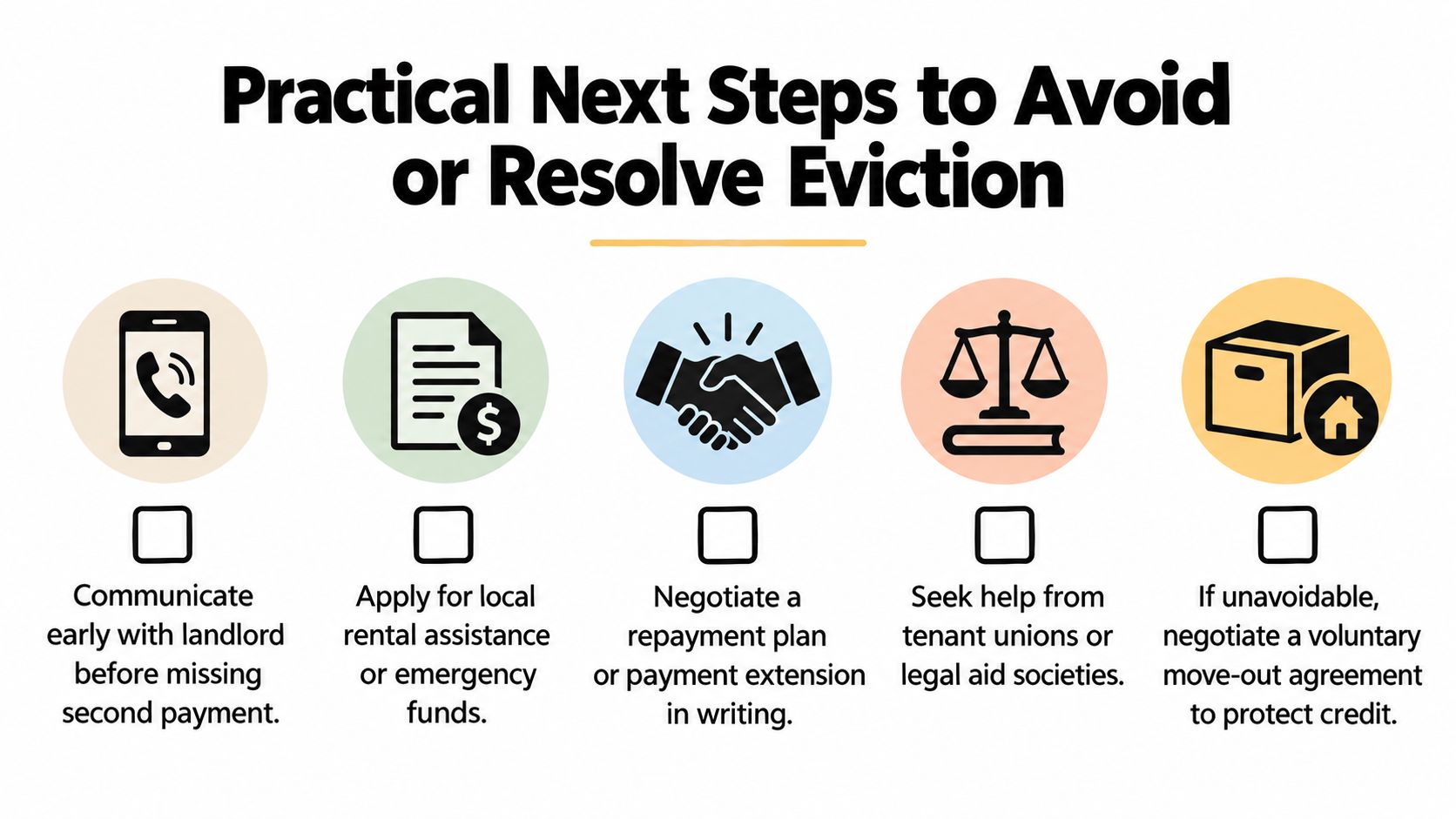
The best time to negotiate is before a formal case is filed. Once a court date exists, both sides have less flexibility and more costs. Tenants should communicate early, while landlords should evaluate recovery realistically instead of allowing frustration to dictate the next step.
A tenant playbook
Start with a written message that states the amount currently available, the date of the next expected payment, and the amount that can be paid on each later date. Attach evidence if an employer, benefits office, insurer, or assistance program has delayed payment. Ask the landlord to confirm the balance and proposed arrangement in writing.
Then take these actions:
- Apply for assistance: Contact local emergency rental assistance programs, community organizations, or legal aid before the cure deadline expires.
- Protect payment evidence: Use a traceable payment method and retain confirmations, receipts, and copies of every message.
- Negotiate a written plan: Specify the initial payment, future installments, treatment of fees, and what happens if a payment is missed.
- Consider a voluntary move-out: If keeping the unit is impossible, negotiate a documented surrender date and the treatment of the deposit and remaining balance.
- Get legal help: Contact tenant advocates or a licensed attorney as soon as a statutory notice or court paper arrives.
Don't abandon the unit without understanding the lease and local consequences. Leaving can reduce the immediate conflict, but it may not eliminate the debt or the risk of a collection claim.
A landlord playbook
Send reminders before and on the due date, then use a documented late-rent workflow after any applicable grace period. The landlord should compare the likely recovery from a payment plan with the cost of vacancy, turnover, filing, service, and enforcement. A plan is not automatically generous. It can be a rational collection strategy when the tenant has credible income and communicates reliably.
Record every call summary, notice, payment, promise, and missed commitment in the tenant ledger. Property management software can automate reminders, calculate lease-based charges, and preserve communication history, but the landlord remains responsible for legal compliance. Automation should support judgment, not replace it.
A voluntary move-out agreement should state the date of surrender, key return, property condition, deposit handling, and whether either party releases or preserves any claim. Clear terms can prevent a confusing exit from becoming another dispute.
Common Questions About Missed Rent and Eviction
Does a landlord have to accept partial payment?
Not necessarily. The answer depends on the lease, local law, and whether the landlord has agreed to a payment arrangement. A tenant shouldn't assume that sending part of the rent cancels a notice or prevents filing. Ask for written confirmation of how the payment will be applied and whether the landlord is preserving the right to pursue the remaining balance.
Can a landlord use the security deposit for unpaid rent?
Often, a deposit may be applied to unpaid rent or damage, but the accounting and notice requirements vary by jurisdiction. A deposit isn't an automatic final-month rent payment unless the landlord agrees. The landlord should provide a lawful accounting, and the tenant should give a forwarding address and keep move-out evidence.
What does “cash for keys” mean?
It usually means the landlord offers a tenant money or another agreed benefit in exchange for a voluntary move-out by a specified date. Put the arrangement in writing, identify when payment occurs, state what happens to the deposit and arrears, and require both sides to sign. The tenant should not surrender possession based only on a verbal promise.
Can a tenant break the lease to avoid eviction?
Leaving may prevent a physical eviction, but it doesn't automatically erase rent owed under the lease. A negotiated termination can be safer if it clearly states the move-out date, remaining balance, payment terms, and any agreement about reporting or release. Tenants should get local legal advice before signing.
Nonpayment is the main trigger for eviction in the United States. Research summarized by the Philadelphia Fed on missed rent and eviction says about half of eviction filings end in judgments, implying roughly 1 million households are evicted each year, while broader estimates put filings at about 3.2 million annually. Those figures make early action more than good manners. They make it the most practical way to protect housing, cash flow, and future rental options.
VerticalRent helps independent landlords manage online rent collection, automated reminders, lease-based late-fee workflows, tenant ledgers, and documented communications in one platform. Use VerticalRent to bring a consistent process to missed payments before a manageable arrears issue becomes a court problem.
Put this into practice
VerticalRent tools related to this guide
Legal Disclaimer
VerticalRent and its authors are not attorneys, CPAs, or licensed legal or financial advisors, and nothing on this site constitutes legal, tax, or professional advice. The information in this article is provided for general educational purposes only. Landlord-tenant laws, eviction procedures, security deposit rules, and tax regulations vary significantly by state, county, and municipality — and change frequently. Nothing on this site creates an attorney-client relationship. Always consult a licensed attorney or qualified professional in your jurisdiction before taking any action based on information you read here.
Co-founded VerticalRent in 2011, growing it from nothing to 100k landlords and renters. Sold it in 2019, then re-acquired it in 2026 to make it better than ever.


