Schedule E Instructions for Landlords: A Practical Reference
Clear schedule e instructions for independent landlords, covering line-by-line entries, rental income and expense mapping, common pitfalls, and how platform……


You're usually not staring at Schedule E in a vacuum. You already have rent deposits in a bank account, repair receipts in email, mortgage statements in a folder, and some kind of ledger in a spreadsheet or platform. The hard part is not the form itself. The hard part is making sure the form reflects the bookkeeping you've been doing all year, property by property, without reclassifying half your records at tax time.
That's the useful way to read the Schedule E instructions. Not as static IRS text, but as the year-end output of your rental ledger. If your books are clean, Schedule E becomes a transfer exercise. If your books are messy, the form exposes every weak spot.
What Schedule E Is and Why Landlords File It
A landlord usually meets Schedule E at year-end, after a full year of rent deposits, vendor bills, mortgage statements, and owner contributions have already passed through the books. Schedule E is the form that turns that running ledger into a tax result. For rental real estate, Part I reports the income, expenses, and net profit or loss that flow into the individual return, as explained in the IRS Schedule E instructions.
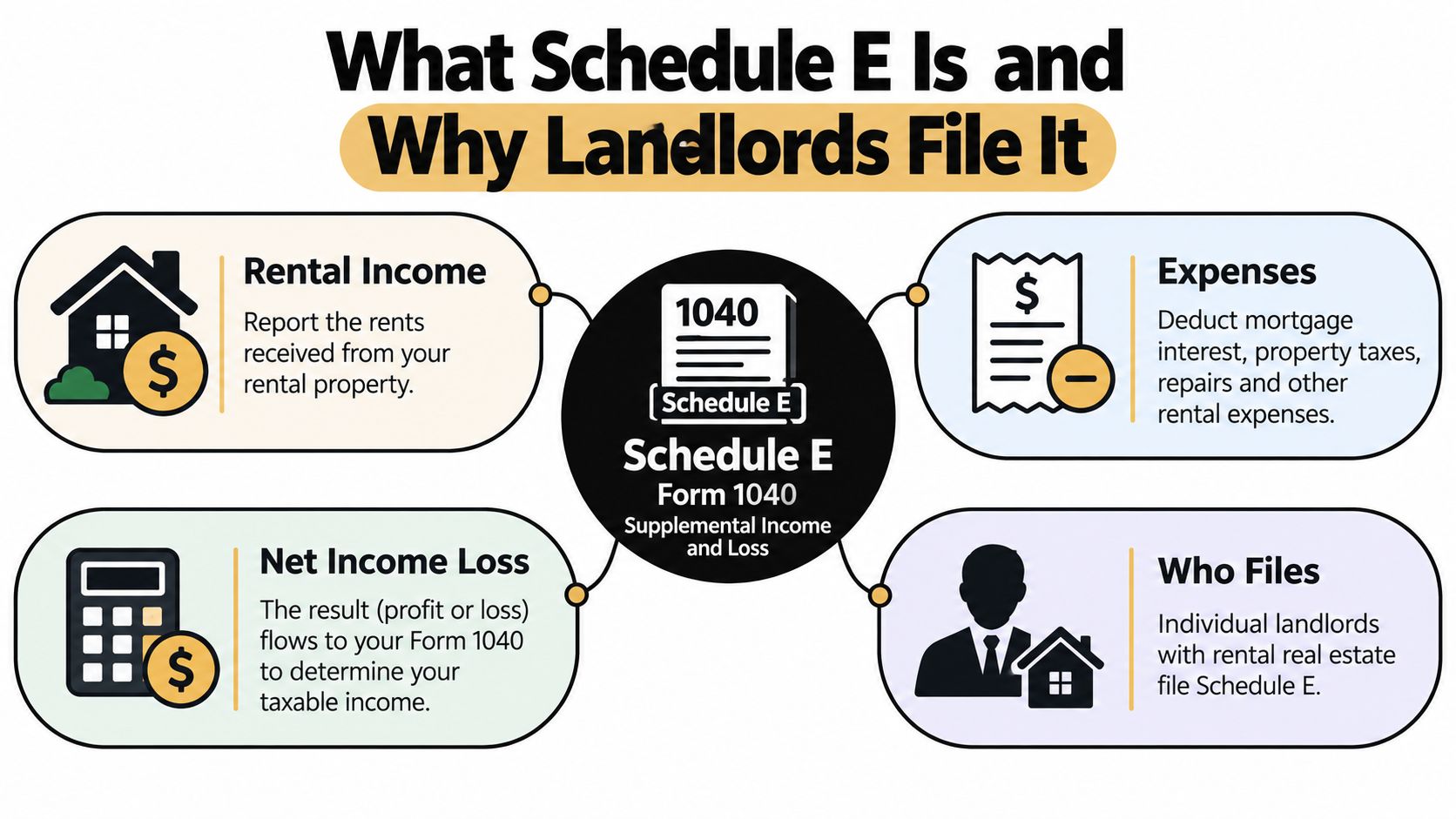
For landlords, the practical point is simple. Schedule E is not where you decide what happened during the year. It is where you report what your property ledger already shows, property by property.
That distinction matters because the form follows bookkeeping logic, not bank-account logic. One rent deposit belongs on the income side. A plumbing invoice belongs in repairs or another expense category. A roof replacement may belong in fixed assets and depreciation instead of current repairs. If those decisions were handled during the year, filing is mostly a transfer job. If they were postponed, Schedule E becomes a cleanup project.
I see the same mistake often with independent landlords. They total the checking account, subtract whatever looks like an expense, and try to force the result into the form. That approach usually misses non-cash deductions such as depreciation, mixes personal and rental spending, and blends multiple properties into one number that does not match the structure of Schedule E.
A cleaner way to work is to line up the form with the records you already use:
- bank and payment activity that shows cash received and paid
- a property-by-property income and expense ledger
- year-end reports exported from software such as VerticalRent or from a spreadsheet with the same categories
- source documents that support unusual items, owner reimbursements, and asset purchases
When those records agree, the form stops feeling abstract. Each line becomes the tax destination for numbers you have already classified.
For landlords trying to get their annual rental taxes organized, that is the value of understanding Schedule E. It gives the IRS a standardized summary of each rental activity, but for you, it also acts as a test of whether the books are usable. If a number on Schedule E cannot be traced back to a ledger entry and then to a statement, invoice, or settlement document, that number needs another look.
Schedule E also matters because it separates operating results from ownership economics. It captures rent, ordinary expenses, and depreciation for each rental activity. It does not replace your cash flow view, and it does not tell you whether a property was a good investment. A property can show positive cash flow and still report a tax loss after depreciation. The opposite can happen too. Landlords who understand that trade-off make fewer filing errors and ask better questions before they sign the return.
The Property Header and Multi-Property Layout
A common year-end mess looks like this: three rentals, one checking account, one export from the property management platform, and a Schedule E draft with everything pushed into column A. That usually starts in the header. If the property identity is wrong or the columns are set up loosely, the income and expense lines that follow are usually wrong too.
Part I gives each property its own column. On a standard Schedule E page, that means columns A, B, and C. Each column should tie to one rental activity, with its own address, income, expenses, and depreciation. The IRS expects you to list the property address and report the totals by property, not by bank account or by owner-made grouping IRS rental real estate recordkeeping guidance.
If your ledger is clean, the header is easy. If your ledger is mixed, the header exposes the problem fast.
Where the header data should come from
Use source records, not memory and not whatever shorthand appears in a bank feed. The address on Schedule E should match the rental property, not your mailing address, management office, or a prior unit number you used in a spreadsheet tab.
| Schedule E Line | Field | Best Source |
|---|---|---|
| Line 1 | Street address | Deed, closing statement, signed lease |
| Line 2 | City, state, ZIP | Deed, lease, tax record |
| Column A, B, or C | Property totals assigned to that column | Property-level ledger, rent roll, year-end platform export |
| Line 1 area | Type of property | Your property records and the form instructions |
Bookkeeping and tax prep should match. If VerticalRent or your spreadsheet already produces a property-by-property Schedule E report, each report should map to one column. If one export includes two duplexes, two single-family homes, or a rental plus owner-paid shared costs with no split, fix that in the ledger before you start entering anything on the form.
Why the column layout matters
The column layout is not just formatting. It forces you to keep each property's activity separate.
Landlords often combine properties because the same LLC owns them, the same mortgage servicer drafts payments, or the same insurance agent writes the policies. None of that changes the reporting structure here. Schedule E is built around the activity for each property. Combining them makes it harder to trace repairs, taxes, interest, and depreciation back to the right asset, and that creates problems later if one property is sold, converted to personal use, or reviewed by the IRS.
Shared costs need a defensible allocation method before they hit Schedule E. For example, if one landlord policy covers two buildings, split the premium using a method you can explain and apply the same way each year unless the facts change. Square footage, unit count, or separately stated invoices can all work, depending on the cost. Guessing at tax time is where small misclassifications start.
The mistake I see often is a year-end worksheet with one line for "rental expenses" and no property detail underneath it. Mortgage interest and property taxes usually get assigned correctly because the statements are obvious. Smaller charges such as pest control, lock changes, screening fees, platform charges, or mileage reimbursements are where columns get crossed. Once that happens, the header is no longer just a label. It is the first sign the books were never separated well enough for the form.
Reporting Rental Income on Lines 3 Through 7
A landlord collects $1,200 in monthly rent, keeps $300 of a security deposit after a tenant leaves, and lets another tenant knock $150 off rent for hauling away debris. By January, only the monthly rent is sitting in the "rent" category. That is how Schedule E line 3 gets understated even when the bank deposits look close.
Lines 3 through 7 work best when you treat them as the output of your property ledger, not as a separate tax exercise. If your books are current, these lines are mostly a classification check. If your books are vague, cleanup starts.
What belongs on these lines
Line 3 is rents received. Pull this from the rent income category for that property, whether the report comes from your ledger or an exported Schedule E report from a platform such as VerticalRent. The key is that the number should reflect rent you recognized for the year, not just whatever hit the bank labeled "rent."
Line 4 is royalties. Many independent landlords leave it blank because they do not have royalty income tied to the property.
Line 5 adds lines 3 and 4.
Line 6 picks up income you received in a form other than cash. If a tenant paid with services, materials, or other property and you accepted that in place of rent, record the value in the ledger so it does not disappear at filing time.
Line 7 is gross rental income before expenses.
| Schedule E Line | Income Type | Ledger Example |
|---|---|---|
| Line 3 | Rents received | Monthly rent, rent applied from prepaid balances, rent paid by a housing program |
| Line 4 | Royalties | Royalty income tracked separately for the property |
| Line 5 | Total rents and royalties | Sum of lines 3 and 4 |
| Line 6 | Other rental income received as services or property | Rent credit for tenant labor or property transferred instead of cash |
| Line 7 | Gross rental income | Total income before expense deductions |
Entries landlords miss
Late fees, lease break payments, retained deposits applied to unpaid rent, and prepaid rent often get booked to catch-all income accounts or never moved out of the deposit liability account. Review the lease and your ledger together. If you kept the money as compensation for the tenant's use of the property, it usually belongs in rental income somewhere in this line range.
Security deposits need careful handling. A deposit you still expect to return is not rent. Once all or part of it is applied to rent under the lease, reclassify it in the ledger at that point. Do not wait until tax season and try to remember why the deposit balance changed six months earlier.
In-kind rent creates a second bookkeeping question. If the tenant's work replaced rent, book the income first. Then decide whether the related cost is a current repair expense or a capital improvement. Landlords often do only half of that entry and end up with understated income or an expense that has no matching support.
Use clear labels. "Tenant payment" is too vague to map cleanly to Schedule E. "June rent," "late fee," "deposit applied to rent," and "tenant labor credit accepted as rent" are much easier to trace when you compare the ledger to line 3 through line 7.
A monthly review fixes most of these problems before they become tax problems. Reconcile rent, check deposit reclassifications, and scan for non-cash arrangements while the facts are still easy to verify.
Deductible Operating Expenses by Category
A landlord usually gets Schedule E expense lines right or wrong long before tax season. The return is just the year-end output of the ledger. If your bookkeeping categories track how the form is laid out, posting gets easier, the exported Schedule E report from software like VerticalRent needs less cleanup, and line 6 through line 19 stop feeling arbitrary.
The tax rule here is simple. Deduct the ordinary and necessary costs of operating the rental. The practical work is classification.
| Schedule E Line | Expense Description | Ledger Category |
|---|---|---|
| Line 6 | Advertising | Listing fees, rental ads, leasing promotion |
| Line 9 | Insurance | Landlord policy premiums |
| Line 11 | Management fees | Property management charges |
| Line 12 | Mortgage interest paid to banks, etc. | Loan interest from lender statements |
| Line 13 | Other interest | Non-mortgage rental borrowing interest |
| Line 14 | Repairs | Plumbing fixes, patch work, minor service calls |
| Line 16 | Taxes | Real estate taxes |
| Line 18 | Depreciation expense or depletion | Annual depreciation entry |
| Line 19 | Other | Utilities, cleaning, lawn care, software, similar items |
Some categories should post cleanly every time. Advertising is any cost to market the unit. Insurance should tie to premium invoices or annual policy statements. Management fees belong on their own line even if the manager paid vendors on your behalf. Real estate taxes should come from tax bills or escrow analysis, not a rough estimate from memory.
Interest is where landlord books often drift. The bank feed shows a full mortgage payment, but Schedule E only gets the interest portion. Principal reduces the loan balance. It is not a current deduction. If you borrowed separately for the rental, such as a line of credit for operating cash, that usually belongs under other interest rather than mortgage interest.
Repairs need judgment. A repair keeps the property in rentable condition. A new roof, a full kitchen remodel, or replacing all windows usually belongs in capitalization, not line 14. Mixed invoices are common, especially after turnover work. Split them while the invoice is fresh. If one bill includes a leak repair, new vanity, and upgraded tile, post the repair portion to repairs and route the improvement portion to a fixed asset or improvement account for later depreciation.
Line 19 causes the most clutter. It works best as a tax-form bucket, not a bookkeeping bucket. Keep utilities, cleaning, lawn service, pest control, HOA dues, software, and postage separate in the ledger, then combine them for line 19 only when preparing the return or reviewing your Schedule E export.
That approach gives you cleaner books and better answers when an expense changes year to year.
I also tell landlords to watch for charges that look administrative but belong elsewhere. Tenant screening fees often end up under management or office expense. Small tools and supplies sometimes get buried in repairs. Owner-paid utilities are easy to miss if they were charged to a personal card and reimbursed later. None of those mistakes is dramatic by itself, but they make the ledger harder to map back to the form.
If you want another practical viewpoint on category decisions, these LendingXpress deduction tips are worth a read. The better habit is to code each transaction to the right property and expense category when it is recorded, so Schedule E becomes a report you review instead of a puzzle you rebuild in March.
Depreciation and Form 4562
Depreciation is where many landlord-prepared returns go sideways. The IRS treats it as a required annual deduction for recovering the cost or other basis of business or investment property with a useful life beyond the tax year. For rental real estate, land is not depreciable, and residential rental property generally uses a 27.5-year recovery period under MACRS with the mid-month convention. The IRS also directs taxpayers to use Form 4562 to compute depreciation IRS Schedule E instructions PDF.
What that means in practice
You do not depreciate the full purchase price of the property as a single undivided number. You separate land from the building because land isn't depreciable. Then you track the building basis and any later capitalized improvements.
The mid-month convention matters because the placed-in-service month affects the first year's calculation. That's one reason depreciation is a schedule, not a back-of-the-envelope estimate.
What landlords get wrong
The most common mistake is skipping depreciation entirely because “the property didn't lose value.” Tax depreciation doesn't ask whether your neighborhood appreciated. It asks whether you own depreciable rental property and placed it in service.
The second mistake is expensing improvements as repairs, which avoids Form 4562 in the short run but creates inaccurate books.
If you need a plain-English companion on this topic, this rental property depreciation schedule guide is a practical reference. I'd still stress this point above everything else. Your depreciation line on Schedule E should come from a maintained asset schedule, not from a guess made during filing week.
Multiple Properties and Passive Activity Limits
Once you own several rentals, Schedule E becomes a reporting system, not just a form. The IRS says if you have more than three rental or royalty properties, you must attach additional Schedule E forms, and the totals column is completed on only one form IRS Publication 527 PDF.
Handling more than three rentals
That rule tells you exactly how your books should be organized. Each property gets its own income, expense, and depreciation totals. Then those property-level figures roll into the combined totals on one Schedule E.
If your bookkeeping system can filter by property, this process stays manageable. If it can't, every additional unit multiplies the cleanup.
- Property-by-property totals first: complete each rental's figures separately.
- Use extra pages when needed: don't compress four properties into three columns.
- One totals column only: combine the figures once, on a single form.
Passive loss issues landlords overlook
This is also where many owners run into passive activity limits. A loss on paper doesn't always mean a currently deductible loss against other income. That's why a negative number on Schedule E should trigger a review of the passive loss rules and related forms, not an assumption that the full amount automatically reduces tax this year.
For a non-tax-lawyer summary of how people distinguish active and passive income concepts more broadly, these forensic accounting income insights provide useful context. For rental filing specifically, I'd also keep this passive activity loss rules overview nearby while working through any loss year.
Don't let the form's simplicity fool you. A clean Schedule E can still feed a separate passive loss limitation calculation.
The practical trade-off is simple. More properties create more opportunity for tax benefit, but they also make weak bookkeeping much more expensive in time and error risk.
Mistakes That Trigger IRS Inquiries
Most IRS problems on Schedule E start long before filing. The return just reveals them. The pattern is usually one of four things: bad classification, mixed-use spending, missing supporting schedules, or ignoring loss limits.
The errors that stand out
| Common Mistake | Why It Draws Attention | Corrective Action |
|---|---|---|
| Expensing an improvement as a repair | Deduction timing doesn't match the nature of the work | Reclassify to fixed assets and depreciate properly |
| Mixing personal and rental charges | Source documents don't support full rental deduction | Allocate and document the rental portion |
| Skipping passive loss limitation work | Reported loss may be overstated | Complete the passive loss forms and adjust carryovers |
| Omitting depreciation | Taxable rental income is misstated | Prepare or update depreciation schedules and file correctly |
Repairs versus improvements is still the big one. A service call to fix a leak is one thing. Work that creates or restores a significant asset is another. If the invoice describes replacement, renovation, or major system work, treat it carefully before posting it as a current expense.
Mixed personal and rental purchases are another chronic issue. If one store receipt includes supplies for your home and the rental, the whole receipt doesn't become a rental deduction just because you used the same card. You need an allocation note and a support file.
What to do when you find a problem
Fix classification errors in the books first. Then make sure the tax treatment follows the corrected accounting. If the issue affects prior-year depreciation or prior-year reporting, you may need to address it through amended filings or other correction procedures.
Clean corrections beat defensive explanations. If a number is wrong, fix the ledger, keep the memo, and file from the corrected records.
Skipping Part II work when there's a loss is another avoidable problem. A landlord sees negative cash flow or a tax loss and assumes the whole amount belongs on the return without limitation analysis. That's how notices start.
Mapping an Income and Expense Ledger to Schedule E
A good Schedule E filing should feel like reconciliation, not creative writing. If your ledger categories are set up well, you can map them line by line and check the totals before filing.
The line-by-line mapping that actually works
| Ledger Category | Schedule E Line | Notes |
|---|---|---|
| Rent income | Line 3, then Line 5 | Main rental receipts category |
| Advertising | Line 6 | Vacancy marketing and listing costs |
| Insurance | Line 9 | Landlord insurance premiums |
| Management fees | Line 11 | Third-party or platform management fees |
| Mortgage interest | Line 12 | Interest only, not principal |
| Repairs and maintenance | Line 14 | Current repairs, not capital improvements |
| Property taxes | Line 16 | Real estate taxes |
| Depreciation | Line 18 | Pulled from depreciation schedule |
| Other operating expenses | Line 19 | Utilities, cleaning, lawn care, similar items |
A platform export helps. A property-level ledger filtered by address lets you fill one Schedule E column at a time. An annual summary by category lets you test whether your ledger totals match what lands on the form.
One option landlords use is a platform-generated ledger such as the income and expense ledger reference, especially when it keeps property tags and tax categories together in one export. The useful part isn't the software name. It's the structure. Property, category, date, amount, and source detail all living in one place.
What should stay off Schedule E
Some ledger activity belongs in your books but not on these tax lines.
- Principal payments: these reduce debt. They aren't current rental deductions.
- Security deposits held in trust: these aren't automatically income.
- Owner contributions: money you put into the property account isn't rental income.
- Transfers between accounts: these are balance sheet movements, not expenses.
A final reconciliation should answer one question clearly. Does every number on the form tie back to a ledger total, and does every ledger total tie back to source documents?
Recordkeeping That Holds Up on Audit
Good recordkeeping isn't glamorous, but it's what makes the Schedule E instructions usable in real life. The stronger your records, the less time you spend defending classifications later.
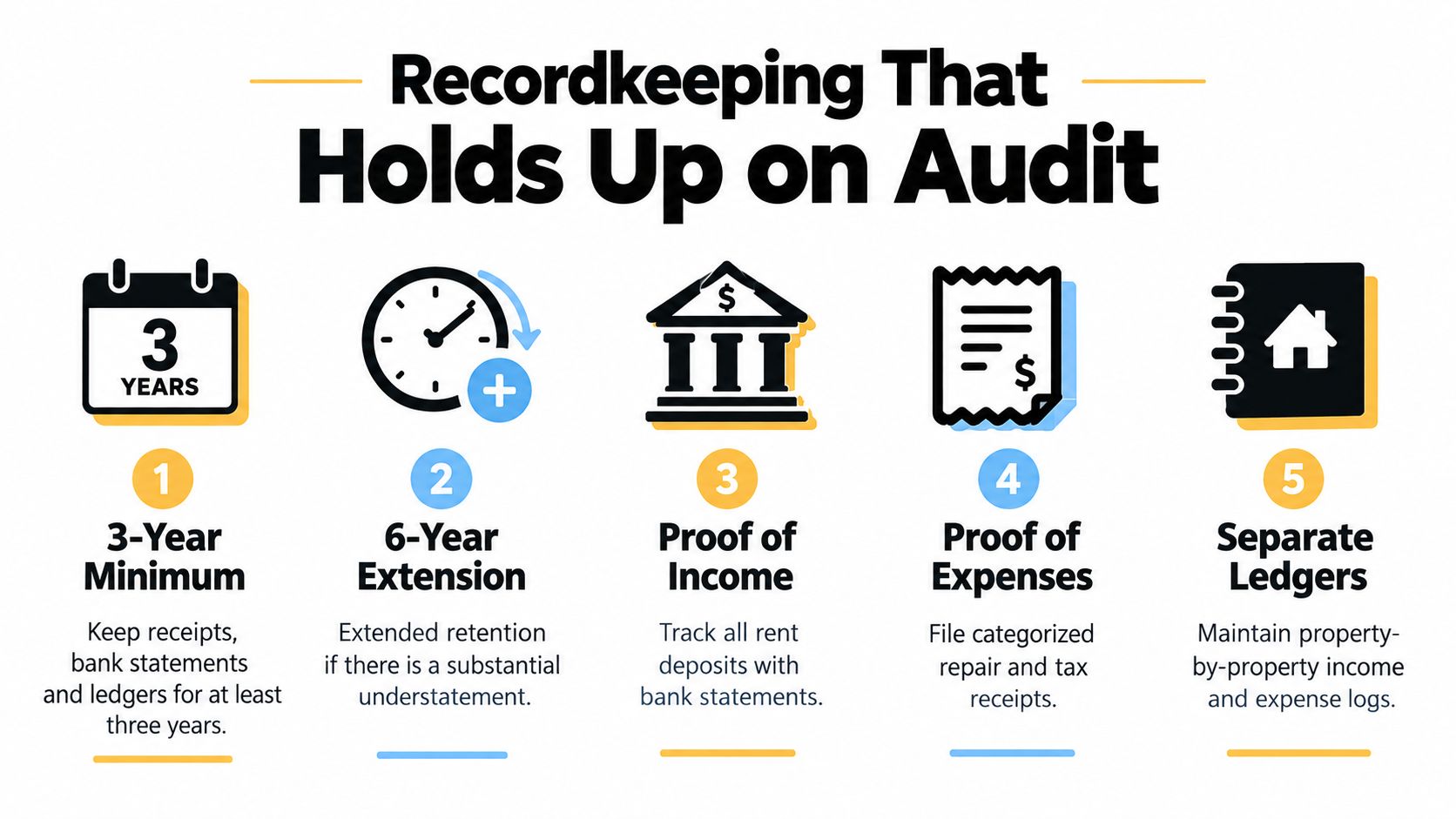
Keep records by property and by category. That means rent ledgers, bank statements, insurance records, tax bills, lender statements, repair invoices, and settlement documents for basis and depreciation. If a charge needs explanation, add a short memo while it's fresh.
The file set that usually matters most
- Income support: tenant ledgers, lease terms, deposit records, bank deposits
- Expense support: invoices, receipts, canceled payments, statements
- Depreciation support: closing documents, asset lists, improvement invoices
- Property separation: a distinct ledger for each rental
Contemporaneous records carry more weight than a spreadsheet rebuilt from memory at filing time.
This walkthrough gives a helpful visual summary of audit-ready habits:
A monthly close is enough for most independent landlords. Reconcile deposits, code expenses, file receipts, and update any asset additions. Then tax season becomes a review process instead of a reconstruction project.
Pre-Filing Checklist and Quick Reference
Before you file, do one verification pass with the form and the ledger side by side. You're checking for completeness, categorization, depreciation support, and consistency with the return.
| Check Item | Corrective Action |
|---|---|
| Property addresses and columns match actual rentals | Correct the header and separate mixed property activity |
| All rent and other rental income is included | Reconcile tenant ledgers and deposits to income lines |
| Expenses are assigned to the right categories | Recode the ledger before finalizing the form |
| Depreciation is included and supported | Update the asset schedule and prepare Form 4562 |
| More than three properties are handled correctly | Attach additional Schedule E pages and combine totals properly |
| Loss treatment has been reviewed | Complete the passive loss work before filing |
| Personal charges are excluded | Remove or allocate mixed-use transactions |
| Schedule E result agrees with the return | Trace the final amount to Form 1040 before submission |
If something doesn't tie out, don't force the return through. The Schedule E instructions work well when the books are right. They're miserable when the books are guessing.
If you want the filing process to feel less manual next year, VerticalRent gives landlords a running income and expense ledger with Schedule E reporting built into the workflow. It's useful when you want rent collection, expense tracking, and property-level records feeding the same year-end tax output instead of assembling Schedule E from scattered files.
Put this into practice
VerticalRent tools related to this guide
Legal Disclaimer
VerticalRent and its authors are not attorneys, CPAs, or licensed legal or financial advisors, and nothing on this site constitutes legal, tax, or professional advice. The information in this article is provided for general educational purposes only. Landlord-tenant laws, eviction procedures, security deposit rules, and tax regulations vary significantly by state, county, and municipality — and change frequently. Nothing on this site creates an attorney-client relationship. Always consult a licensed attorney or qualified professional in your jurisdiction before taking any action based on information you read here.
Co-founded VerticalRent in 2011, growing it from nothing to 100k landlords and renters. Sold it in 2019, then re-acquired it in 2026 to make it better than ever.


