Profit and Loss Statement for Rental Property: 2026 Guide
Learn how to create a profit and loss statement for rental property in 2026. This guide covers key components, tips, and examples for landlords.


The tax deadline is approaching, and your rental records are spread across a bank account, email inbox, paper folder, and a spreadsheet you stopped updating months ago. You know the property collected rent, but you're less certain which repairs were paid, whether the insurance bill was included, or how much vacancy reduced the money you kept.
A profit and loss statement for rental property brings those details into one working document. Built from real transactions and reviewed throughout the year, it shows what the property earned, what it cost to operate, and how much cash remained after the expenses that matter to you as an owner.
Why You Need a Profit and Loss Statement for Your Rental Property
At year-end, many landlords try to reconstruct the property's finances from memory. They search for receipts, download old bank statements, ask contractors to resend invoices, and discover that a personal purchase was paid from the rental account. The result may be enough information to hand to a tax preparer, but it rarely provides a clear view of how the property performed.
A monthly P&L prevents that scramble. It records income and expenses while the transactions are still familiar, so you can investigate a missing receipt or incorrect category before the details disappear. It also separates a simple rent log from the full cost of operating a rental.
Practical rule: A rent total tells you what came in. A P&L tells you what the property actually produced after operating costs.
A management document, not just a tax document
The U.S. tax version of a rental P&L typically feeds Schedule E, where rental real estate income and expenses are reported. The IRS Schedule E instructions identify ordinary and necessary costs such as taxes, interest, repairs, insurance, management fees, agents' commissions, and depreciation as potentially deductible categories.
That makes accurate records important for tax reporting, but the operational value comes first. A property can collect consistent rent while repairs, insurance, utilities, or vacancy steadily consume the margin. A monthly statement exposes that drift before an annual total hides it.
What a useful monthly review reveals
Review each property separately rather than blending every unit into one portfolio total. Look for:
- Collection problems: Rent that was expected but wasn't received.
- Expense movement: A repair or utility category that has started rising.
- Vacancy impact: Empty days that reduce effective income even when the advertised rent looks strong.
- Cash pressure: Mortgage payments, capital work, and other cash outflows that leave less money available than the operating result suggests.
The P&L becomes a financial roadmap. It helps you decide whether to adjust pricing, investigate a recurring repair, build a reserve, or reconsider how a property is managed. It also gives your tax professional organized source data instead of a box of unexplained transactions.

Gathering and Categorizing Your Rental Income and Expenses
Build the statement from actual bank activity, not estimates. Choose a defined period, such as a month, quarter, year to date, or tax year, then gather the documents that prove each transaction.
Start with a complete source file
Collect the rent roll, bank statements, receipts, invoices, mortgage statements, insurance bills, and property tax bills. Include records for owner-paid utilities, management charges, advertising, maintenance, and vendor payments. If tenants pay late fees or other property-related charges, capture those deposits as income rather than leaving them buried in the bank feed.
A dedicated bank account for each property makes this work much easier. It reduces the need to split personal transactions and helps you match deposits and withdrawals to a specific address. If you use one account for several properties, create a property field for every transaction and retain the allocation notes.
Record income when it arrives
For a practical cash-basis P&L, record rent when you receive it. Use clear income categories such as:
- Rent collected: Base rent deposited during the reporting period.
- Late fees: Charges received from residents.
- Other property income: Parking, storage, laundry, pet-related charges, or similar receipts when applicable.
- Security deposits: Track these carefully according to their purpose and local requirements. Don't automatically treat a refundable deposit as earned rental income.
Then categorize expenses consistently. The IRS guidance for Schedule E separates rental income and expenses in Part I and requires an owner of only part of a property to report only that owner's share. That matters for co-investing, partial ownership, and multi-owner portfolios.
Use categories that survive tax preparation
A workable expense list may include property taxes, insurance, mortgage interest, repairs, management fees, agents' commissions, utilities, advertising, and depreciation. Keep principal payments and capital improvements identifiable even when they don't belong in the operating expense total, because both affect the owner's broader cash picture.
Avoid a single category called “property expenses.” It may save a few minutes during data entry, but it forces you or your tax preparer to reconstruct the details later. A dedicated rental property expense tracker can help keep categories and supporting records together.
For landlords with more than three rental properties, the IRS requires multiple Schedule E forms and then combines totals on one Schedule E. A property-level ledger therefore isn't excessive administration. It gives a small portfolio the structure needed for accurate reporting as ownership grows.
Calculating Net Operating Income and Understanding Cash Flow
A cash-basis P&L should make two decisions easier: whether the property is operating well and whether it is producing spendable cash. Start with the core calculation:
Total property income minus operating expenses equals net operating income, or NOI.
Use rent and other collected property income as the starting point. Subtract the costs required to keep the rental running, including taxes, insurance, management, repairs, maintenance, and owner-paid utilities. Keep financing, depreciation, and capital projects on separate lines. That structure preserves NOI as a measure of the property's operations and gives you cleaner figures for Schedule E reporting.
NOI answers a narrower question
NOI measures how the property performs before financing. It does not show how much cash remains for the owner. Mortgage principal reduces the bank balance but is not an operating expense. Mortgage interest may appear in the broader P&L and tax reporting, while financing costs should remain distinct from the operating result.
Vacancy also changes the cash picture. Gross rent assumes full occupancy and complete collection. True cash flow starts with what was received, then subtracts vacancy, operating expenses, debt payments, capital spending, and other cash obligations. A property can show a positive gross profit while producing little cash after an empty unit, a large repair, or a principal payment.
That distinction matters when comparing rental property with other what are income producing assets. The P&L should show whether returns come from daily operations, financing terms, or a non-cash accounting item.
Market data makes local benchmarking necessary
Use market data to decide whether your own operating costs justify a rent change, a larger reserve, or a closer review of vendors. In its analysis of 2022 data, the National Apartment Association reported operating expenses of $17,608 per unit in San Francisco and $5,470 per unit in Las Vegas, a $12,138 per-unit spread. About 96% of analyzed markets recorded year-over-year operating expense increases, including Las Vegas at 16.4%, Norfolk at 14.6%, Orlando at 14.5%, Minneapolis at 11.9%, and Atlanta at 11.0%.
If your per-unit expense sits below the Las Vegas figure or above the San Francisco figure, benchmark it against your own metro before adjusting rent or reserves. The same analysis found NOI ranging from $23,216 in San Francisco to $3,662 in Minneapolis, with the strongest NOI growth in Norfolk at 36%, Dallas at 29.5%, and Salt Lake City at 28.5%. These figures are context, not a forecast.
After calculating NOI, continue down the statement. Subtract mortgage principal, mortgage interest where relevant to your presentation, capital expenditures, and other cash outflows. Use this guide to calculate rental property cash flow when checking the final calculation.
Cash-Basis vs Accrual Accounting for Small Landlords
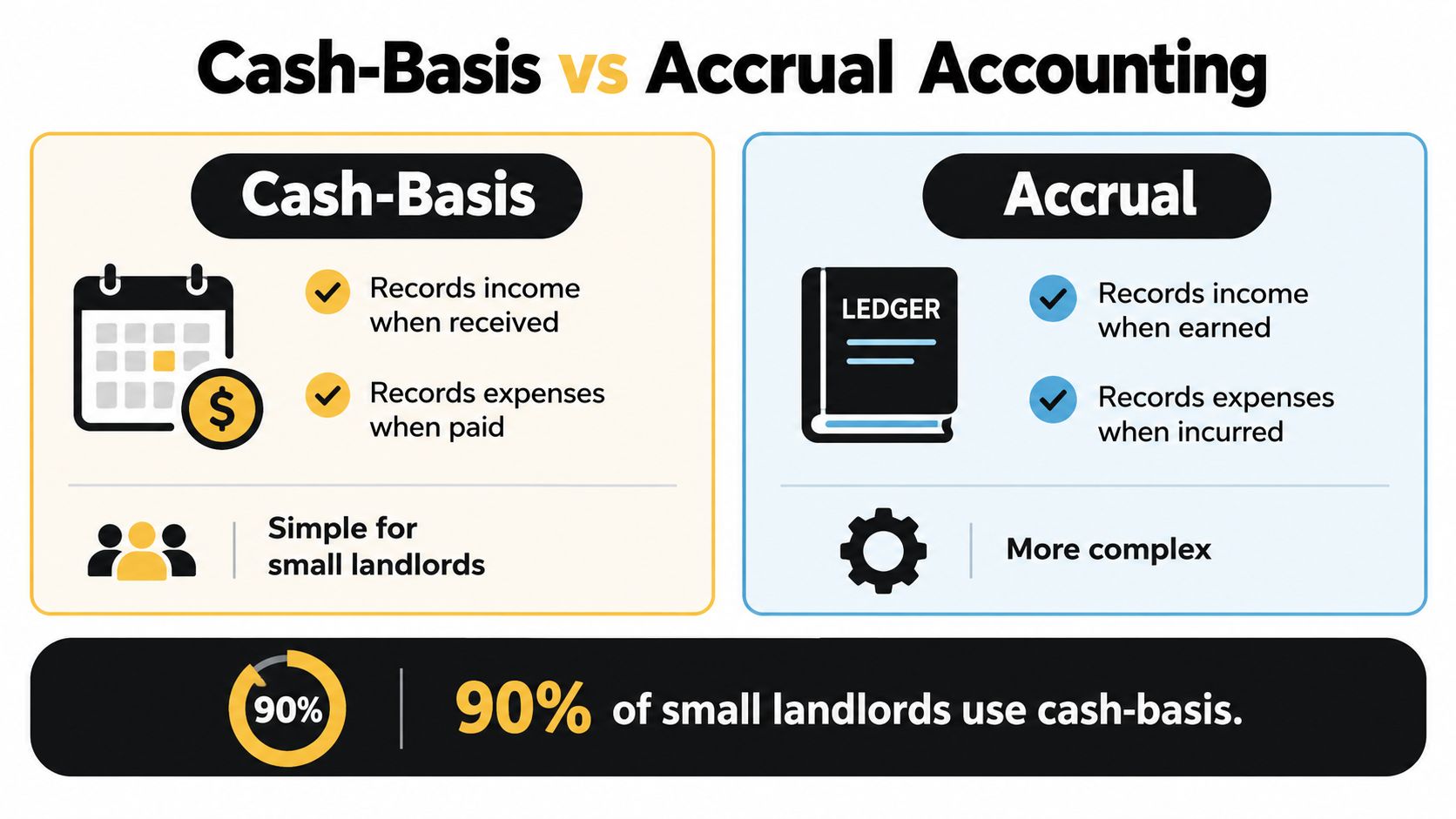
Cash-basis accounting usually fits an independent landlord's daily reality better than accrual accounting. Under cash basis, you record income when the payment reaches you and expenses when you pay them. The statement then reflects the movement of money through the property during the reporting period.
Accrual accounting records income when it's earned and expenses when they're incurred, even if payment happens later. That approach can provide a useful view for larger or more complex operations, but it introduces timing questions that small landlords may not need.
Why cash basis works for a small portfolio
Suppose a contractor sends an invoice near the end of the month but you don't pay it until the following month. Accrual records the expense when the work was incurred. Cash basis records it when the payment leaves your account. Neither method is automatically wrong, but cash basis makes the monthly statement easier to reconcile against your bank balance.
The practical workflow is:
- Set the period: Decide which month or tax year you're reviewing.
- Gather transaction records: Use bank statements, receipts, invoices, rent rolls, mortgage statements, insurance bills, and tax bills.
- Capture received income: Don't count a billed amount that hasn't been collected.
- Map each transaction: Assign a property and a specific income or expense category.
- Reconcile the result: Compare the statement with the bank activity and investigate unexplained differences.
That process reduces timing errors and makes month-to-month variance checks possible. It also produces a cleaner working file for Schedule E preparation.
When another system may be justified
Accrual accounting can make sense when you manage substantial payables, share financial reporting with partners, or need to match obligations to the period in which they arose. The trade-off is added discipline. You'll need to track receivables, payables, adjustments, and timing differences instead of relying primarily on cleared transactions.
A spreadsheet can work if you maintain it consistently. If you're evaluating software, a practical guide to optimizing rental finances with Global offers another way to compare automation and accounting workflows. Choose the method that produces records you can explain, reconcile, and hand off confidently.
Mapping Your P&L to Schedule E and Tax Reporting
A tenant pays late, a repair invoice arrives after month-end, and one property has two owners. Your P&L still needs to show which property earned the income, which expenses were paid, and what portion belongs to each owner. Build the report so every line maps to a Schedule E category instead of transferring one blended portfolio total.
Schedule E Part I reports rental real estate income and expenses. An owner with only part of a property reports that owner's share. Your working file should therefore include the property address, ownership percentage, collected rent, and categorized expenses. The Schedule E rental income tax guide provides a useful filing reference, but your source documents remain the basis for the entries.
Keep repairs separate from improvements
A repair returns an existing item to usable condition. An improvement adds value, extends useful life, or changes the property and may require separate tax treatment. An invoice labeled “maintenance” does not settle the question. Keep the scope of work, service date, amount, and receipts with the transaction.
Putting a capital improvement in repairs inflates current expenses and can lead to corrections later. Other frequent errors include omitting depreciation, mixing personal and rental use, and combining several properties in one reporting column.
Tax-record discipline: Do not let a vague vendor description determine the tax treatment. Preserve enough detail for your tax professional to classify the work correctly.
Treat depreciation as a separate layer
Depreciation is a non-cash deduction. It reduces taxable income without a current cash payment, so it belongs in the tax layer rather than in the operating cash result. Residential rental property is typically recovered over 27.5 years. Keep that recovery schedule separate from rent collections, repairs, debt payments, and other bank activity.
A practical P&L can show operating performance, financing, capital spending, and cash flow in distinct layers. Tax records then add depreciation and other filing classifications. This explains why a property may have positive cash flow but a taxable loss, or show accounting profit that exceeds the cash left after vacancy and unpaid bills.
Before filing, trace every Schedule E category to receipts, statements, and invoices. Confirm the ownership allocation, then investigate differences between the P&L and the filed amounts. Tax treatment depends on the property and your use of it, so ask a qualified tax professional about decisions that do not fit a clear routine.
Advanced Tips for Year-Round Profit and Loss Management
A useful P&L is a living operating report, not a document created once for tax preparation. Review it monthly by property, compare current activity with prior periods, and investigate changes while the evidence is easy to find.
Start with three questions:
- What changed: Did rent collection, vacancy, repairs, or utilities move unexpectedly?
- Why did it change: Was the cost a one-time event, a recurring obligation, or a sign of deferred maintenance?
- What action follows: Should you adjust a lease, inspect the property, change a vendor, or increase a reserve?
Include vacancy in the review. A property can appear cash-flow positive on collected rent while becoming economically weak after empty periods, repairs, and non-cash depreciation are considered. The useful question isn't only “What did I make?” It's “Which costs are temporary, which are recurring, and which units are drifting below break-even after vacancy?”
Automate capture, retain judgment
Property management software can import transactions, connect income and expenses to an address, and produce monthly or tax-year summaries. Automation reduces manual entry, but it doesn't eliminate review. A vendor charge may still need a corrected category, a shared utility may need allocation, and a capital project may require separate treatment.
Modern automated P&Ls can expose month-to-month volatility that a year-end spreadsheet hides. Use the resulting report as a decision tool, not as an unquestioned answer.
Here's a practical review sequence you can repeat:
- Reconcile deposits and withdrawals.
- Confirm every property has been assigned correctly.
- Review vacancy and uncollected rent.
- Separate operating costs from financing and capital spending.
- Flag unusual changes and attach documentation.
- Export or share the cleaned report with your tax professional.
The report becomes valuable when it changes what you do next.
Conclusion - Making Your Profit and Loss Statement Work for You
A rental P&L gives you more than a year-end tax total. It shows how much income each property collected, where operating costs are moving, how vacancy affects performance, and why cash flow may differ from taxable income.
Build it from real transactions, keep properties and categories separate, review it monthly, and preserve the documents behind unusual entries. Then map the cleaned records to Schedule E with professional tax guidance where classification or ownership questions arise.
Start with the most recent month. Reconcile the bank activity, record vacancy, separate repairs from improvements, and create a short list of unexplained transactions. That small reset turns an annual scramble into a repeatable management habit.
VerticalRent tracks rental income and expenses by property, shows P&L results by address, and exports year-end information in a Schedule E format. Visit VerticalRent to organize your rental ledger and make the next monthly review easier.
Put this into practice
VerticalRent tools related to this guide
Legal Disclaimer
VerticalRent and its authors are not attorneys, CPAs, or licensed legal or financial advisors, and nothing on this site constitutes legal, tax, or professional advice. The information in this article is provided for general educational purposes only. Landlord-tenant laws, eviction procedures, security deposit rules, and tax regulations vary significantly by state, county, and municipality — and change frequently. Nothing on this site creates an attorney-client relationship. Always consult a licensed attorney or qualified professional in your jurisdiction before taking any action based on information you read here.
Co-founded VerticalRent in 2011, growing it from nothing to 100k landlords and renters. Sold it in 2019, then re-acquired it in 2026 to make it better than ever.


