Rent Payment Receipt Template and How to Fill It Out
Free rent payment receipt template with every field tenants and tax records need, plus steps to fill it out and send it correctly in 2026.


It's the fifth of the month, and your phone buzzes with a text from Unit 2B asking for a receipt showing last month's rent cleared. You open your banking app, scroll past three utility drafts and a hardware store charge, and find a lump deposit that doesn't match the base rent on the lease. Did that transfer include a late fee from the month before, or did the tenant short you by fifty dollars?
In 2024, the median reported monthly rent among U.S. renters was $1,200, according to the Federal Reserve's Report on the Economic Well-Being of U.S. Households. Across a full year and even a small two- or three-unit portfolio, you're moving tens of thousands of dollars through a checking account. Casual text confirmations won't hold up when a renter disputes a balance or a tax examiner asks where a deposit came from.
A solid rent payment receipt template isn't a polite thank-you note. It's a transaction-control document that links three records together: your bank deposit, your rent ledger, and your annual tax return. When every field is filled out properly, a single page settles payment disputes before they escalate.
Every Field a Rent Payment Receipt Template Needs
A dependable receipt works like a mini accounting entry, not a blank slip with a dollar figure scribbled on it. That structure aligns with NSW Government rent receipt rules, which specify that receipts and rent ledgers should record the recipient, payer, premises address, payment date, amount, and covered rental period. Copy the table below to build a template you can reuse every month.
| Field | What to enter | Example |
|---|---|---|
| Receipt number | Unique and sequential, never reused | RR-2026-0301 |
| Landlord name and contact | Owner of record or managing agent, with a phone or email | Maria Lopez, phone on the lease |
| Tenant name | Every adult named on the lease | Daniel Okafor and Priya Nair |
| Property address | Full unit address including unit number | Cedar Ave, Unit 2B, Austin, TX |
| Date funds received | The day money reached your account, not the due date | 3 March 2026 |
| Rental period covered | Start and end dates of the period paid | 1 March to 31 March 2026 |
| Amount received | Total amount and currency | $1,450.00 USD |
| Breakdown of charges | Base rent kept separate from late fees, utilities and other charges | Base rent $1,400.00; late fee $50.00 |
| Payment method and reference | Bank transfer, card, check or money order, plus transaction ID | ACH transfer, bank confirmation ID |
| Balance after payment | Remaining balance, or paid in full | $0.00, paid in full |
| Issue date and saved copy | Date of issue with timestamp; PDF kept in the unit file | Issued 3 March 2026, 10:42 AM |
Fields That Cause the Most Errors
Four fields account for almost every bookkeeping headache for small landlords. First is the date funds received: entering the first of the month because that's the due date hides late payments and throws off your bank reconciliation. Always record the exact calendar day the funds settled in your account or cash landed in your hand.
Second is the rental period covered. Writing "monthly rent" or "March payment" creates confusion the moment a tenant falls behind by a month and claims a later check covered an earlier balance. Spell out both the start date and the end date every single time.
Third is the charge breakdown. Folding a $50 late fee or a utility reimbursement into one $1,450 "rent" line makes your ledger look like you raised rent mid-lease and muddies non-rent income at tax time. Finally, lock down a sequential receipt numbering pattern such as RR-2026-0301 (prefix, year, month, sequence). Never reuse a number, even if a check bounces or you make a typo, because gaps or duplicates raise immediate red flags during a review.
Copy-Ready Single-Page Layout
You can paste the layout below into Google Docs, Microsoft Word, or a spreadsheet and export each finished receipt as a PDF. Here's how a $1,450 March payment with $1,400 in base rent and a $50 late fee looks when filled in cleanly:
Header Block Receipt No.: RR-2026-0301 Landlord / Agent: Maria Lopez (phone on the lease, maria@example.com) Received From: Daniel Okafor and Priya Nair
Payment Block Property Address: Cedar Ave, Unit 2B, Austin, TX Date Funds Received: 3 March 2026 Rental Period Covered: 1 March 2026 to 31 March 2026 Payment Method and Reference: ACH transfer, bank confirmation ID
Charge Breakdown Base Rent (1 March to 31 March 2026): $1,400.00 USD Late Fee: $50.00 USD Total Amount Received: $1,450.00 USD
Balance and Issue Line Balance Remaining After Payment: $0.00 (Paid in full) Issued By: Maria Lopez | Issued 3 March 2026, 10:42 AM | Saved Copy: Unit2B_RR-2026-0301.pdf
A receipt that cannot be matched to one bank transaction is not finished.
How to Issue and Send Each Receipt Step by Step
Digital transfers handle a huge share of monthly rent now, yet paper payments haven't disappeared. In 2025, online rent payments represented 51% of payments, based on Rentec Direct's rent payment data analysis of more than $21.8 billion in rent collected from January 2014 through October 2025. Whether you accept checks or use a portal for collecting rent payments online, a payment notification from an app doesn't replace a verified receipt. Each receipt you issue is one link in an audit trail, and it only protects you if it ties back to the bank deposit, the ledger entry, and eventually the tax return.
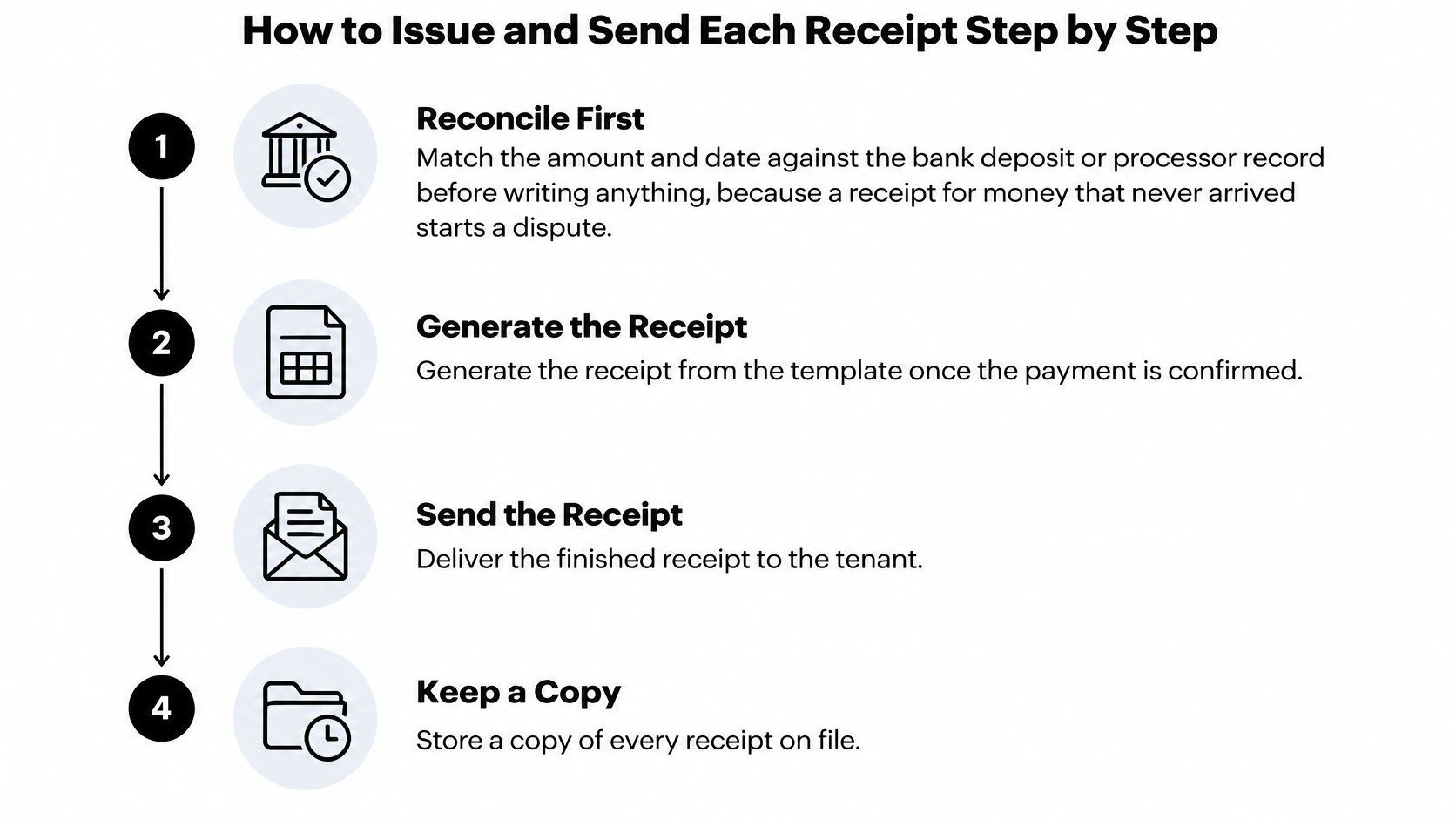
Follow this repeatable sequence every time money arrives so your records stay tight from deposit to archive.
- Reconcile against the bank or payment processor first. Check that the exact dollar amount and arrival date appear in your checking account or merchant payout report before you write anything. This comes first because issuing a receipt for a pending transfer or an uncleared check hands the tenant proof of payment for money you haven't received. The classic slip here is firing off a confirmation email as soon as a tenant texts a screenshot of a bank transfer.
- Generate the receipt directly from your rent ledger. Post the cleared deposit to your unit ledger first, then pull the amount, covered dates, and remaining balance straight from that ledger row into your template. Doing the ledger first guarantees both documents agree to the penny. Never retype amounts from memory while rushing between errands, because one transposed digit creates an instant mismatch.
- Verify every mandatory field against the lease. Before exporting the PDF, confirm that the tenant names, unit number, rental period, itemized charges, and paid-in-full or partial status match the active lease terms. Checking before you hit send prevents awkward corrections later and stops you from accidentally applying a payment to the wrong unit when you own multiple doors.
- Deliver the receipt through a durable channel. Email the finished PDF as an attachment or post it to a tenant portal where both parties can download it later, and log the exact send date. Avoid texting a cropped phone screenshot of a spreadsheet. Screenshots cut off timestamps, get buried in message threads, and fail to show a clean document trail if a dispute surfaces six months later.
- Archive the receipt alongside the underlying payment evidence. Save the timestamped PDF in a dedicated folder for that unit together with the bank statement line, check image, or processor payout confirmation, and keep your ledger ready to export on demand. When a tenant later claims they paid a month you show as unpaid, this bundle is what settles the argument in minutes rather than weeks.
Retention Benchmarks and Ledger Exports
Treat tenant record requests like a measurable service standard rather than an annoyance. Under NSW Government rent record guidelines, landlords and agents must maintain rent records and provide a copy of the ledger within 7 days after a tenant's written request.
Even if your state or country sets a different timeline, adopt that seven-calendar-day maximum as your personal operating rule. When your PDFs and ledger live in organized unit folders, exporting a clean history takes five minutes instead of a stressful weekend digging through old emails.
Your monthly quality benchmark is straightforward: 100% completion of every mandatory identifier on each receipt, paired with zero unexplained differences between your issued receipt totals, your rent ledger, and your deposited bank funds. Hit both numbers every month and your receipts stop being courtesy slips. They become the evidence chain that carries you through a dispute, an audit, or a tax review.
Receipts for Partial, Late, Returned and Prepaid Rent
Standard full-month payments are easy. The trouble starts when a tenant pays half now and half Friday, pays three months ahead, or sends a check that bounces four days later.
To document those exceptions accurately, start with how tax timing works. IRS Topic 414 explains that most individual landlords operate on the cash basis: you generally count rental income when you constructively or directly receive it, and you deduct expenses when you pay them. The IRS also notes that uncollected rent is not deductible as an expense for a cash-basis landlord because you never included it in income in the first place.
That cash-basis rule is why the actual received date on your receipt matters more than the calendar month printed on the lease. If rent is due on January 1 but arrives on January 5, or if January rent lands in your bank account on December 30, the receipt date establishes which tax year owns that income. Schedule E requires records supporting the rents you report, and without them you may have to reconstruct bank statements or risk additional tax and penalties.
| Scenario | How to record it |
|---|---|
| Full rent paid on time | One receipt for the rental period |
| Partial payment | Apply to the oldest unpaid period and show the remaining balance |
| Payment after due date | Record the actual received date; late fee on its own line |
| Returned or bounced payment | Mark the original receipt void with the reason; do not delete it |
| Prepaid rent | Receipt covers future months; the received date stays today |
| Security deposit | Separate deposit receipt, never folded into rent |
Handling Deposits and Partial Payments Without Muddy Ledgers
Security deposits deserve their own clean lane. A deposit is held in trust or under local holding rules rather than earned as monthly rent, so mixing it onto a first-month rent receipt inflates your apparent rental income and confuses move-out accounting. Just as group organizers use dedicated planners to collect hen party deposits easily without tangling individual contributions into general expenses, landlords should issue a standalone deposit receipt that stays completely separate from monthly rent.
Partial payments need just as much precision. Say your tenant owes $1,400 for April rent and sends $900 on April 2. Your receipt must apply that $900 to the oldest unpaid period (1 April to 30 April), state $500.00 remaining balance clearly, and note the next due date rather than marking April paid. Reviewing clear guidelines on handling partial rent payments as a landlord helps you stay consistent before you accept short funds.
Write your payment-allocation order directly into your lease agreement, specifying whether partial payments satisfy past-due base rent first or accrued fees first. A receipt can only document the rule your lease already sets; it can't invent a policy mid-dispute.
Cash-basis reality: When a tenant pays January rent on December 29, your receipt must show December 29 as the received date and January 1 to January 31 as the covered period so your year-end tax totals match your bank deposits.
Mistakes, Disputes and Tax Records
Consider a common scenario: a landlord managing three units gets a message from a tenant insisting February rent was paid on time, even though the landlord's checking account shows a missing deposit. Without dated receipts tied to covered periods, the conversation turns into dueling memories and cropped screenshots. With a sequential receipt history showing the exact received date and rental period for January and March, plus a clear gap for February, the question gets settled on one page.
The same discipline protects you at tax time. Here's how a clear handoff and consistent documentation look in daily practice.

According to IRS rental real estate recordkeeping guidance, rental income covers any payment received for the use or occupation of property, and landlords generally report rental income and expenses for each property on Form 1040 Schedule E. The IRS states that good records help property owners monitor performance, prepare financial statements, identify the source of receipts, track deductible expenses, prepare tax returns, and support reported figures during an examination. Documentary evidence such as receipts, canceled checks, and bills backs up those entries. When you pair clean income logs with expense records for Schedule E, you can see LendingXpress's 2026 deduction breakdown to make sure repair bills, insurance, and depreciation categories line up cleanly with your annual reporting.
Most landlords think fixing a typo on a sent receipt is harmless. You open the Word document, change the date or dollar amount, hit save over the old file, and email the updated version. That habit is one of the fastest ways to wreck your credibility in a dispute or audit, because two different versions of the same receipt number now exist in the wild.
Six Recordkeeping Mistakes That Trigger Disputes
- Overwriting a corrected receipt: Editing a previously issued file erases your audit trail. Instead, leave the original PDF intact, mark it void or reversed with the date and reason, and issue a brand-new receipt number that explicitly references the original number.
- Leaving out the issue timestamp: A date alone isn't enough when two payments or a reversal happen on the same day. Stamp both the calendar date and exact time on every saved PDF so the sequence of events stays indisputable.
- Combining rent with fees or deposits on one line: Bundling $1,400 in rent and a $50 late fee into one unlabeled $1,450 entry invites arguments over whether rent increased and distorts non-rent income tracking. Put each charge on its own line.
- Writing "monthly rent" without exact dates: Generic labels let a tenant argue that a May transfer covered April arrears. Always spell out the full start and end dates covered by the funds.
- Recording cash without a signed receipt: Cash creates no bank trail on its own. Count the bills in front of the tenant, hand over a signed receipt immediately, log the entry into your ledger the same day, and deposit the cash promptly so the bank slip matches the receipt amount.
- Deleting tenant files after move-out: Clearing old folders once keys come back leaves you exposed years later. Keep rent receipts, ledgers, and supporting payment records through the applicable tax limitations period, including property records relevant to the year you eventually sell or dispose of the property.
How a Complete Paper Trail Resolves a Late Fee Claim
Say a tenant disputes a $50 late fee from May, claiming they paid before the grace period closed and that you double-charged them on a corrected invoice. Because you never overwrite old receipts, you pull three documents in two minutes: the original receipt showing the bank arrival date past the grace period, the replacement receipt issued after an address typo (citing the original number and reason), and the matching row from a structured rent ledger example displaying the exact same $50 fee and running balance. Every number agrees across all three records, ending the disagreement calmly.
If you want a quick walkthrough of how to keep those rental records organized alongside your receipts, watch this short overview.
Don't wait for a dispute or an IRS letter to find gaps in your files. Build a five-minute check into the end of every month.
Monthly audit habit: Pull your last three issued receipts today and verify that each one carries a timestamp, exact start and end dates, and a dollar-for-dollar match to your bank statement.
Pick a Receipt System for Your Next Rent Cycle
Choosing between a manual document template and software comes down to three practical factors: how many units you manage, how many tenants pay with cash or paper checks, and how reliably you reconcile your checking account each month.
A manual template in Google Docs or Excel works well for one or two units paid strictly by bank transfer, provided you lock down your numbering rule and sit down to reconcile once a month. The main bottleneck isn't typing the receipt; it's manually cross-checking every single receipt against your bank deposits without letting a month slip by.
Once volume climbs, manual matching turns into unpaid clerical work where typos creep in. Software removes that bottleneck, as long as its generated receipts and ledger still tie cleanly back to each bank deposit. With VerticalRent, tenants set up autopay once so rent is collected automatically every month, every payment automatically generates a receipt for the tenant and is logged to the landlord's income ledger, and every rent payment is automatically recorded as rental income in the Schedule E category with no manual entry.
Here's a clean decision rule I would follow: if you manage more than three units or accept any cash payments, automate your collection and receipt workflow. If you manage one or two units paid solely by bank transfer, a strict PDF template paired with a monthly ledger reconciliation is usually enough to stay audit-ready.
Run a One-Unit Test Next Month
Before moving your whole portfolio, run next month's rent for one unit through your chosen template or platform and check three specifics once funds settle:
- Confirm the receipt number sequence incremented cleanly with no duplicates or skipped entries.
- Verify the ledger line matches your bank deposit to the exact cent and settlement date.
- Ask the tenant to confirm they received and opened their copy through your chosen delivery channel.
Lock in these four setup items before your next due date arrives:
- Numbering rule written down: Document your format (such as RR-YYYY-MMNN) at the top of your ledger so you never improvise.
- Reconciliation day fixed: Put a recurring calendar block two days after your grace period ends to match deposits against receipts.
- Template or platform chosen: Commit to either your standardized PDF file or an automated rent collection tool for the coming cycle.
- First reconciliation date set: Pick the exact calendar date this month when you'll run your first three-way check across bank, ledger, and receipts.
If you'd rather skip hand-matching deposits and typing PDFs every month, VerticalRent connects online rent collection, automatic tenant receipts, income ledgers, and Schedule E categorization in one place built for independent landlords. Visit VerticalRent to see how automated rent collection and instant receipt logging can clean up your next rent cycle.
Put this into practice
VerticalRent tools related to this guide
Legal Disclaimer
VerticalRent and its authors are not attorneys, CPAs, or licensed legal or financial advisors, and nothing on this site constitutes legal, tax, or professional advice. The information in this article is provided for general educational purposes only. Landlord-tenant laws, eviction procedures, security deposit rules, and tax regulations vary significantly by state, county, and municipality — and change frequently. Nothing on this site creates an attorney-client relationship. Always consult a licensed attorney or qualified professional in your jurisdiction before taking any action based on information you read here.
Co-founded VerticalRent in 2011, growing it from nothing to 100k landlords and renters. Sold it in 2019, then re-acquired it in 2026 to make it better than ever.


