IRS Schedule E Instructions for Rental Owners
IRS Schedule E instructions for landlords: report rent by property, sort expenses and depreciation, and learn when a loss will not lower tax.


You've totaled the rent, downloaded the mortgage statement, and sorted the repair receipts. Your spreadsheet shows a rental loss, so you expect your taxable income to fall. Then the tax software produces a different result, and you're left wondering whether you entered something incorrectly.
The IRS Schedule E instructions address the reporting task, but reporting a loss and deducting it are different jobs. Start with accurate records for each property, then determine whether the ownership, depreciation, at-risk, and passive-loss rules allow the result you expect.
What Schedule E Reports for Each Rental
Say you own a duplex and also rent a furnished room in your home. You add the deposits together and prepare to enter one combined rent figure. That total might reconcile to your bank account, but it doesn't preserve the property detail needed for the return.
Schedule E is an attachment to an individual income tax return, not a separate rental-business return. The IRS Schedule E instructions provide columns A, B, and C for up to three properties and direct taxpayers to report additional properties using the same format. Its results ultimately feed into Form 1040.
For a typical independent landlord, the working area is Part I. It covers rental real estate, personal property leased with the real estate, and a rented room or other space. Furniture supplied with a rental doesn't turn that property's rent into an unrelated reporting activity.
Put each activity in the right place
Where rental and related income goes on Schedule E
| Part | What it reports | Typical source | Small-landlord note |
|---|---|---|---|
| Part I | Rental real estate and royalties | Property ledger of rent, expenses, days, and depreciation | Use a separate property column |
| Part II | Partnerships and S corporations | Schedule K-1 | Don't rebuild these amounts from the rental checkbook |
| Part III | Estates and trusts | Schedule K-1 | Report the fiduciary share, not the underlying building ledger |
| Part IV | REMIC residual interests | REMIC statement | Separate from ordinary rent on a house or apartment |
| Part V | Summary of income or loss | Totals from the earlier parts | Feeds into the individual return; losses use parentheses |
The distinction matters when your portfolio includes both directly owned property and an interest in a rental partnership. The underlying assets may all be buildings, but you don't report every building through your personal property ledger.
For a hypothetical property with an annual loss of $4,800, the loss would appear as ($4,800) rather than as a positive expense total. Keep the calculation behind that result, including the income ledger, invoices, and depreciation schedule.
Practical rule: Identify the owner and activity before choosing the expense category.
Begin your tax folder with an address list, ownership shares, and activity types. Keep property-specific support rather than relying on a portfolio-wide profit-and-loss statement, because an examiner may ask how you arrived at a particular property's reported amounts.
Property-tax planning belongs in that supporting workflow, too. For Texas owners reviewing assessed values, INTELLI's resource on protesting rental property valuations in Texas provides useful context for a separate task: challenging the valuation behind the tax bill, rather than deciding where to report the expense.
How Co-Owners Split Schedule E Reporting
The deed tells you who owns the property. It doesn't, by itself, settle how every owner should report the rental activity.
A sole owner generally reports the directly owned rental through the property's own Schedule E column. With co-owners, first identify whether you have shared ownership, a community-property arrangement, or an entity treated as a partnership.
Match the reporting method to the arrangement
| Ownership arrangement | Reporting approach to resolve | Records to keep |
|---|---|---|
| Sole ownership | Direct property reporting | Property ledger and ownership documents |
| Spouses with community property | Coordinate state ownership rules with federal filing status | Deed, state-law treatment, and return allocation |
| Partnership or entity taxed as a partnership | Entity reporting followed by owner-level Schedule K-1 reporting | Entity return, K-1, and owner-level adjustments |
| Eligible qualified joint venture | Divide reportable items according to the spouses' interests | Election support, allocation worksheet, and participation records |
A partnership's rental expenses shouldn't be deducted again through the owners' personal property columns. The owner reports the appropriate pass-through amounts rather than creating a duplicate set of deductions from the same checkbook.
Marriage doesn't automatically establish a qualified joint venture. Under IRS Publication 925, the election requires spouses filing jointly who jointly own and operate the business and both materially participate; they divide income, deductions, gains, losses, and credits according to their interests.
Consider a hypothetical eligible arrangement with a 60/40 ownership split, $21,600 of rent, and $12,000 of expenses. The larger share would receive $12,960 of rent and $7,200 of expenses; the other share would receive $8,640 and $4,800, respectively.
That arithmetic comes after eligibility, not before it. If one spouse approves tenants, signs leases, and coordinates repairs while the other merely appears on the deed, you shouldn't assume both satisfy the participation requirement.
Rental real-estate income is generally outside self-employment tax, but that doesn't eliminate passive-loss questions. Nor does a joint-venture election automatically produce a better tax result.
Match the return to both the legal owner and the person who operates the rental. Keep dated management records so the filing position rests on documented work, not a recollection assembled during tax preparation.
How to Complete Schedule E Part I
Use a separate annual worksheet for each address. A hypothetical single-family rental charging $1,800 a month is a useful starting point, but the rent agreement alone won't establish what belongs on the return.
The IRS rental-property guidance calls for property-level income, expenses, depreciation on line 18, and additional schedules when needed, with combined totals for lines 23a through 26 appearing on only one schedule.
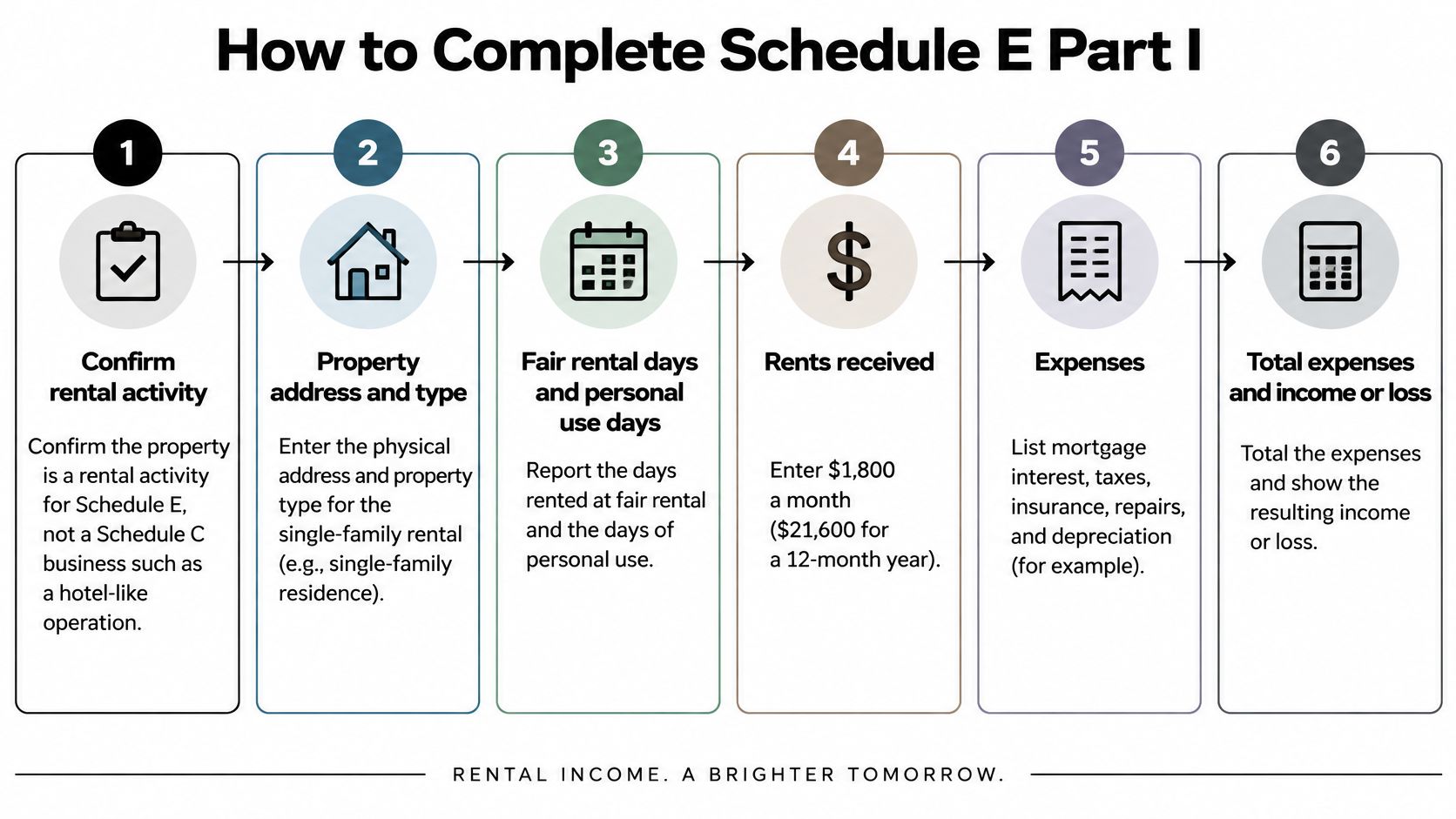
This process graphic shows the main entry sequence.
Work from classification to reconciliation
Confirm the activity belongs on Schedule E. An ordinary residential rental isn't the same reporting situation as a hotel-like operation providing substantial services. Resolve that classification before entering expenses, especially if you provide services during guests' stays.
Enter the property's physical address and property type. Then enter the day counts for that address. For tax year 2025, the IRS instructions require both fair-rental days and personal-use days for each listed property.
Reconcile rent received or constructively received. In the hypothetical example, twelve payments of $1,800 produce $21,600 of gross rent. Compare that calculation with the tenant ledger rather than assuming the lease amount equals collections.
For a cash-method landlord, rent for December that isn't received or made available until January ordinarily belongs to the receipt year. A security deposit applied to unpaid rent also needs an income entry when its treatment changes. Don't count only bank deposits and overlook noncash settlements.
Allocate shared expenses when you personally used the property. Mortgage interest, insurance, taxes, and utilities may require a rental-versus-personal allocation. Keep the calculation with the day-count record rather than reducing expenses without explanation.
Enter operating expenses in their matching categories. Preserve the difference between routine repairs and capital work. A contractor's invoice labeled maintenance doesn't settle the tax treatment if the actual work replaced a major building component.
Bring in the current-year depreciation calculation and attach the depreciation form when required. Don't use the mortgage payment, purchase price, or outstanding loan balance as a substitute for the asset schedule.
Calculate the property's income or loss, then repeat the property worksheet for every other address. Keep each column tied to its own ledger even when all rent flows through one bank account.
Add supplementary schedules when the property columns are full. Consolidate the designated totals only once. Otherwise, the same income or deductions can be counted again when the return combines the schedules.
Reconcile the finished entries to deposits, invoices, and the annual ledger. Investigate differences before accepting the software's final calculation.
Check the common entry failures
- Merged properties: A correct portfolio total doesn't establish the correct result for each address.
- Missing day counts: A blank calendar field isn't a substitute for confirming how the property was used.
- Personal costs: Owner-paid doesn't necessarily mean rental-deductible.
- Missing depreciation documentation: A completed income worksheet doesn't replace a required asset calculation or attachment.
Before leaving the worksheet, check that every property column agrees with its own annual ledger. That's a stronger control than checking only whether the overall refund looks reasonable.
Where Common Rental Expenses Go
A repair and an improvement can come from the same contractor, on the same invoice, and require different tax treatment. Judge the work performed, not the vendor's name or the payment method.
For example, a hypothetical faucet repair costing $275 may keep an existing fixture working. A hypothetical $14,000 roof replacement generally creates a capital expenditure instead of an immediate repair deduction. A kitchen remodel or replacement heating and cooling system deserves the same capital-work review.
IRS Publication 527 identifies ordinary and necessary rental costs such as insurance, management fees, commissions, taxes, interest, and repairs. It also separates depreciation from operating expenses, so a single catch-all maintenance category won't produce a reliable tax worksheet.
Give each receipt a destination
Schedule E lines for common landlord costs
| Cost | Schedule E treatment | Example | Do not include |
|---|---|---|---|
| Gross rent | Income, rents received | Hypothetical monthly rent collected from a tenant | Refundable security deposits still owed to the tenant |
| Advertising | Deductible operating expense | Listing photography or an advertisement for the rental | The purchase price of the building |
| Insurance | Deductible operating expense | Landlord coverage attributable to the rental | Personal homeowner coverage on a residence that wasn't rented |
| Management and commissions | Separate operating-expense categories | Property-management charges or a leasing commission | A capital improvement bundled into a contractor invoice |
| Mortgage interest | Bank mortgage interest separate from other interest | Interest supported by the lender statement | Principal payments or refinance proceeds |
| Repairs | Repairs category | Fixing an existing faucet or patching localized damage | A replacement roof or substantial remodel |
| Taxes and utilities | Their respective expense categories | Property taxes and owner-paid rental utilities | Utilities the tenant paid directly to the provider |
| Improvements and furnishings | Capital-asset review and applicable depreciation reporting | Replacement building components or rental furniture | An unsupported full deduction disguised as a repair |
Advertising, rental-related travel, cleaning, legal and tax-preparation services, supplies, and other operating costs also need their own classifications. Use the form's category names in your bookkeeping file so the year-end transfer doesn't require recoding every transaction.
Separate spending from deductions
Consider a hypothetical annual expense stack: $6,200 of mortgage interest, $2,400 of property taxes, $1,150 of insurance, $1,800 of repairs, $900 of utilities, and $1,200 of management fees. Those expenses total $13,650, before depreciation or any other allowable items.
That example deliberately excludes loan principal. Paying down debt changes your cash position, but it doesn't turn principal into an operating deduction. Likewise, refinance proceeds aren't rent merely because they arrive in the rental bank account.
A refundable security deposit also needs separate handling. While you remain obligated to return it, don't treat it as ordinary rent; review the income treatment if you later retain it for damage or unpaid rent.
Keep the evidence: Save an invoice that describes the repair, not just a card receipt showing the amount paid.
For a broader category checklist, use the landlord tax deductions guide for Schedule E. Code each receipt to one property and one expense destination, and flag mixed invoices for review before posting them.
How Depreciation Reaches Line 18
Buying a rental doesn't make the entire purchase price an immediate deduction. You need a supported asset basis, an allocation between land and depreciable property, and a documented date when the rental became ready and available for use.
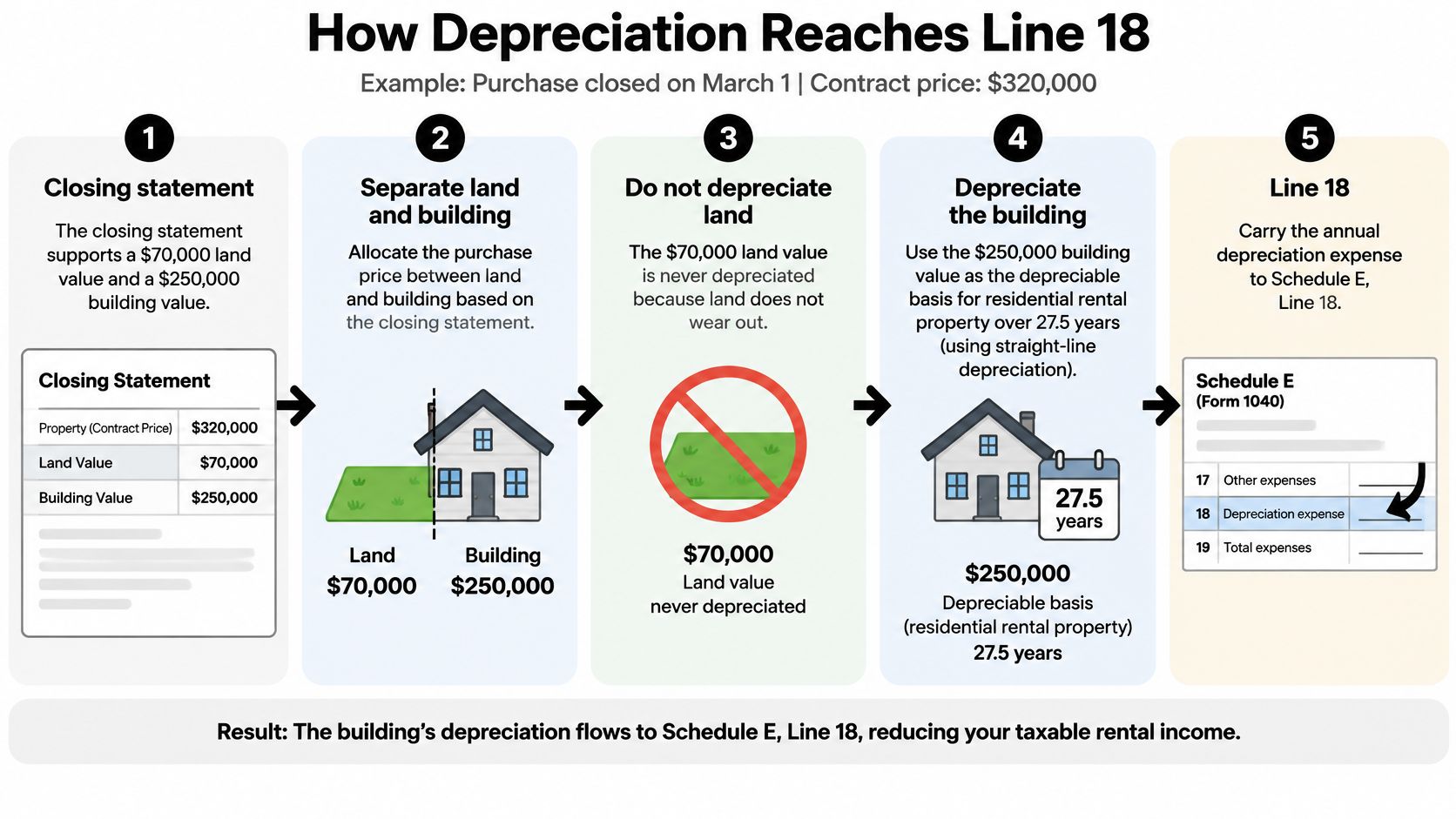
Consider a hypothetical purchase closed in March for $320,000, with a supported allocation of $70,000 to land and $250,000 to the building. The building allocation is the starting point for the depreciation calculation, not the full contract price.
The graphic illustrates that separation and the reporting destination.
Establish the asset before calculating the deduction
The IRS depreciation guidance in Publication 527 requires determining depreciable basis, excluding land, identifying the placed-in-service date, applying the appropriate method and recovery period, and reporting the annual deduction on Schedule E line 18, with Form 4562 when applicable.
Placed in service means ready and available for rent, not purchased. In the hypothetical purchase, if renovations prevent the house from being available until May, use the availability date rather than the March closing date.
Later assets need their own records. A refrigerator installed after the building becomes available shouldn't disappear into an undifferentiated repairs total. Record its cost, description, installation date, business use, and applicable tax treatment separately.
Use Publication 527's applicable tables and instructions for the recovery period and first-year calculation. Don't divide the building cost by an assumed period and claim the resulting full-year amount without checking the placed-in-service convention.
Make the documents agree
- Closing documents: Support acquisition costs and the land/building allocation.
- Fixed-asset register: Identify the building and later additions separately.
- Depreciation form: Reflect the applicable calculation and required disclosures.
- Rental schedule: Agree with the current-year deduction from the asset records.
The closing statement may establish total consideration without establishing a defensible land value. If so, retain the additional allocation support rather than treating a convenient split as documented fact.
For another explanation of the calculation workflow, use the rental property depreciation guide. Keep the asset schedule beyond the filing season because depreciation reduces adjusted basis and affects a later sale or exchange.
This video offers an additional walkthrough of the depreciation topic.
Don't depreciate land, treat a replacement roof as an ordinary repair, or claim the personal-use portion as rental depreciation.
Mixed-use properties require particular care. A rental-use allocation may affect the deduction, but a simple day-count fraction doesn't resolve every vacation-home limitation. Preserve the calendar and have the complete use pattern reviewed.
Why a Schedule E Loss May Not Lower Tax
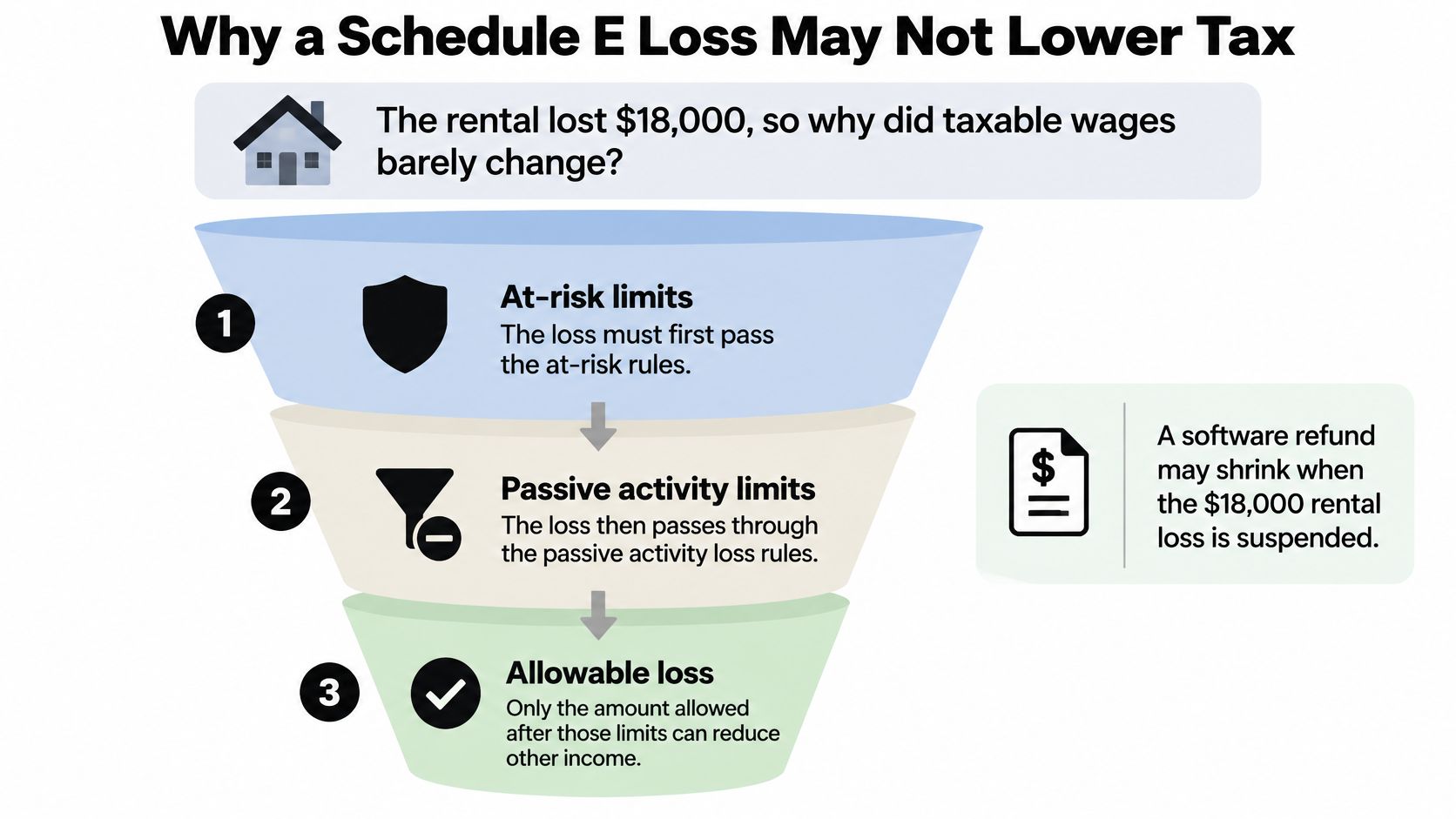
Say your hypothetical rental produces an $18,000 loss, but your taxable wages barely change. That result doesn't necessarily mean the software ignored your expenses. It may mean the loss wasn't currently deductible against your other income.
Accurate books establish the rental result. Separate tax rules determine whether you can use it. The IRS Schedule E instructions describe the loss limitations and the special allowance of up to $25,000, which phases out when modified adjusted gross income exceeds $100,000 and generally disappears at $150,000.
The funnel shows why the reported loss and the allowable deduction can differ.
Apply the limits in the correct order
Start with the at-risk rules, then apply the passive-activity rules. Don't assume the balance on a mortgage statement establishes the amount at risk, because debt treatment depends on the financing and applicable exceptions.
Rental activities are generally passive. A remaining passive loss normally offsets passive income rather than wages, unless an exception permits another result. The special allowance requires eligibility, including active participation, and its income phaseout can prevent an otherwise accurate rental loss from reducing employment income.
Limits applied after the Schedule E loss
| Limit | Where it is applied | Planning rule | What the landlord sees |
|---|---|---|---|
| At-risk | Before passive-loss rules | Deduction limited by amounts at risk | An excess loss may be deferred |
| Passive activity | Passive-loss computation, often Form 8582 | Rentals are generally passive | The loss doesn't automatically offset wages |
| Active-participation allowance | Special allowance computation | Participation and income tests apply | An eligible loss may offset other income |
| MAGI phaseout | Modified adjusted gross income calculation | The allowance declines as applicable income rises | Less current deduction despite unchanged property books |
| Married filing separately | Filing-status-specific computation | Different, more restrictive rules apply | Don't assume a standard allowance |
| Real estate professional | Professional-status and participation analysis | Qualifying status and material participation are separate requirements | Nonpassive treatment may be available |
This isn't a table of newly established future-year amounts. Confirm the instructions for the return you're preparing rather than assuming a planning worksheet settles eligibility.
Track what remains suspended
A qualifying real-estate professional must also address material participation. Separate rental interests generally require separate activity analysis unless a valid grouping election applies. Managing repairs enthusiastically doesn't, by itself, establish an exception.
Prior-year suspended losses need their own rollforward. Entering them into software doesn't make them deductible; the return still has to determine whether current income or another qualifying event permits their use.
Refinancing deserves careful review, too. Cash received from a loan doesn't automatically create deductible losses or establish additional amounts at risk. For pass-through ownership, owner-level basis limitations may present a separate obstacle before other loss tests.
Use the passive activity loss rules guide to organize the questions, then reconcile the carryforward with the completed return.
The central warning is straightforward: perfect transaction categories can still produce a nondeductible current-year loss. Profitable rentals can require additional analysis as well, including whether rental income belongs in the net investment income tax calculation.
Match the Records Before You File
Before submitting the return, assemble a review packet for each address. A spreadsheet total is a starting point, not the supporting evidence.
Complete the property tie-out
- Rent: Match the tenant ledger to deposits and explain retained deposits, credits, and noncash settlements.
- Expenses: Match deductions to receipts and invoices, with capital work separated from operating costs.
- Use: Match rental and personal-use entries to a dated calendar.
- Depreciation: Match the reported deduction to the fixed-asset register and any required depreciation attachment.
Keep closing statements, loan documents, and prior asset schedules alongside the annual records. Add the prior-year passive-loss carryforward, ownership allocation, and participation documentation so the preparer doesn't have to reconstruct them from scattered files.
Resolve the deduction questions separately
Ask a tax professional to review suspended losses, uncertain spousal participation, refinancing complications, or a property sale. Those issues require more than a corrected expense category.
For the year ahead, record transactions by property when they happen. A spreadsheet can work if you consistently attach support and reconcile it; our VerticalRent ledger offers another option, with rent payments recorded automatically and the AI Expense Categorizer mapping receipts to Schedule E categories and logging them to the ledger.
Keep the responsibilities distinct: bookkeeping supports the reported result; tax analysis supports the deduction. Before filing, confirm that someone has reviewed both, especially when the rental shows a loss you expect to offset other income.
Our Platinum plan includes the AI tax summary and Schedule E export, helping you organize property records for return preparation. Visit VerticalRent to set up your property ledger and prepare a clearer year-end handoff to your tax professional.
Put this into practice
VerticalRent tools related to this guide
Legal Disclaimer
VerticalRent and its authors are not attorneys, CPAs, or licensed legal or financial advisors, and nothing on this site constitutes legal, tax, or professional advice. The information in this article is provided for general educational purposes only. Landlord-tenant laws, eviction procedures, security deposit rules, and tax regulations vary significantly by state, county, and municipality — and change frequently. Nothing on this site creates an attorney-client relationship. Always consult a licensed attorney or qualified professional in your jurisdiction before taking any action based on information you read here.
Co-founded VerticalRent in 2011, growing it from nothing to 100k landlords and renters. Sold it in 2019, then re-acquired it in 2026 to make it better than ever.


