What Is Fee Splitting? a Landlord's Guide to Shared Fees
Find out what is fee splitting for landlords, how Stripe routes shared payments, and the legal limits to check before you split any fee.


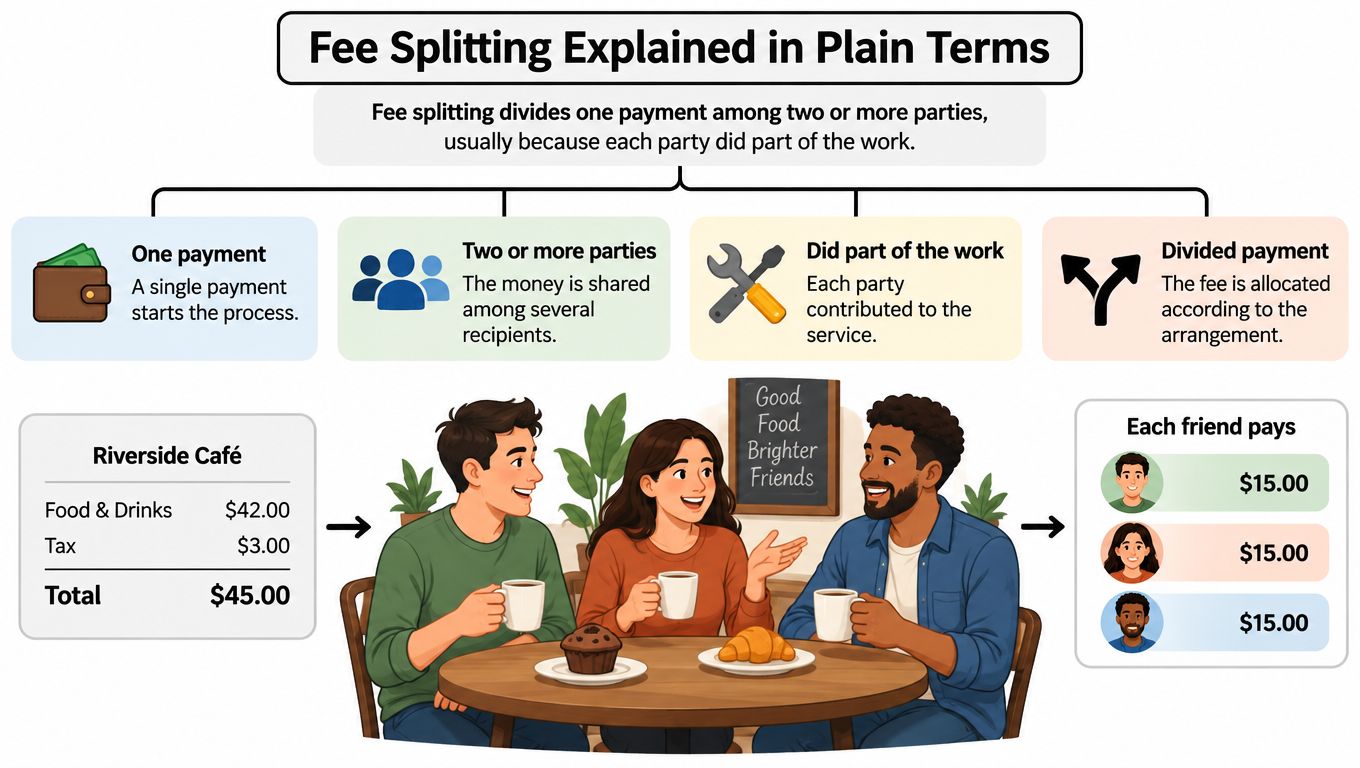
Fee splitting divides one payment among two or more parties, usually because each party did part of the work; a lawful arrangement must satisfy the applicable rules, not merely assign each recipient a percentage.
If a payment processor can divide the money automatically, does that mean everyone receiving a share has earned it? That's the gap landlords need to examine. A checkout receipt shows where money went, but it doesn't necessarily explain why each recipient was entitled to it.
Fee Splitting Explained in Plain Terms
Think about friends dividing a café bill. Each person's contribution makes sense because you can connect it to what they ordered. A business fee split works in the opposite direction, one payment goes out to several recipients, but the same question helps: what belongs to whom, and why?
Say an applicant pays a screening-related charge. A screening provider produces the report, a platform handles the payment and records, and the landlord reviews the application. Those are distinct activities. Whether each activity can legally support a charge to the applicant is a separate question from whether the software can distribute the money.
A fee needs a reason, not just a recipient
The Consumer Financial Protection Bureau's RESPA guidance explains the federal mortgage-settlement framework: Section 8(b) prohibits sharing a settlement-service charge unless the payment compensates services performed. That framework concerns transactions involving federally related mortgage loans, not every rental application or maintenance invoice.
For landlords, it supplies a useful compliance question without replacing rental-specific law. A recipient who produces a report, processes a payment, or completes a repair has an identifiable task. A recipient who receives money only because they introduced a customer raises a different issue.
Rental businesses encounter several kinds of fees:
- Application charges relate to applying for housing and may face local restrictions on collection, amounts, or permitted uses.
- Payment-processing charges relate to collecting and transferring money.
- Maintenance job fees relate to completed services and the agreed treatment of labor, materials, and platform compensation.
Don't assume permission to collect one type authorizes another. A lease clause about rent collection doesn't establish that an application charge is permitted, and a vendor invoice doesn't establish that a referral commission is lawful.
Practical rule: Ask what work earns each share before asking which percentage looks reasonable.
That's the useful answer to “what is fee splitting?” It's an allocation of compensation, not just a technical payment feature.
How One Payment Reaches Several Parties
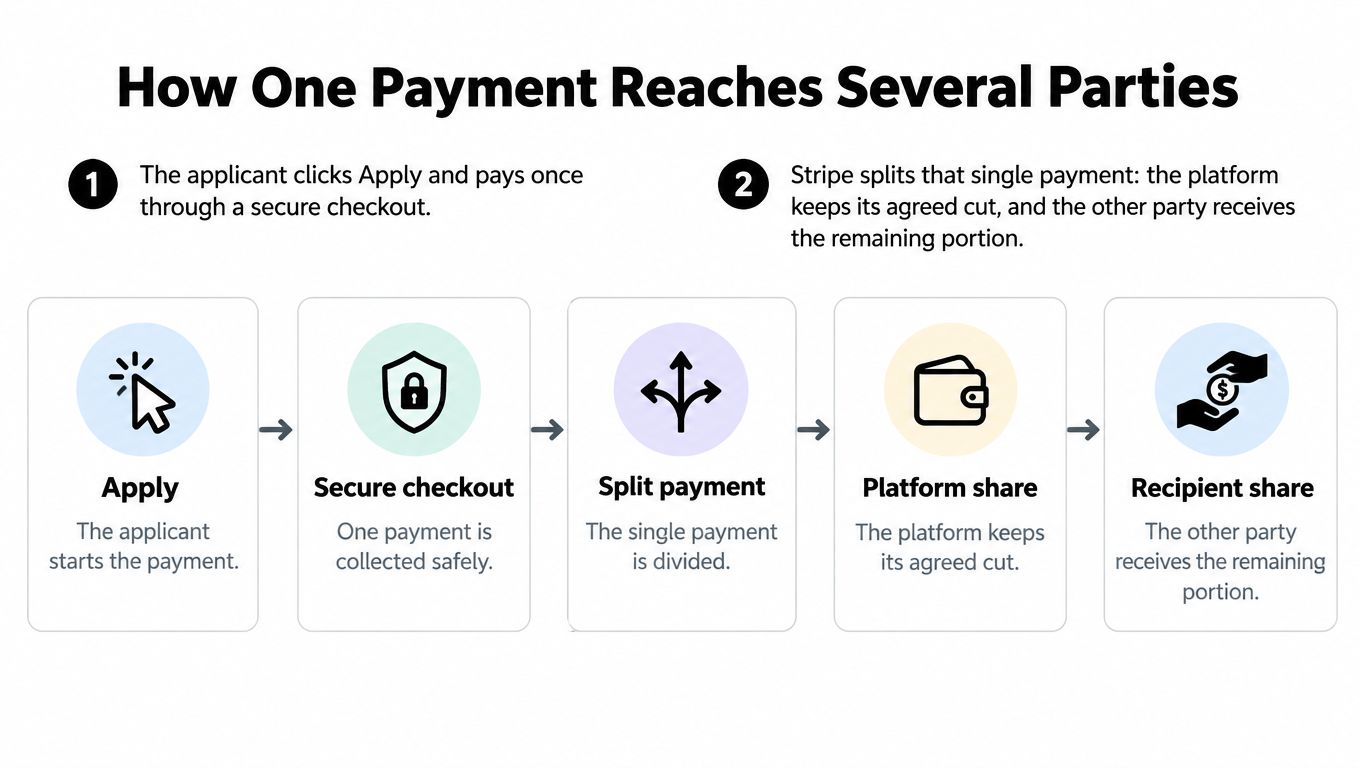
How can one checkout charge reach more than one recipient without losing track of who earned each share? The process works like dividing a receipt: the total is collected once, then allocated according to the agreed terms. Clear records let a landlord trace each portion from checkout to payout.
When an applicant clicks Apply, Stripe splits the application payment. VerticalRent takes a platform cut, and the landlord's application fee goes directly to the landlord's bank account. Stripe Connect deposits the landlord's share in 2 business days. Rent payouts also use Stripe Connect.
Follow the transaction from checkout to reconciliation
- The applicant sees the charge. The payment screen should identify what the charge covers, who imposes it, and the applicable refund terms.
- The processor collects payment. Keep the transaction identifier so the checkout, allocation, and payout can be matched.
- The allocation follows the agreement. The landlord's and platform's portions should match the written terms, not an undocumented adjustment.
- The ledger records the result. Track the gross charge, adjustments, platform compensation, net disbursements, and payment status.
- The bank deposit is reconciled. Match each payout to its underlying transactions instead of treating an unexplained deposit as rental income.
Processor configuration affects costs and responsibilities. Suby's guide, Standard, Express, and Custom fees explained, provides context for comparing Stripe Connect account structures. Keep processor charges distinct from platform compensation in your records. A correct calculation alone does not establish that a proposed split is lawful. Check the arithmetic with a commission-split calculator, then examine what work supports each share.
Illustrative split of an application fee
These hypothetical calculations show how allocations can be described. They are not actual prices, recommended charges, or legal approvals.
| Example | Work behind each share |
|---|---|
| Suppose a $50 charge is allocated 70/30: landlord $35, platform $15 | The landlord performs a permitted application review; the platform provides defined screening-related technology, processing, and records |
| Suppose a $100 charge is allocated 80/20: landlord $80, platform $20 | Each recipient performs the services specified in the agreement, and the applicant charge is checked against local law |
Payment routing doesn't decide professional compliance
The South Carolina Bar's fee-division ethics opinion illustrates how a regulated profession can assess services, responsibility, client consent, and the overall fee. Attorney rules are not rental rules, but the example shows why routing the full payment through one account before paying others does not determine whether a split is proper.
A technology charge is not automatically a hidden referral payment, and the label alone does not establish that it is legitimate. Before setting up an allocation, identify the deliverable each recipient must provide and the records that will show the work was completed. Legality turns on the substance behind each share, not its percentage.
Where Fee Splitting Is Legal and Where It Is Restricted
Fee splitting isn't automatically illegal. The governing law follows the transaction, the profession, and the jurisdiction. A mortgage-settlement rule, a lawyer's ethics rule, and a residential application-fee restriction answer different questions.
The Colorado real-estate manual's discussion of RESPA distinguishes Section 8(b), which addresses unearned shared settlement charges, from Section 8(a), which prohibits payments made under an agreement to refer settlement-service business; Section 8(c) recognizes bona fide compensation for goods, facilities, or services supplied. Under the unearned-split provision, a settlement charge must be shared between parties, and the divided portion must be unearned.
Customer permission doesn't erase a statutory prohibition. The federal RESPA regulation also addresses nominal or duplicative services and makes clear that customer approval doesn't validate an otherwise prohibited arrangement.
Match the rule to the activity
Fee-splitting tests by context
| Context | Governing rule | What makes a share lawful | Main risk |
|---|---|---|---|
| Mortgage and settlement services | RESPA's unearned-split provision | Payment for services actually performed | Unearned share of a charge |
| Attorney fee division | Applicable state ethics rules | Required client notice and consent, reasonable total fee, and qualifying work allocation or shared responsibility | Undisclosed or improper division |
| Healthcare revenue | Applicable referral and fee-sharing prohibitions | Permitted compensation for actual services, with appropriate fair-market-value support | Payment for patient referrals |
| State professional licensing, including Illinois | Applicable professional licensing statute | An arrangement permitted by the statute and its exceptions | Dividing professional compensation for referrals |
| Rental platforms and landlord fees | Rental-fee law, licensing rules, contracts, and other applicable law | A permitted charge and compensation supported by documented services | Prohibited charges or referral compensation |
This is a comparison framework, not permission to apply one profession's exceptions to another.
For example, the Illinois professional fee-splitting statute restricts direct and indirect division of covered professional compensation, including referral arrangements, subject to statutory exceptions. It shouldn't be read as a blanket rule for every Illinois landlord transaction.
A California enforcement summary describes penalties under the fee-splitting law it discusses of up to one year of imprisonment, a fine of up to $50,000, or both for a first conviction. That's a sector-specific warning, not a statement that an ordinary rental-fee dispute carries those penalties.
Check rental application fee laws separately, then have a local attorney review the proposed arrangement in each state where you or your providers operate.
Five Compliance Checks, Benefits and Risks
Start with the transaction you intend to collect. Pull up the application terms, provider agreement, checkout disclosure, and ledger fields together. If those documents describe different services or recipients, resolve the mismatch before taking payment.
The American Bar Association's healthcare fee-splitting analysis identifies recurring concerns about patient referrals, compensation to people who don't perform the underlying services, and whether management compensation reflects actual services and fair-market value. Those healthcare restrictions aren't a rental statute, but they show why reviewing a percentage alone is inadequate.
Run the checks against the actual agreement
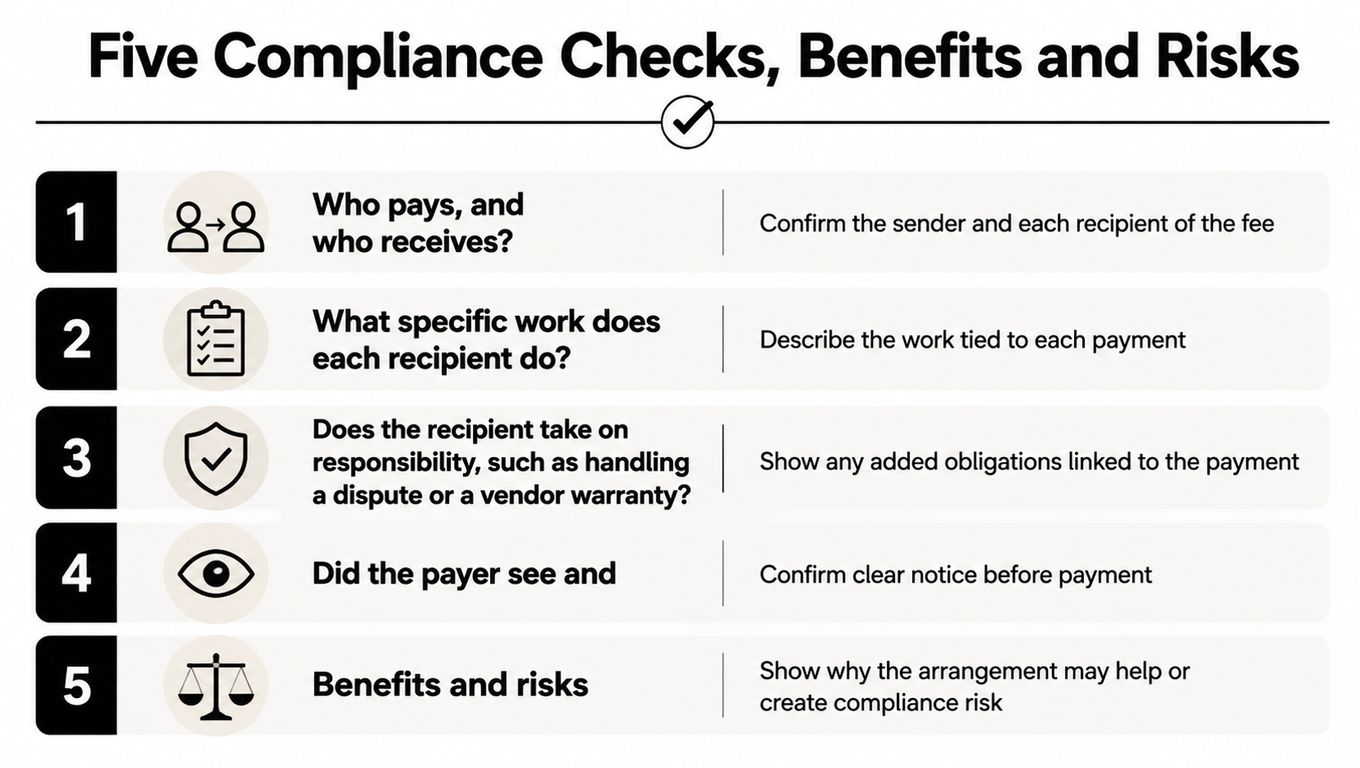
Who pays, and who receives?
Identify the applicant, tenant, landlord, platform, and vendor by their contractual roles. Record the legal recipient, not just a display name or bank-account nickname. Distinguish a fee imposed on an applicant from a service expense the landlord owes.What specific work does each recipient do?
Replace descriptions such as administration with concrete deliverables: producing a screening report, maintaining a payment record, dispatching a vendor, or completing a repair. Specify whether the service is required for every transaction and what happens when it isn't delivered.What responsibility does the recipient accept?
Check who corrects a defective report, answers a billing complaint, handles a failed transfer, or honors a workmanship warranty. Don't add responsibility to a contract merely to justify compensation. The recipient must accept and perform the obligation.What did the payer see before paying?
Assign someone to send the disclosure and preserve its version with the transaction. A checkbox without the terms it referred to is weak evidence. Consent may be relevant, but it doesn't authorize a charge that the governing law prohibits.What triggers the payment?
Look at the event that creates entitlement: delivery of a service, completion of a job, introduction of an applicant, or referral volume. If payment becomes due before any defined service occurs, investigate whether the arrangement is really purchasing access rather than work.
Build a fee-allocation matrix
Keep a spreadsheet or exportable database with these fields:
- Transaction identity: Transaction type, identifier, payer, and gross amount.
- Recipient entitlement: Beneficiary, contracted service, and percentage or fixed amount.
- Money movement: Settlement timing, refund treatment, and adjustments.
- Supporting evidence: Contract version, disclosure record, invoice, report, or completion record.
For a screening-related transaction, attach evidence that the report was delivered and any separately compensable review occurred. For a maintenance transaction, attach the work order, itemized invoice, and completion confirmation. Keep sensitive screening information access-controlled rather than copying it into a broadly shared accounting sheet.
Test partial refunds, chargebacks, failed payments, and fee reversals. A successful checkout test won't tell you whether a refund reverses the correct recipient's share. Also test what staff should do when the platform has paid a recipient but the underlying payment is later challenged.
A complete ledger explains both the original payment and every later change to it.
Separate operational safeguards from professional duties
McGuireWoods' guidance on dividing legal fees describes lawyers' duties to notify the other lawyer, safeguard disputed or not-yet-distributable funds in trust, promptly deliver earned amounts, and provide an accounting when requested. Those are professional obligations in that context, not a universal instruction for landlords to open attorney-style trust accounts.
For rental operations, establish an appropriately reviewed procedure for disputed payouts. Name the person who receives the complaint, determines whether a hold is permitted or required, communicates with recipients, and reconciles the final outcome. Don't let an automatic payout schedule substitute for that decision.
Automation can remove manual transfers and generate transaction-level records that support bookkeeping and tax preparation. It can also distribute an error quickly. A separate transfer described as a service payment won't necessarily cure an arrangement that is substantively prohibited fee sharing.
Copyable operating summary
| Category | Benefit or risk | Operating control |
|---|---|---|
| Benefit | Fewer manual transfers | Use agreed allocation instructions |
| Benefit | Clearer recipient calculations | Show gross, deductions, and net |
| Benefit | Better accounting support | Reconcile transactions to deposits |
| Risk | Payer disputes an undisclosed allocation | Preserve the disclosure and acceptance record |
| Risk | Refund reverses the wrong share | Define and test recipient-level reversals |
| Risk | Recipient is paid before entitlement is established | Verify delivery and use lawful dispute holds |
The strongest implementation pairs payment instructions with a named person responsible for exceptions.
Fee Splitting Examples From Real Rental Cases
The following are hypothetical rental scenarios, not reported client cases or legal determinations. They show how to examine everyday transactions without assuming that a tidy invoice makes every charge permissible.
An application review with distinct deliverables
An applicant pays a screening-related charge. The platform produces credit and eviction information, while the landlord reviews the file against written rental criteria.
The documentation should distinguish those activities rather than describe both as screening. Even with evidence of work, the landlord still needs to establish that local law permits charging the applicant for the relevant activities. A completed review isn't automatic permission to recover its cost.
A referral payment without a defined service
A property manager asks for a percentage whenever they send a prospective tenant to a landlord. They don't conduct a review, arrange a showing, manage the tenancy, or accept another defined obligation.
That arrangement warrants legal review before payment. Depending on the applicable licensing and referral rules, it may be prohibited; there isn't enough information to call it lawful merely because the landlord, rather than the applicant, pays it. Don't manufacture an administration description after the referral has occurred.
A completed repair with materials identified
A handyman completes a repair and submits an invoice separating labor from billed materials. In our completed-job workflow, materials cost is a deduction, not an extra charge, when the job is allocated between labor and materials.
Keep the invoice and completion record together. They should explain the agreed job total and materials treatment without charging for the same materials again.
| Scenario | Documented work | Consent shown | Payment tied to | Practical assessment |
|---|---|---|---|---|
| Application review | Report delivery and review record | Preserve prepayment terms | Defined application services | Potentially defensible if the charge and allocation are permitted |
| Introduction-only referral | No separate service identified | Agreement alone is insufficient | Sending a prospective tenant | Pause for licensing and referral review |
| Completed repair | Invoice and completion confirmation | Accepted work order | Completed labor and billed materials | Clearer basis, subject to contract and applicable law |
Good records also make these transactions easier to explain outside a dispute. Bookkeeping and Accounting of Florida Inc.’s discussion of keeping property finances ready for lenders provides context for organizing property income and expenses.
If you can't identify the work behind a proposed share, don't release it until the entitlement has been resolved.
Paperwork should prove what happened, not create a story for a payment nobody can otherwise explain.
Confirm Your Split Terms Before You Collect
Put the agreement ahead of the checkout. Coto & Waddington, Attorneys at Law's guide, Coto & Waddington on contract clauses, provides useful context for turning commercial expectations into written terms.
Sign off on the collection setup
- Write the allocation into the applicable terms. Name the payer, recipients, and calculation method.
- Attach service descriptions. Make each recipient's deliverable and responsibility identifiable.
- Assign disclosure ownership. Specify who presents the terms before payment and retains acceptance.
- Verify the ledger. Confirm it captures gross charges, deductions, recipient shares, and transaction status.
- Test exceptions before launch. Use the processor's test environment where available to check refunds and failed payments, then reconcile the first live transaction.
Distinguish tenant charges from landlord deductions
Our rent-collection platform fee is 3% for both ACH and card payments. When a tenant pays by card, Stripe's 2.9% plus $0.30 convenience fee is charged on top of rent and passed through at cost; bank transfers carry no extra renter fee.
Card payment example on a $1,500 rent
| Line | Amount |
|---|---|
| Monthly rent | $1,500.00 |
| Card processing, 2.9% plus $0.30, paid by tenant | $43.80 |
| Tenant total paid | $1,543.80 |
| Platform fee, 3% of rent, deducted from landlord | $45.00 |
| Landlord net receipt | $1,455.00 |
Read these figures alongside the written terms, not instead of them. When comparing property management fees, separate the landlord's deduction from any tenant-paid processing charge.
Compare the example with your current costs, then run the compliance questions against your first live split. Name the disclosure owner, establish a lawful procedure for holding disputed shares until resolution, and confirm the rules wherever you and your providers operate.
VerticalRent offers application-payment splitting, online rent collection, and transaction records to help independent landlords track how collected money is allocated. Visit VerticalRent to review the workflow and match your collection setup to your written fee terms before accepting payments.
Put this into practice
VerticalRent tools related to this guide
Legal Disclaimer
VerticalRent and its authors are not attorneys, CPAs, or licensed legal or financial advisors, and nothing on this site constitutes legal, tax, or professional advice. The information in this article is provided for general educational purposes only. Landlord-tenant laws, eviction procedures, security deposit rules, and tax regulations vary significantly by state, county, and municipality — and change frequently. Nothing on this site creates an attorney-client relationship. Always consult a licensed attorney or qualified professional in your jurisdiction before taking any action based on information you read here.
Co-founded VerticalRent in 2011, growing it from nothing to 100k landlords and renters. Sold it in 2019, then re-acquired it in 2026 to make it better than ever.


