Rent Collection for Landlords: Key Legal Rules
Learn the best methods, legal rules, and practices for rent collection for landlords in 2026. Streamline your process and avoid costly mistakes.

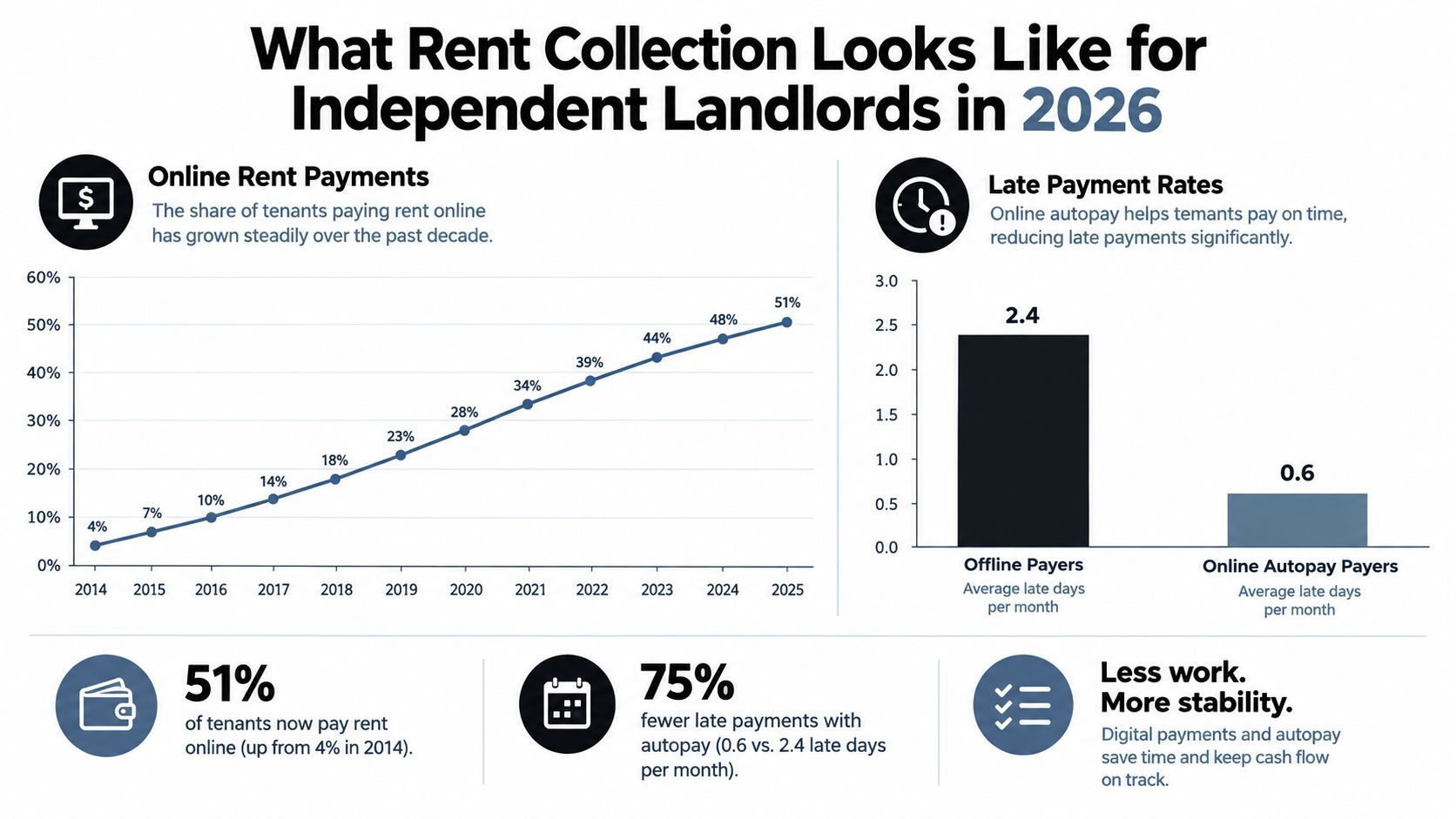
Online rent payments rose from 4% in 2014 to 51% in 2025, and offline payers were consistently the most likely to pay late. The payment channel itself is one of the most underappreciated levers a landlord controls.
That finding changes how I approach rent collection for landlords. A late fee is a rule applied after the problem occurs. Payment design acts earlier. The right channel, a well-timed reminder, and a tenant-friendly autopay option can make rent easier to pay without turning every month into a confrontation.
I've collected rent across small portfolios long enough to see that most collection failures aren't caused by one bad tenant decision. They come from friction, unclear instructions, weak records, inconsistent follow-up, or a payment method that creates avoidable delays. The system matters more than the sternness of the email.
What Rent Collection Looks Like for Independent Landlords in 2026
The shift toward digital payments is clear. Rentec Direct's dataset shows online rent payments increasing from 4% in 2014 to 51% in 2025, while offline methods declined from 96% to 49%. The same dataset found that offline payers were consistently more likely to pay late, including a peak of 25% late in 2025, and were 23% more likely to pay late than online payers over the decade. See the Rentec Direct rental payment data for the methodology and trend details.
That doesn't mean every tenant should be forced into one payment method. It means landlords should treat the channel as part of the collection strategy. ACH usually protects margins, cards reduce tenant friction, and manual methods can remain useful for residents who don't use online banking. The mistake is letting convenience for the owner dictate a system that makes payment harder for the tenant.
Practical rule: Design the payment path before you design the penalty.
A workable small-portfolio system has several connected parts:
- Payment selection: Offer an ACH-first default, with card and compliant manual alternatives where appropriate.
- Recurring billing: Set the exact rent amount, due date, and authorized recurring-payment terms in the lease and platform.
- Reminder cadence: Use advance notices and a consistent post-due workflow instead of relying on memory.
- Late-fee logic: Apply fees only when the lease and applicable law allow them.
- Deposit handling: Keep security deposits separate from operating income and record their status clearly.
- Ledger synchronization: Connect payments, reversals, fees, and notes to the unit and tenant record.
- Dispute documentation: Preserve receipts, notices, returned-payment records, and tenant responses.
- Tenant messaging: Explain how to pay, when funds settle, and what happens after a missed deadline.
The historical baseline shows why this discipline matters. The National Multifamily Housing Council recorded full or partial payment during the first five days of the month at 95.9% in 2019, 93.8% in 2020, and 92.0% in December 2021 across 11.8 million renters nationwide. Its tracker also recorded a first-week payment rate of 69.2% in early April 2020, showing how quickly collection conditions can deteriorate during an income shock. The NMHC Rent Payment Tracker provides the historical context.
For independent landlords, the lesson is practical. Build a process that can absorb ordinary lateness, document exceptions, and preserve cash flow without treating every tenant as a collections case.
Comparing Payment Methods From ACH to Cash Apps
Each payment channel solves a different problem. I generally start with ACH because it keeps transaction costs low and creates a clean bank-to-ledger trail. Cards can be more attractive to tenants who already manage their bills that way, but the processing cost needs to be visible before you make cards the default.
Industry guidance identifies recurring ACH costs around $0.26 to $0.50 per payment, while card payments are commonly priced as a percentage of rent. A 3% card fee on $1,500 rent equals $45 per month, so the payment method changes the economics of every unit. These figures are discussed in this ACH fee analysis for rent collection.
| Payment Method | Typical Cost | Settlement Speed | Tenant Friction | Documentation Quality | Dispute Risk | Best Fit For |
|---|---|---|---|---|---|---|
| ACH transfer | Usually a low flat transaction cost | Often slower than cards | Moderate at enrollment, low afterward | Strong when platform-linked | Return or NSF risk | Most recurring payments |
| Debit card | Percentage-based processing cost may apply | Often faster than ACH | Low | Strong through a payment platform | Chargeback risk | Tenants who prefer cards |
| Credit card | Percentage-based processing cost, sometimes with a fixed component | Often fast | Low | Strong through a payment platform | Higher chargeback and dispute exposure | Short-term cash-flow flexibility |
| Paper check | Bank and handling costs, plus staff time | Mail and bank float delay settlement | Moderate to high | Fair if deposited and logged promptly | Stop-payment and NSF risk | Tenants who need a traditional option |
| Money order | Purchase fee paid by tenant, handling time for owner | Depends on delivery and deposit | Moderate | Fair, provided the receipt is retained | Lower chargeback risk, verification work | Tenants without checking accounts |
| Zelle or Venmo | May appear free, depending on account and transaction | Can be quick | Low for one-off payments | Weak without manual reconciliation | Limited landlord controls | Occasional fallback payments |
| Physical lockbox drop | Handling and deposit labor | Depends on collection schedule | High | Weak unless every envelope is receipted | Cash loss, theft, and counting risk | Rare accommodation, not a default |
Cash apps are convenient, but they weren't built around leases, recurring rent ledgers, late-fee logic, or year-end reporting. Checks also remain workable when a tenant needs them, yet they create mail float, deposit work, and greater exposure to returned payments.
For a deeper explanation of the operational trade-off, compare ACH and credit card payments. My decision rule is simple: default to ACH for tenants who want predictable recurring payments, offer cards where convenience justifies the cost, keep a documented manual fallback, and don't accept an informal app payment without recording it against the correct lease and unit.
Setting Up Recurring Payments and Reminders That Actually Reduce Late Rent
Autopay works when it feels controlled, not imposed. At lease signing, show the tenant the amount, withdrawal date, funding account requirements, cancellation process, and receipt workflow. Give manual-payment users a clear alternative so they don't feel trapped, but make recurring payment the easiest path.
Recurring systems have been cited as reducing late payments by 40% to 60%. One benchmark reported on-time rent rising from 61% to 84%, average time to full payment falling from 11 days to 4 days, and landlord follow-up time dropping from 6 to 9 hours to 0.5 to 1 hour per month. Those figures appear in Forte's analysis of recurring rent payments.
Build the workflow around the lease
Configure the rent amount, due date, grace-period language, and any split-payment rules inside the collection platform. Tools such as Buildium, AppFolio, Baselane, and Stessa can support different combinations of recurring billing, reminders, and accounting, but the lease remains the controlling document.
A practical cadence is:
- Five days before the due date: Send a notice showing the amount, due date, and payment link.
- On the due date: Send a friendly confirmation or reminder to tenants who haven't initiated payment.
- After the grace period: Send a written late notice and state the lease-defined consequence.
- Around days 7 to 10: If the balance remains unpaid, send the legally appropriate cure or quit notice after verifying local requirements.
Don't assess a late fee while the grace period is still open. Configure the system to wait, verify the ledger, and apply only the fee authorized by the lease and law. Selective waivers can preserve a good relationship, but record the reason and apply a consistent policy to avoid arbitrary treatment.
Keep every reminder, receipt, returned-payment notice, and tenant response in the ledger. A practical accounts receivable guide for startups is useful for thinking about aging balances, follow-up ownership, and reconciliation discipline outside the rental context. For a landlord-specific software workflow, see this automated rent collection software guide.
Legal Rules for Late Fees Grace Periods and NSF Charges
Late-fee rules are local, and a lease clause doesn't override a statute. Before turning on automated charges, check the state, county, and city rules that apply to the property. Some jurisdictions require a grace period, some limit the amount or timing of a late fee, and many regulate returned-payment charges separately.
The federal Fair Debt Collection Practices Act generally doesn't treat an ordinary landlord collecting the landlord's own rent as a covered debt collector. That doesn't remove other obligations. The Fair Credit Reporting Act matters if you report rental payment information to consumer reporting agencies, and fair-housing rules still apply to how you handle fees, waivers, notices, and enforcement.
The state examples below are intentionally conservative. Verify the current statute and local rules before relying on them, because the lawful result can depend on the lease, property type, payment amount, and notice method.
| State | Grace Period | Late Fee Rule | NSF Limit |
|---|---|---|---|
| California | Varies by local rule and lease requirements | Must be reasonable and tied to actual administrative costs, with additional limits possible | Verify the current statutory limit and lease language |
| New York | Varies by applicable law and lease | Must comply with state and local restrictions | Verify the current statutory limit |
| Texas | May depend on lease terms and statutory conditions | Must be authorized by the lease and comply with applicable law | Verify the current statutory limit |
| Florida | Lease and local requirements may control | Must be clearly disclosed and lawful | Verify the current statutory limit |
| Illinois | Local rules can materially affect requirements | Check state and municipal limits | Verify the current statutory limit |
California illustrates why generic templates are risky. The plan notes cite a minimum 5% of rent for transactions under $1,679 in 2026, but that is a jurisdiction-specific legal claim requiring current verification before use. Don't copy a fee percentage into every lease because it appears in an online landlord template.
A safer enforcement sequence
- Confirm the payment wasn't received or delayed in settlement.
- Wait until any applicable grace period ends.
- Send written notice using the method required by law and the lease.
- Apply only the stated, lawful fee.
- Document the calculation and supporting ledger entry.
- Treat an NSF charge separately, and don't stack charges unless clearly permitted.
- Keep security deposits out of the operating account.
Landlords who manage several properties may also benefit from administrative support, but a legal assistants resource isn't a substitute for a local attorney. Use professional review when drafting notices, changing lease language, or handling a contested balance. The rent-payment grace-period guide can help organize the questions you need to answer before automating enforcement.
Bookkeeping Tax Records and Schedule E for Rental Income
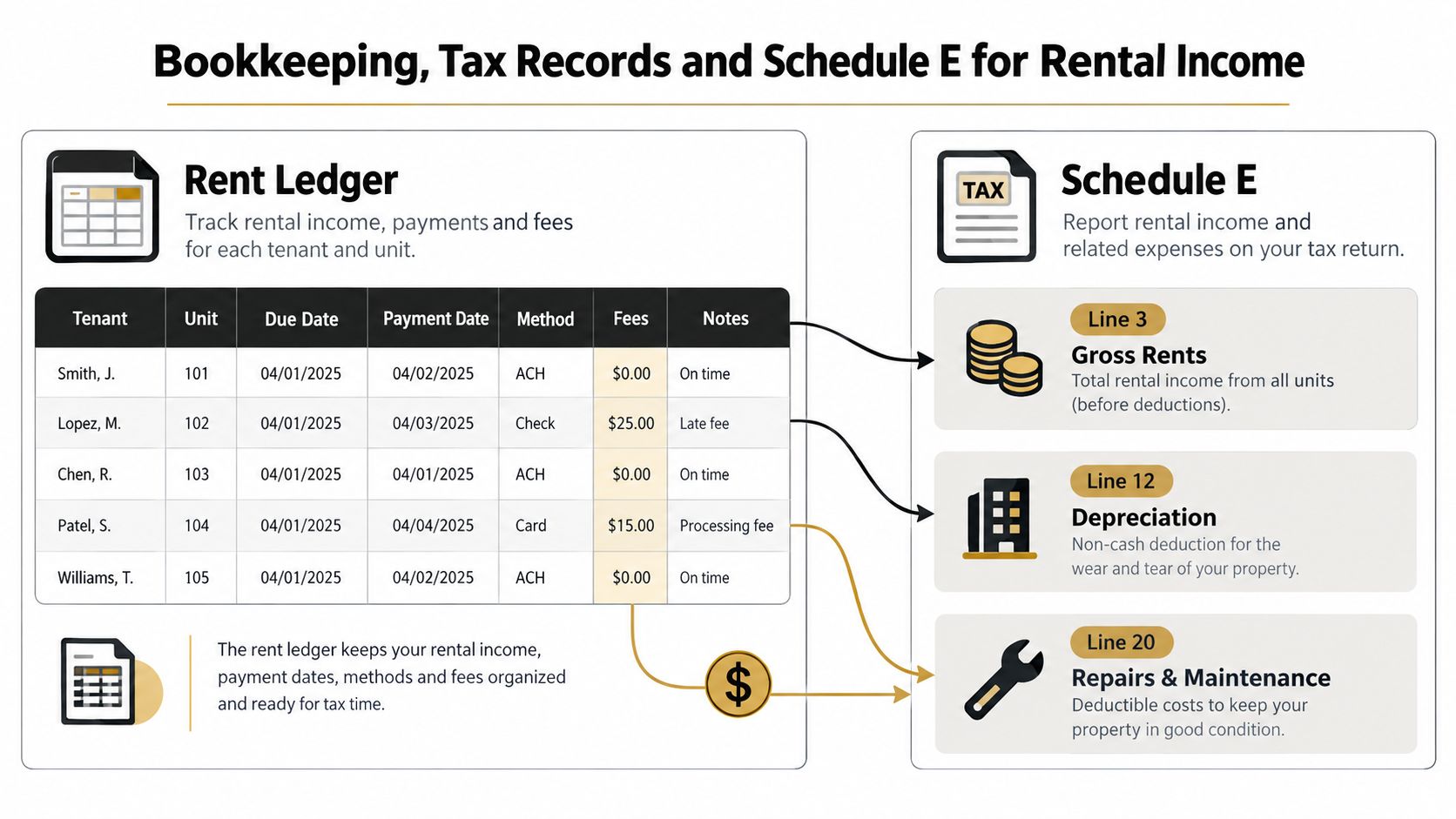
A rent ledger should tell the complete story of every charge. At minimum, record the tenant, unit, due date, payment date, payment method, amount received, fees, reversals, and notes about communication. I reconcile the ledger to the bank statement monthly, not just at tax time, because a missing deposit is easier to resolve while the transaction is still fresh.
Use one transaction trail
Create the rent charge first, then apply payments against it. If a tenant pays partially, apply the amount to the oldest outstanding charge unless the lease or local law requires another treatment. For a returned payment, reverse the original receipt, record the bank charge separately, and preserve the return notice.
Schedule E reporting should distinguish rental income from property expenses. Gross rents belong in the rental-income records, while categories such as advertising, insurance, repairs, and depreciation should be supported by their own receipts and statements. Don't bury fees, repairs, or reversals in an unexplained lump sum.
Security deposits are liabilities while they remain refundable. Reclassify a deposit as income only when the lease and applicable law allow you to apply it to unpaid rent or damage beyond ordinary wear and tear. Provide the required accounting and retain photographs, invoices, inspection records, and notices.
Reconcile before the year closes
- Match deposits: Compare every ledger receipt to the bank activity.
- Explain exceptions: Identify partial payments, reversals, transfers, and fees.
- Separate liabilities: Keep deposits and owner funds in the correct accounts.
- Export supporting records: Save statements, receipts, notices, and lease amendments.
- Retain files: Keep tax records for the period your tax adviser recommends, and retain lease and deposit files longer when a dispute or legal requirement calls for it.
A Schedule E export is useful only when the underlying ledger is accurate. Automation can post transactions, but the owner still needs to review unusual entries and confirm that the account categories match the actual business purpose.
Tenant Communication Templates for Late and Bounced Payments
A late-rent message should be short, factual, and tied to the lease. Avoid sarcasm, threats, or personal explanations. The tenant needs to know the balance, the deadline, the payment path, and the consequence of doing nothing.
The first overdue reminder
SMS, soft version
Hi [Name]. I don't see the rent payment for [unit] posted yet. Please check your payment status and use [ACH link] if you still need to submit it. Reply if you've already paid.
Email, firm version
Subject: Rent balance for [unit]
Hello [Name], The rent balance for [month] remains unpaid after the applicable grace period. Under section [number] of the lease, the late charge is [lawful lease-defined amount]. Please pay the total balance through [payment method] or contact me today if a payment is pending.
Regards, [Name]
Don't state that an eviction has begun unless the legally required process has started.
The day 7 to 10 follow-up
SMS
Your rent balance for [unit] is still outstanding. Please submit payment in full within five business days through [link], or contact me today to discuss the account. This message doesn't replace any formal notice required by law.
Subject: Required action on outstanding rent
Hello [Name], The account shows an unpaid balance of [amount] for [month]. Please cure the balance within the period stated in the attached notice and lease, using [payment method]. If you believe the ledger is incorrect, send the payment record or dispute details in writing so I can review them.
[Name]
Returned payments and recurring lateness
For an NSF event, identify the returned payment, request the lawful replacement method, state the applicable deadline, and list any permitted NSF charge separately. Don't resubmit a failed debit if the platform or lease doesn't authorize it.
For habitual lateness, discuss lease compliance rather than character. A written notice should identify the dates, amounts, and cure requirement. Keep SMS as a convenience, but use the formal notice method required by local law when legal rights are involved.
A 30-60-90 Day Roadmap to Modernize Your Rent Collection
A migration works best when you measure the old process before changing it. Don't switch channels halfway through a billing cycle without telling tenants exactly what changes and what stays the same.
Days 1 to 30, audit
Pull the past rent ledgers, catalog every payment channel, identify units with repeated lateness, and compare settlement timing by method. Review every lease for due dates, grace periods, late-fee language, NSF provisions, and payment instructions.
Your day-30 checkpoint should answer three questions: Which units create the most follow-up work? Which payment methods produce the weakest records? Which lease clauses need review before automation?
Days 31 to 60, configure
Choose an ACH-first platform with card support and a manual fallback. Configure each lease separately, then draft any required addendum covering recurring authorization, cancellation, grace periods, late-fee calculations, and returned payments.
Give tenants written notice and allow a dual-channel transition. During that period, accept the old method if required, but make the new workflow clear and easy to test. A tenant shouldn't discover a changed payment process after a failed deadline.
Days 61 to 90, optimize
Turn on autopay enrollment, schedule reminders before the due date, activate lease-based fee logic only after the grace period, and sync the ledger with your accounting system. Review the first complete cycle against the audit baseline, focusing on payment dates, manual touches, reversals, and unresolved balances.
If a tenant refuses ACH, don't make the relationship a referendum on technology. Keep a compliant alternative, require the same documentation, and apply the same reminder and notice policy consistently.
Common Mistakes and a Final Landlord Checklist
Higher late fees don't solve a badly designed payment path. A tenant who forgets, can't use the portal, or uses a slow channel may still pay late after a fee increase. Consistent enforcement matters, but channel reliability and clear reminders address the cause earlier.
Avoid these common errors:
- Accepting cash without a dated receipt.
- Waiving fees inconsistently without recording the reason.
- Applying a late fee before the grace period closes.
- Commingling security deposits with operating funds.
- Failing to document partial payments and reversals.
- Reporting to credit bureaus without proper written procedures.
- Using a personal payment app that leaves weak tax and lease records.
Before the next billing cycle, check:
- Lease due date and payment clause.
- Grace-period language.
- Late-fee calculation.
- NSF provision.
- ACH enrollment path.
- Card-payment cost disclosure.
- Manual fallback method.
- Reminder schedule.
- Tenant ledger fields.
- Deposit account treatment.
- Monthly bank reconciliation.
- Year-end tax export.
A strong rent-collection process makes payment easy, enforcement predictable, and records defensible. Review the system as an operating process, not just a clause in the lease.
VerticalRent combines online ACH and card rent payments with autopay, reminders, lease-based late-fee settings, and ledger updates for independent landlords. Visit VerticalRent to evaluate whether its collection and Schedule E workflow fits your portfolio.
Put this into practice
VerticalRent tools related to this guide
Legal Disclaimer
VerticalRent and its authors are not attorneys, CPAs, or licensed legal or financial advisors, and nothing on this site constitutes legal, tax, or professional advice. The information in this article is provided for general educational purposes only. Landlord-tenant laws, eviction procedures, security deposit rules, and tax regulations vary significantly by state, county, and municipality — and change frequently. Nothing on this site creates an attorney-client relationship. Always consult a licensed attorney or qualified professional in your jurisdiction before taking any action based on information you read here.
Co-founded VerticalRent in 2011, growing it from nothing to 100k landlords and renters. Sold it in 2019, then re-acquired it in 2026 to make it better than ever.


