Handyman Repair Near Me: A Landlord's Complete Hiring Guide
Searching for 'handyman repair near me'? This guide helps landlords find, vet, and hire reliable pros. Learn pricing, red flags, and how to manage repairs.

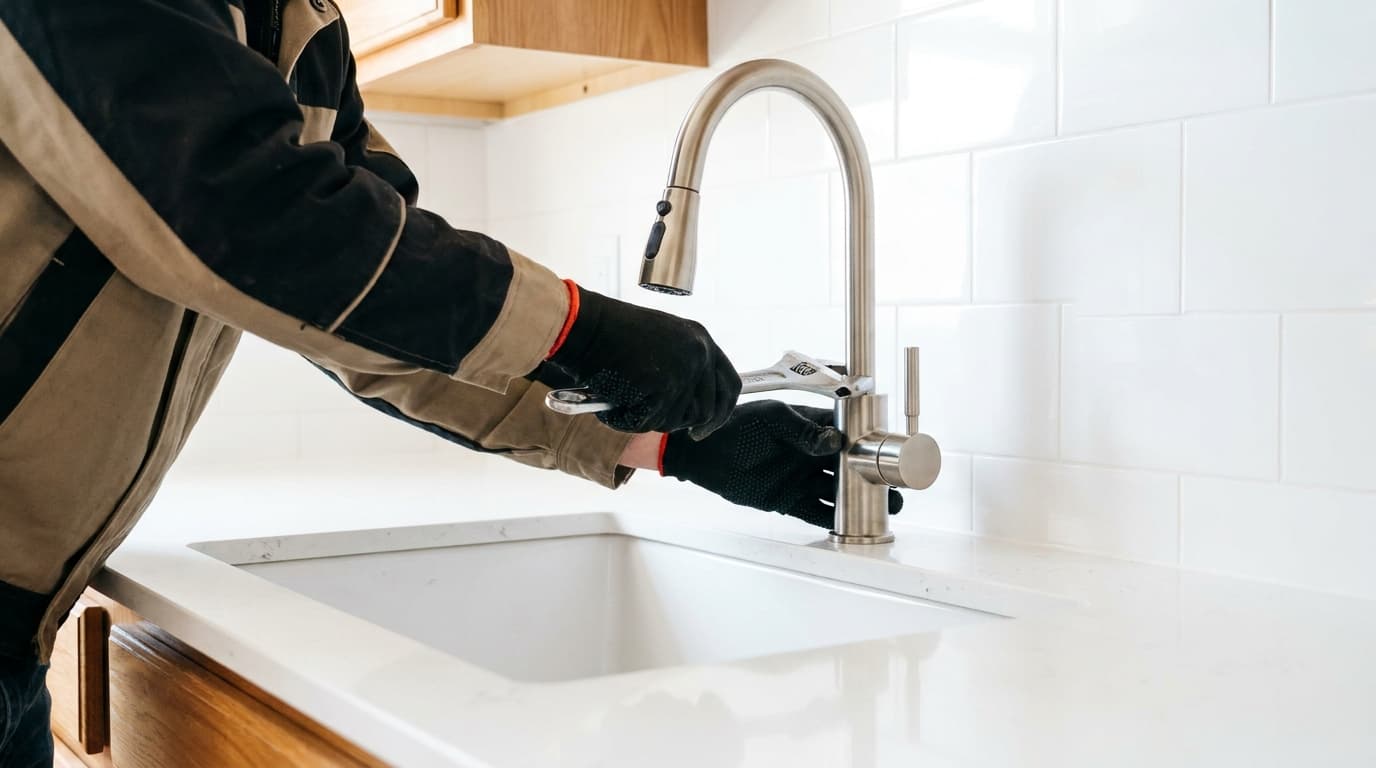
Your tenant sends a message at 7:12 a.m. The bathroom door won't latch, a towel bar pulled out of the drywall, and the kitchen faucet has started dripping. None of these jobs are large enough to justify a full contractor search. All of them are large enough to create tenant frustration, schedule disruption, and avoidable wear if you let them sit.
That's why so many landlords end up typing Handyman repair near me into a search bar between other tasks. What you're really looking for isn't just a person with tools. You're looking for someone who shows up, stays in scope, communicates clearly with your tenant, and doesn't create an insurance or licensing problem you didn't have yesterday.
The Challenge of Finding a Good Handyman Fast
Small repairs create outsized management headaches. A loose cabinet hinge or damaged door trim can look minor on paper, but if the repair drags out, the tenant experiences it as neglect. That's the landlord's problem, even when the actual work takes less than an hour.
The hard part isn't finding options. It's filtering them fast enough to make a decision without making a bad one.
The broader labor pool is large. The U.S. Bureau of Labor Statistics estimates 1,629,700 general maintenance and repair worker jobs in May 2024, with about 159,800 openings per year projected on average, which shows this is a substantial, established service market rather than a niche category for odd jobs (BLS occupational outlook for general maintenance and repair workers). For landlords, that's good news and bad news at the same time. Supply exists, but the search results still mix professionals, part-timers, and people taking on work they shouldn't.
Practical rule: A fast hire only helps if the person can finish the job without creating a second problem.
A bad handyman hire usually hurts in three places:
- Tenant satisfaction drops: Missed appointments and partial fixes make tenants doubt every future repair promise.
- Budget control slips: Vague quotes turn into add-ons, extra trips, and billing disputes.
- Liability exposure rises: If the repair crosses into licensed trade work, the risk isn't just poor workmanship. It can become an insurance issue.
That's why the search for Handyman repair near me needs a process. Not a long process. A sharp one.
For rental work, the winning approach is simple. Build a short list from the right places. Screen out anyone with unclear scope or weak business habits. Interview with pricing and documentation in mind. Then lock the job down in writing before anyone enters the unit.
Landlords who skip those steps often think they're saving time. Usually they're just moving the work from the front end to the back end, where it costs more and annoys everyone involved.
Where to Look for Local Handyman Candidates
The best source depends on the job. A routine turnover punch list calls for one kind of search. A same-day tenant repair calls for another. If you treat every search channel as equal, you waste time sorting low-quality leads.

Start with people who already hire for rentals
Referrals from other landlords usually outperform broad search platforms. Another landlord can tell you whether the handyman handles occupied-unit communication well, whether they finish punch lists without supervision, and whether their invoices are clean enough for bookkeeping.
Good referral sources include:
- Local landlords and investors: Ask who they use for repeat turns, minor plumbing-related fixture swaps, door repairs, and drywall patches.
- Real estate agents and brokers: They often know who handles pre-listing fixes and inspection-response items quickly.
- Paint stores and supply counters: Counter staff often know which small operators buy regularly and professionally.
- Tenant-friendly vendors already in your orbit: If you trust your locksmith or cleaner, ask who they see doing solid handyman work nearby.
A private referral network is slower to build, but once it exists, it beats cold searching.
Use public channels carefully
Facebook neighborhood groups, Nextdoor, and local community boards can surface useful names. They also produce a lot of noise. The quality of your post matters. Don't write, “Need a handyman ASAP.” Write the actual scope, property location, whether the unit is occupied, whether photos are available, and whether you want a fixed-price quote.
That filters out a lot of unserious replies.
Directory and lead-gen platforms are convenient, but many listings still don't answer the questions landlords need answered. Many local search results for handymen fail to provide pricing transparency for small, urgent repairs, including total job cost, trip fees, and minimum charges, which forces landlords into a tedious call-and-compare process (Angi handyman service example showing the market gap).
A quick comparison helps:
| Channel | Best use | Main advantage | Main risk |
|---|---|---|---|
| Referral network | Repeat vendors | Higher trust | Smaller pool |
| Facebook or Nextdoor | Non-urgent local searches | Fast community reach | Mixed professionalism |
| Directory apps | Broad search coverage | Convenience | Weak pricing clarity |
| Vendor directories | Building a shortlist | Easier filtering | Still requires vetting |
If you want a cleaner starting point than a generic search result page, a focused service pro directory for rental-related vendors is more useful than browsing random profiles with no rental context.
One more point matters here. Better handymen are often better marketed. If you've ever wondered why one operator looks organized online while another looks invisible, this overview of boosting leads for home service businesses helps explain the gap. It's useful context because online visibility doesn't prove quality, but poor visibility often makes it harder to judge whether the business is active and serious.
How to Vet and Verify a Handyman Before Calling
A listing page can tell you who exists. It can't tell you who belongs in your rental.
Before you call anyone, do the remote checks first. That's where you eliminate the candidates who create the most trouble.

Check whether the business looks real
A legitimate handyman business usually leaves a consistent trail. You should be able to find the same business name, service area, phone number, and job photos across its profiles. Consistency matters more than polish.
Look for these signs:
- Clear service descriptions: “Drywall patching, door hardware, trim repair, fixture replacement” is stronger than “We do everything.”
- Original job photos: Repeated local-looking work beats generic stock images every time.
- Review patterns that sound human: A few mixed but detailed reviews are often more believable than a wall of generic praise.
- A stable communication method: A dedicated phone line, booking form, or business email tells you more than a profile that only says “DM me.”
If the online presence is vague, the quote usually is too.
Insurance belongs in this stage as well. You don't need a long debate about it on the first pass. You need to know whether they can provide proof when asked. For landlords, that's not red tape. It's basic screening.
If you want a practical landlord-oriented checklist for the broader contractor side of this issue, this guide on hiring contractors for rental properties is a useful companion to the handyman-specific process.
Know the legal line before you ask for a quote
Regarding handyman services, many landlords become careless. “Handyman” is not a legal category that automatically covers every repair in a unit. Most states set limits on what unlicensed handymen can legally do versus what requires a licensed trade. One example often cited is Texas, where unlicensed handyman work is generally allowed only when the total job price is under $500 excluding parts. Hiring an unlicensed person for work that legally requires a license can also affect an insurance claim if something goes wrong (Rocky Top Handyman discussion of handyman licensing limits).
That means your first question isn't only “Can this person do it?” It's also “Should this person be doing it at all?”
Use this rough split:
- Usually handyman territory: Drywall patching, door alignment, hardware swaps, caulking, trim repair, minor cosmetic fixes
- Often licensed-trade territory: Panel work, new electrical runs, major plumbing changes, anything structural, anything code-sensitive
For a landlord, the cheapest quote can become the most expensive mistake if the worker shouldn't have taken the job in the first place. If you want a plain-English look at insurance expectations around this kind of work, TCDS Agency handyman policies offer a helpful reference point before you hire.
The Vetting Interview and Pricing Expectations
Once you've narrowed the list, the first call should sound less like shopping and more like vendor qualification. You're not interviewing for personality. You're testing whether this person can handle rental work without constant supervision.

Questions that reveal how they actually work
Start with the job in front of you, then listen for how they think.
Ask things like:
What information do you need from me to quote this properly?
A solid handyman asks for photos, dimensions, material details, and access conditions.Do you work in occupied rentals?
This matters. Rental work includes tenant coordination, arrival windows, and basic professionalism inside someone else's home.Do you quote fixed price for small repairs, or is it hourly with a minimum?
You need to know the billing model before you compare anything.Who buys materials, and how do you handle change items?
Sloppy jobs often go sideways at this stage.Can you send proof of insurance before scheduling?
If they hesitate or get irritated, keep moving.
A good call feels organized. They ask clarifying questions. They don't promise everything instantly. They tell you what they can't do as clearly as what they can.
Landlord test: If you wouldn't trust them to text your tenant directly about arrival time, don't hire them for an occupied unit.
What the pricing should sound like
You don't need perfect national pricing to judge whether a quote is sensible. You need a benchmark and a structure. Benchmark data shows most handymen charge $60 to $85 per hour in typical U.S. markets, with a broader range of $50 to $150 per hour depending on specialty and market. Flat-rate jobs often land around $150 to $600, and common examples include $75 to $250 for drywall patching and $150 to $500 for door repair or installation (Housecall Pro handyman pricing benchmarks).
That tells you a few useful things:
- Tiny jobs often carry friction costs: Travel, setup, parking, and supply runs matter.
- Bundled work usually prices better: Three minor repairs on one visit often make more financial sense than three separate dispatches.
- Specialty crossover changes the quote: The closer the task gets to plumbing, electrical, or finish carpentry, the more variation you'll hear.
A weak quote usually has one of two problems. It's either too vague to enforce, or so cheap that the provider is likely planning to make it up through extras, delays, or shortcuts.
For occupied rentals, I prefer fixed pricing whenever the scope is visible from photos. Hourly billing has its place, especially when hidden conditions are likely. But for straightforward punch-list work, fixed price keeps the tenant, vendor, and owner aligned better.
Defining the Work Scope and Finalizing the Hire
Most small repair disputes don't start with bad intentions. They start with casual assumptions.
The fix is a written scope, even for simple jobs. It doesn't need legal theater. It needs clarity.
What to put in writing every time
Consumer guidance consistently points to a structured, scope-first estimate as the safest way to quote handyman work, and it warns that the most common disputes come from surprise scope changes and confusion over who owns material costs (Checkbook guidance on hiring handyman services).
That written scope should include:
- Exact task list: “Patch two drywall anchor holes in hallway bath and repaint affected area” is better than “repair wall.”
- Location details: Identify the room, unit, and access instructions.
- Material responsibility: State whether the handyman buys parts or you supply them.
- Price format: Fixed price, hourly rate, minimum charge, and what triggers extra billing.
- Scheduling window: Date, arrival range, and whether the tenant is home.
- Completion standard: What counts as done, especially for paint touch-up or hardware alignment.
A short written approval by text or email is usually enough for minor work, as long as the scope is specific.
Payment and tenant coordination
The payment side should stay just as clean. Don't pay in full before the work is complete. For small repairs, the simplest structure is approval up front, payment after completion, and photos if you can't inspect in person.
Keep communication tight:
- Send the tenant one message: Include vendor name, arrival window, and repair summary.
- Tell the handyman who the decision-maker is: Tenants can report problems. They shouldn't authorize additional work unless you've allowed it.
- Require a change-order pause: If the scope changes, work stops until pricing is approved.
Clear scope beats a friendly handshake every single time.
Landlords who formalize small repairs this way usually spend less time untangling “I thought that was included” arguments. More important, tenants see a managed process instead of an improvised one.
The Smarter Way to Handle Repairs with VerticalRent
The manual method works, but it asks the landlord to act as dispatcher, screener, estimator, bookkeeper, and communication hub on every repair. That's manageable with one unit and a flexible schedule. It gets old fast when requests stack up.
VerticalRent addresses that operational gap by putting maintenance coordination inside one system instead of spreading it across texts, call logs, search results, and invoices. Through VerticalRent maintenance management, landlords can handle repair flow in a way that feels closer to a proper work-order process than a DIY scramble.

Here's why that matters in real life.
A tenant can submit the issue with photos or video instead of sending a vague text like “sink broken.” That gives the landlord better context before anyone gets dispatched. The platform can then keep the request, communication trail, and vendor activity tied to the property record rather than buried inside separate apps.
That solves several landlord problems at once:
- Less phone-tag: Everyone sees the same repair record.
- Better documentation: Photos, messages, invoices, and payment history stay attached to the job.
- Cleaner oversight: The landlord doesn't have to reconstruct what happened later for taxes or tenant follow-up.
- Fewer avoidable errors: Scope and communication are easier to track when they live in one place.
The real upgrade isn't convenience by itself. It's having a repair record that's usable after the job is over.
For independent landlords, that's the difference between handling maintenance reactively and running it like an actual system. You still need judgment. You still need to decide when a handyman is appropriate and when a licensed trade is required. But the administrative load gets lighter, and that's often what makes consistent repair handling possible.
If you're tired of juggling tenant texts, vendor calls, and scattered repair records, VerticalRent gives you one place to manage maintenance requests, dispatch service pros, track communication, and keep clean documentation across your rentals.
Put this into practice
VerticalRent tools related to this guide
Legal Disclaimer
VerticalRent and its authors are not attorneys, CPAs, or licensed legal or financial advisors, and nothing on this site constitutes legal, tax, or professional advice. The information in this article is provided for general educational purposes only. Landlord-tenant laws, eviction procedures, security deposit rules, and tax regulations vary significantly by state, county, and municipality — and change frequently. Nothing on this site creates an attorney-client relationship. Always consult a licensed attorney or qualified professional in your jurisdiction before taking any action based on information you read here.
Co-founded VerticalRent in 2011, growing it from nothing to 100k landlords and renters. Sold it in 2019, then re-acquired it in 2026 to make it better than ever.


